D2C Growth Playbook: From Launch to 10,000 Orders
Grow a D2C brand in stages: validate the product, establish unit economics, find a repeatable acquisition channel, improve retention, then expand carefully.
On this page
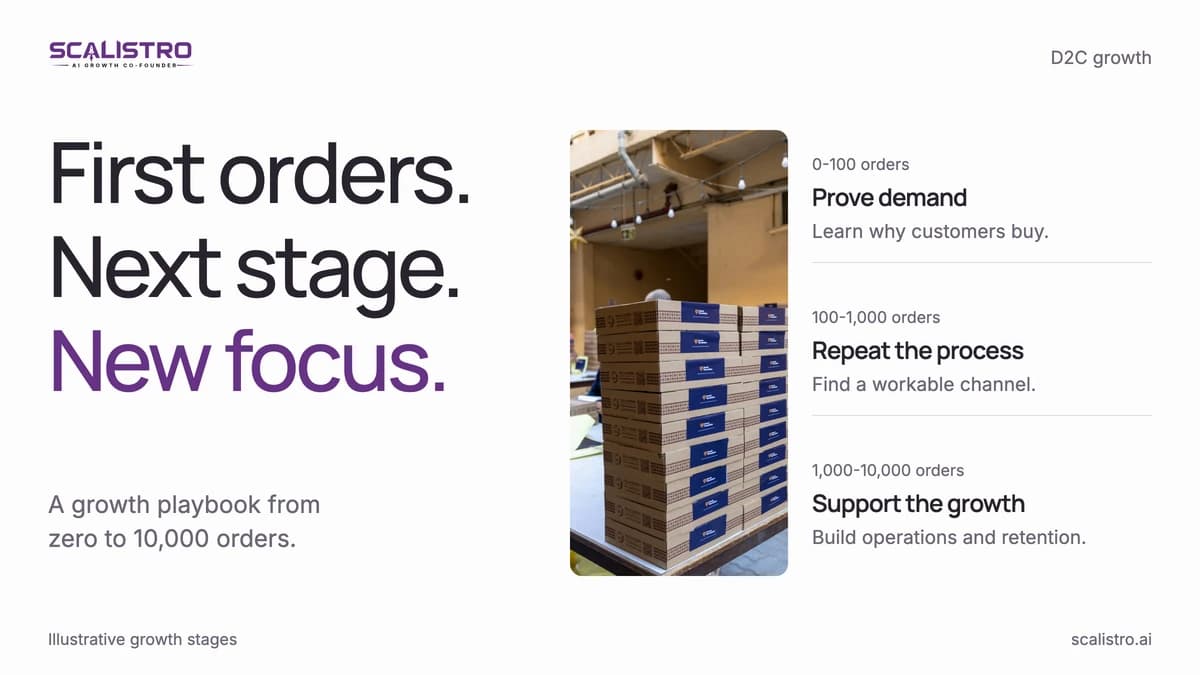
The path from a first sale to 10,000 orders changes as a brand learns. Before 100 orders, learn why people buy and whether each order makes economic sense. From 100 to 1,000, find a repeatable acquisition channel. From 1,000 to 10,000, strengthen operations and retention so growth does not overwhelm the business.
Use these order ranges as decision points, not deadlines. The right next step depends on customer behavior and contribution margin, not only how many orders have arrived.
Phase 1: Foundation (Orders 0 to 100)
At 0 to 100 orders, prove that customers value the product at a workable price. Talk to buyers directly and calculate the margin on real orders before investing in a larger acquisition system.
Swipe to explore. Tap to open full size.
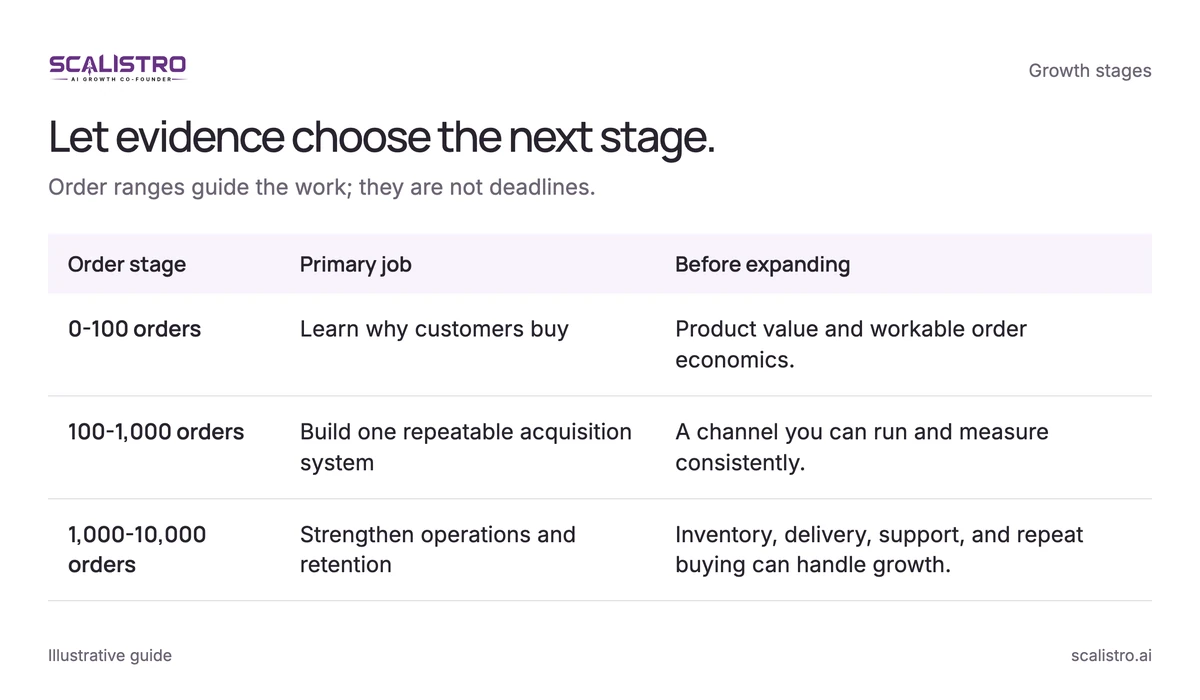
Image details: Let evidence choose the next stage.
| Order stage | Primary job | Before expanding |
|---|---|---|
| 0-100 orders | Learn why customers buy | Product value and workable order economics. |
| 100-1,000 orders | Build one repeatable acquisition system | A channel you can run and measure consistently. |
| 1,000-10,000 orders | Strengthen operations and retention | Inventory, delivery, support, and repeat buying can handle growth. |
Talk to Every Customer
After each order, ask why the customer bought, what nearly stopped them, and what would make them return. A short personal conversation can reveal language and objections that a generic survey misses. Save the exact phrases customers use for later product pages and ads.
Manual Marketing Only
Post and reply yourself while the customer base is small. Join relevant communities to answer questions, follow their rules, and avoid unsolicited promotion. These conversations teach you which benefits matter and give you material for later creative briefs.
Validate Your Unit Economics
Subtract product, packaging, shipping, payment, and acquisition costs from average order value. A margin below 50 to 60 percent is a warning sign for many D2C categories. More orders will not fix a loss on each order, so address price or cost before scaling spend.
Phase 1 Metrics That Matter
Use these measures to decide whether the product deserves more acquisition investment.
- Repeat purchase rate: What percentage of first-time buyers come back? Above 25 percent in the first 90 days is a strong signal of product-market fit.
- Customer satisfaction: Are customers genuinely happy? Not just not-unhappy, but actively enthusiastic? Check NPS, review language, and referral willingness.
- Organic word-of-mouth: Are customers mentioning you to friends without being asked? This is the strongest signal that your product solves a real problem.
- Contribution margin: After all direct costs, do you have enough margin to fund growth? Below 50 percent margin is a red flag for most D2C categories.
Phase 2: Traction (Orders 100 to 1,000)
At 100 to 1,000 orders, turn customer learning into one acquisition system you can run repeatedly. Keep checking repeat purchase and margin as volume grows.
Pick One Channel and Master It
Choose the channel where your customer already discovers products and where the product's value is easiest to show. Spreading a small budget across five channels makes it hard to learn from any of them. Start with one:
- Meta Ads (Instagram and Facebook): Best for visually compelling products, products with strong before-and-after stories, and products with broad appeal. Meta's targeting and creative optimization are the most sophisticated in the market.
- Google Ads (Search and Shopping): Best for products with existing search demand - products people are already looking for. If your product category has high search volume, Google captures intent-driven buyers efficiently.
- TikTok Ads: Best for products that demonstrate well in short-form video, products targeting Gen Z and younger millennials, and products with a strong hook or surprise factor.
- Influencer marketing: Best for products that benefit from third-party credibility, products in aspirational categories, and products with strong visual appeal.
Add a second channel only when the first consistently acquires customers at a profitable CPA and the team understands which creative produces the result.
Build Your Creative Engine
Turn customer quotes and common objections into a weekly test brief. Aim for 10 to 20 new variations, but make each test a real difference in message, visual, or format. AI can prepare variants while a person chooses the angles and checks product accuracy.
Implement Email Marketing
In Litmus's State of Email survey, 35 percent of marketers reported $10 to $36 back for every $1 spent on email, and 30 percent reported $36 to $50 (Litmus). Build four flows before sending more one-off promotions:
- Welcome series (3 to 5 emails): Introduce your brand story, highlight your best products, share customer testimonials, and offer a first-purchase incentive.
- Abandoned cart series (2 to 3 emails): Remind browsers about products they left behind, address common objections, and create urgency.
- Post-purchase series (3 to 4 emails): Thank customers, provide usage tips, ask for reviews, and cross-sell complementary products.
- Win-back series (2 to 3 emails): Re-engage customers who have not purchased in 60 to 90 days with a relevant offer or useful product reminder.
Together, these flows can become a meaningful share of revenue. Review deliverability, conversion, and customer feedback even after they are automated.
Phase 2 Metrics That Matter
Compare acquisition efficiency with repeat revenue rather than judging a channel on first-order ROAS alone.
- Customer Acquisition Cost (CAC): How much does it cost to acquire a new customer? Track this by channel and by campaign.
- Return on Ad Spend (ROAS): For every dollar you spend on ads, how many dollars in revenue do you generate? Your breakeven ROAS depends on margin: if half of each order's revenue is left after product, shipping, and fees, you need at least 2x ROAS just to break even.
- Customer Lifetime Value (LTV): How much revenue does the average customer generate over their lifetime with your brand? Your LTV to CAC ratio should be at least 3:1 for sustainable growth.
- Email revenue as a percentage of total: Track email's share of revenue each month. If it falls while the list grows, review your flows first.
Phase 3: Scale (Orders 1,000 to 10,000)
At 1,000 to 10,000 orders, invest in the processes that keep growth profitable: channel diversity, conversion, inventory, reporting, and customer experience.
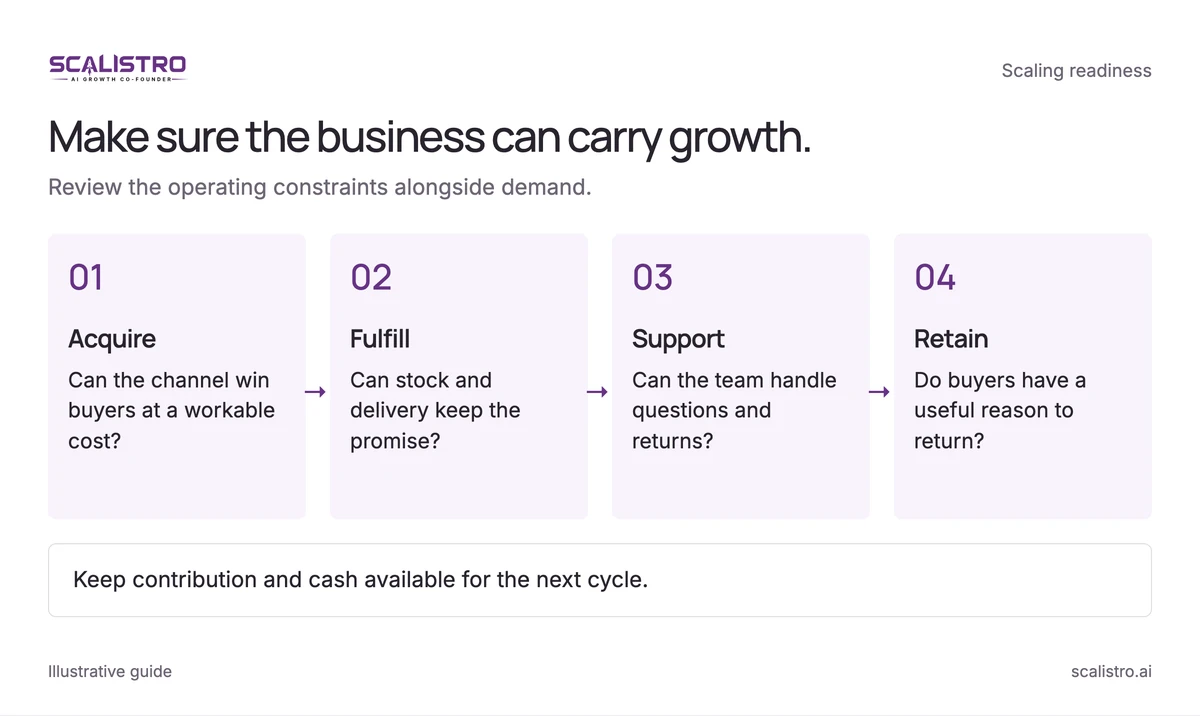
Swipe to explore. Tap to open full size.
Image details: Make sure the business can carry growth.
Make sure the business can carry growth. Review the operating constraints alongside demand. Acquire - Can the channel win buyers at a workable cost?; Fulfill - Can stock and delivery keep the promise?; Support - Can the team handle questions and returns?; Retain - Do buyers have a useful reason to return? Keep contribution and cash available for the next cycle.
Diversify Acquisition Channels
Add a second channel to reduce dependence on one auction or algorithm. If Meta is proven, test Google Shopping or TikTok; if Google is proven, test Meta. Give each new channel its own small learning budget and scale only when its customer economics work.
Optimize Your Full Funnel
Small conversion gains matter more at this volume. A 5 percent improvement can add hundreds of monthly orders, depending on traffic. Work through the funnel in this order:
- Landing pages: Test headlines, hero images, social proof placement, and CTA copy. Incremental improvements compound over time.
- Checkout flow: Reduce friction at every step. Enable guest checkout, offer multiple payment methods, and pre-fill shipping information where possible. Every abandoned checkout is a customer you paid to acquire but failed to convert.
- Product pages: Optimize product images (see our product photography guide), descriptions, reviews display, and cross-sell recommendations.
- Site speed: Portent's 2022 study found ecommerce conversion rates fall by an average of 0.3 percent for every additional second of load time (Portent, 2022). Optimize images, leverage browser caching, and minimize unnecessary scripts.
Build Systems, Not Workarounds
Document the repeatable steps for creative testing, support, inventory, and financial reporting. Schedule content and lifecycle messages where the rules are clear, and use AI to prepare creative variants and surface performance changes across your store and ads. Keep ownership of exceptions and spending decisions with named people.
Phase 3 Metrics That Matter
These measures reveal whether growth still creates profit and stronger customer cohorts.
- Blended CAC: Your average acquisition cost across all channels. This is your true cost of growth.
- Contribution margin: Revenue minus all variable costs (COGS, shipping, payment processing, marketing). This tells you how much each order contributes to covering fixed costs and profit.
- Channel efficiency: Track CAC, ROAS, and LTV by channel independently. Scale channels where efficiency is improving and investigate channels where it is declining.
- Customer lifetime value by cohort: Track how LTV evolves for each monthly cohort of new customers. If LTV is declining cohort over cohort, your product or customer experience has a problem that growth is masking.
The 5 Most Common Mistakes That Prevent D2C Brands from Reaching 10,000 Orders
Use this list as a checkpoint before adding budget, channels, or headcount.
1. Scaling Before Product-Market Fit
Below 20 percent repeat purchase with little unsolicited recommendation, investigate the product and experience before increasing acquisition. More paid first orders will not create lasting demand by themselves.
2. Diversifying Channels Too Early
Five $600 channel tests provide little learning compared with a focused $3,000 test on the most promising platform. Prove one repeatable source of profitable customers, then expand.
3. Ignoring Email Marketing
Skipping lifecycle email leaves repeat revenue unclaimed. Build the four core flows and measure second purchases before paying for more first purchases.
4. Under-investing in Creative
When media spend is 10 times creative spend, too few new ideas may reach the account. Reserve production time and budget for distinct concepts, then compare their purchase outcomes.
5. Not Tracking Unit Economics
Track contribution margin after every variable cost. If the team cannot calculate what each order contributes, pause scaling decisions until the accounting is clear.
At the launch stage, use the bootstrap budget guide to test demand without overspending.