AI Marketing Workflow for D2C Brands: From Idea to Ad
Use AI to draft ads, images, and reports faster while people choose the ideas, check the work, and launch the final campaigns.
On this page
- Introduction
- Where the Time Goes
- Task-by-Task Time Comparison
- The Complete Time Comparison Table
- How to Keep Quality While Moving Faster
- Example: How a Small Skincare Team Could Restructure Its Week
- Example: A Fashion Brand's Product Launch Sprint
- Example: An Emerging Beverage Brand's Trend Response
- What Faster Work Changes Over Time
- Set Up Your Own Workflow
- Frequently Asked Questions
An AI marketing workflow for a D2C brand can shorten the time between an idea and a live ad. AI helps make first drafts and image sizes. People choose the message, check the product, and launch the approved campaign.
In the illustrative estimates below, that process takes a fraction of the hours needed to do every production step by hand. Faster work is useful only when the final ad is accurate and brings in buyers. The examples below show where the time went and what still needed a person.
Where the Time Goes
In a hand-made workflow, resizing images, rewriting the same message for each channel, and gathering reports can take up much of a marketer's day. That leaves little time to understand buyers or plan a better offer.
AI can take on much of the first-draft and formatting work, which frees time for ideas and review. The team used more of its day to choose ideas and check the final work.
Task-by-Task Time Comparison
These time ranges are illustrative estimates for a small D2C marketing team, not measured averages. Use them to find your team's slowest step, then time your own work.
Ad Creative Production
Human-only: A designer creates 5 to 8 ad creatives per day, including concept development, design, copywriting, and formatting for multiple placements (feed, story, reel). A week of ad creative production yields 25 to 40 creatives.
With AI help: A person writes the brief in 1 to 2 hours. AI makes 40 to 60 options in 2 to 3 hours. The person chooses and edits 20 to 30. The whole job takes 4 to 7 hours rather than a full week.
Time savings: 75 to 80 percent
Social Media Content Creation
Human-only: A social media manager spends 8 to 12 hours per week creating content - ideating topics, writing captions, selecting and editing images, scheduling posts, and creating stories or reels. For a 5-post-per-week schedule, that is roughly 2 hours per post including all supporting work.
AI plus human: The human defines the weekly content themes and tone in 30 to 45 minutes. AI generates 15 to 20 caption options, suggests relevant hashtags, and creates image concepts. The human selects, edits, and personalizes the best options in 1 to 2 hours. Total time: 2 to 3 hours per week versus 8 to 12 hours.
Time savings: 70 to 75 percent
Email Copywriting
Human-only: Writing a single email - including subject line, preview text, body copy, and CTA - takes a skilled copywriter 2 to 4 hours. A weekly email and a monthly newsletter consumes 12 to 20 hours per month.
AI plus human: The human defines the email objective, key message, and audience segment in 15 to 20 minutes. AI generates 5 to 8 complete email drafts with multiple subject line options. The human selects the best draft, refines the copy, and ensures brand voice alignment in 30 to 60 minutes. Total time per email: 45 minutes to 1.5 hours versus 2 to 4 hours.
Time savings: 60 to 65 percent
Campaign Setup and Launch
Human-only: Setting up a new Meta campaign from scratch - including campaign structure, audience creation, budget allocation, creative upload, copy input, UTM parameters, and QA - takes 2 to 4 hours for a complex campaign with multiple ad sets.
With AI help: AI can prepare the campaign brief, naming, copy, and a setup checklist. A person still chooses the audience, budget, tracking, and final settings in Meta Ads Manager. Some teams complete that review and setup in 30 to 60 minutes instead of 2 to 4 hours. Scalistro does not currently set or launch those campaigns for you.
Time savings: 75 to 85 percent
Performance Reporting
Human-only: Pulling a comprehensive weekly performance report - aggregating data from Meta, Google, Shopify, email, and organic social - takes 4 to 8 hours. This includes data export, formatting, analysis, and insight generation.
With AI help: The tool gathers available results and flags unusual changes. A person checks what happened and writes the next steps. In this estimate, review takes 30 to 60 minutes instead of 4 to 8 hours. The freshness of each number depends on when the connected platform updates it.
Time savings: 85 to 90 percent
A/B Testing Setup and Analysis
Human-only: Designing an A/B test - defining the hypothesis, creating variations, setting up the test structure, monitoring results, and analyzing outcomes - takes 3 to 6 hours per test cycle. Most human-only teams run 2 to 4 tests per month.
With AI help: AI drafts variations and summarizes results. A person decides what the test asks, sets it up in the ad platform, and judges whether there are enough purchases to choose a winner. In this estimate, the work takes 1 to 2 hours per test, which leaves room for more tests each month.
Time savings: 65 to 70 percent (with 3-4x more tests run)
The Complete Time Comparison Table
| Marketing Task | Human-Only (Weekly) | AI + Human (Weekly) | Time Saved | Output Change |
|---|---|---|---|---|
| Ad Creative Production | 25-40 hrs | 4-7 hrs | ~80% | Equal or more creatives |
| Social Media Content | 8-12 hrs | 2-3 hrs | ~75% | Same volume, more variety |
| Email Copywriting | 3-5 hrs | 1-1.5 hrs | ~65% | More variations tested |
| Campaign Setup | 2-4 hrs per campaign | 30-60 min per campaign | ~80% | Fewer setup errors |
| Performance Reporting | 4-8 hrs | 30-60 min | ~90% | Real-time vs. weekly lag |
| A/B Testing | 3-6 hrs per test | 1-2 hrs per test | ~70% | 3-4x more tests per month |
| Total Weekly Hours | 45-75 hrs | 9-15 hrs | ~80% | Higher quality + volume |
In these estimates, 45-75 hours of weekly work falls to 9-15 hours. Controlled studies show smaller but real gains: professionals using ChatGPT finished writing tasks 40 percent faster with 18 percent higher quality (Noy and Zhang, Science 2023, via MIT News). A team still needs people who know the product and can approve the work.
How to Keep Quality While Moving Faster
Use the time saved for better ideas and careful review. Three habits matter:
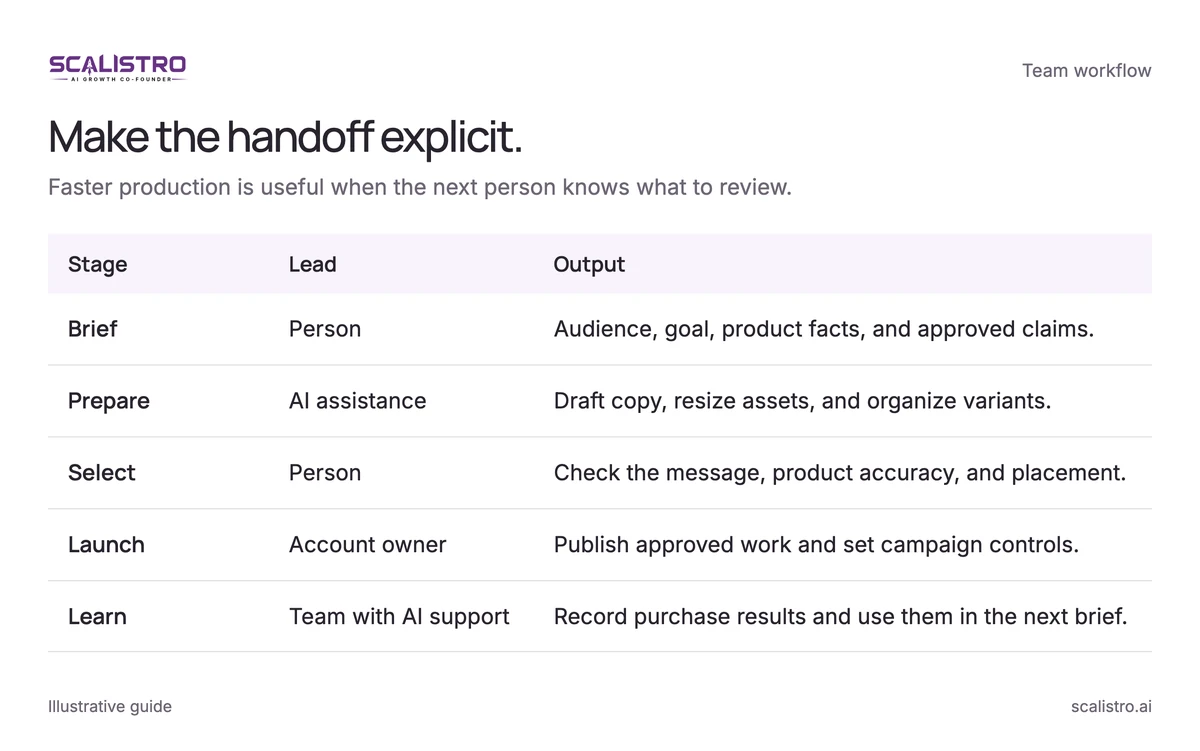
Swipe to explore. Tap to open full size.
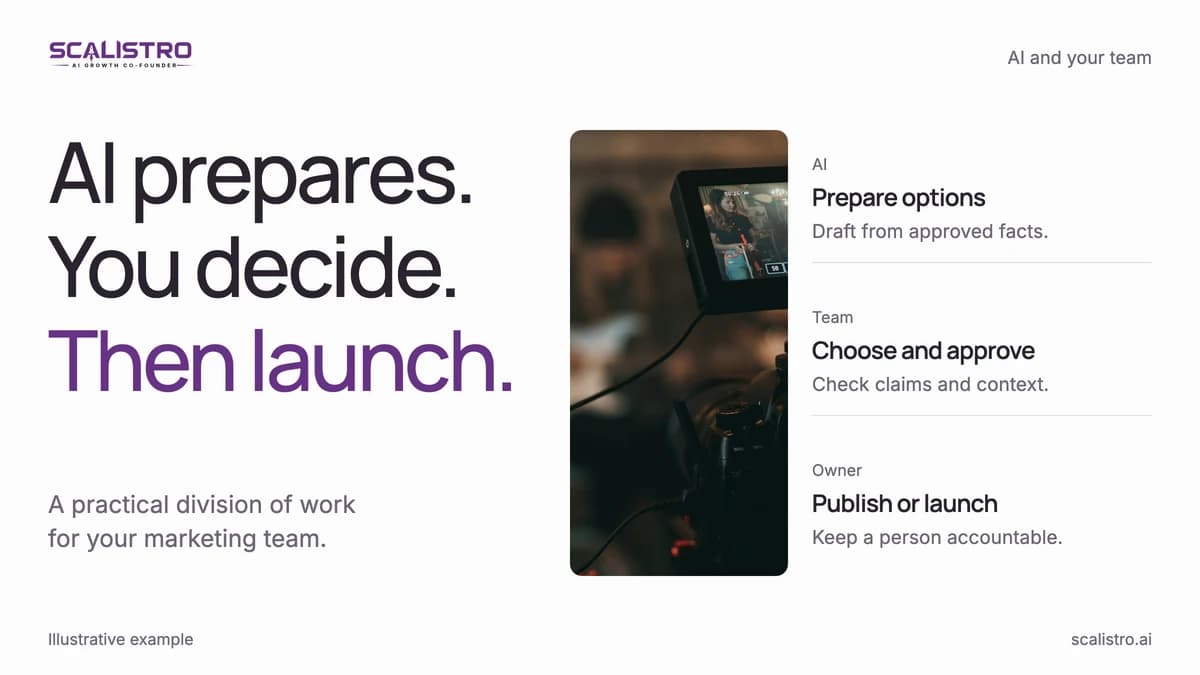
Image details: Make the handoff explicit.
| Stage | Lead | Output |
|---|---|---|
| Brief | Person | Audience, goal, product facts, and approved claims. |
| Prepare | AI assistance | Draft copy, resize assets, and organize variants. |
| Select | Person | Check the message, product accuracy, and placement. |
| Launch | Account owner | Publish approved work and set campaign controls. |
| Learn | Team with AI support | Record purchase results and use them in the next brief. |
Let AI Handle Repeated Formatting
Resizing an approved image or preparing six headline lengths takes time but rarely changes the idea. Let AI prepare those versions, then inspect each crop and line before it goes live.
Spend More Time on the Idea
If a creative lead spends six hours making files, only two hours remain for the message. Saving production time can give that person more room to talk to customers and find a stronger angle.
Learn From Each Test
Testing 15 ads a week gives a team more chances to learn than testing five, if each gets enough traffic. After 8 to 12 weeks, the team can see which product stories buyers respond to. Save those lessons for the next brief.
Example: How a Small Skincare Team Could Restructure Its Week
This is an illustrative example, not a customer result. Picture a D2C skincare brand with a 3-person marketing team: a marketing manager, a designer, and a part-time copywriter. Its weekly output before changing the workflow:
- 5 to 8 new ad creatives
- 4 social media posts
- 1 email campaign
- Weekly performance review (delivered every Tuesday for the prior week)
- 1 to 2 A/B tests per month
The designer had a three-week backlog. The team could not make new ads or review results as quickly as it wanted.
After Implementing AI Plus Human Workflow
If the team used Listro to prepare images, draft social posts, and review connected ad results, a realistic weekly plan might become:
- 25 to 35 new ad creatives (AI-generated, human-reviewed)
- 10 to 12 social media posts (AI-drafted, human-refined)
- 2 to 3 email campaigns with 3 to 5 subject line variations each
- Faster access to connected performance data instead of assembling a weekly report by hand
- 6 to 8 A/B tests per month
The marketing manager would spend more of the week on ideas and decisions, and the designer and writer more time improving the best work.
To judge whether a change like this works, compare the same measures before and after 90 days:
- Cost per acquisition, for campaigns using the new creative
- Social engagement and visits from social, per post
- Email revenue per campaign and per recipient
- Hours the team spends on production versus ideas and review
Example: A Fashion Brand's Product Launch Sprint
Consider a fashion brand launching a collection of 24 products, each needing photography, ad creatives, social content, email announcements, and landing page copy. With a hand-made workflow, getting from final product to full marketing launch might take 6 to 8 weeks.
The AI Plus Human Approach
The team used AI to prepare options while people chose the collection story and approved the final work:
- Week 1: Human creative director defined the collection narrative, visual mood, and key messaging angles. AI generated product imagery in 12 different lifestyle settings from base product photos. Human reviewed and selected the top 3 to 4 settings per product.
- Week 2: AI generated 150+ ad creative variations across the 24 products. Human team selected and refined 60 launch creatives. AI drafted email sequences, social captions, and landing page copy. Human copywriter refined all text for brand voice and accuracy.
- Day 15: The team launched the approved campaigns. Every product had its own ad options, and tests were ready to run.
In this example, the launch is ready in about 15 days instead of six to eight weeks, without new hires or overtime. People still checked the product and message before publishing.
Example: An Emerging Beverage Brand's Trend Response
Sometimes a trend fits the brand for only a day or two. A long approval process can miss it.
Imagine an emerging beverage brand that spots a viral fitness trend on TikTok that fits its product. If its content process takes 3 to 5 days from brainstorm to scheduled post, the trend may be over before the post goes live.
The AI Plus Human Response
With AI help, the marketing manager spots the trend at 9 AM, AI prepares post and ad options by 11 AM, the team selects and refines the best by noon, and the content is live by early afternoon.
The team spends about five hours from idea to published work. Whether the posts perform depends on the idea and the audience, so measure the response against your usual posts.
What Faster Work Changes Over Time
The biggest gain is having more chances to learn, provided the tests are large enough to trust.
More Useful Tests
Eight tests a month give a team 48 results after six months, compared with 12 results from two tests a month. More tests do not guarantee more learning if each test has too few buyers. Keep the questions clear and the budget large enough to judge them.
Fresh Ads Ready When Needed
Keep a few new ads ready as older ones lose results. The claim that platforms always boost new ads for 48 to 72 hours is too broad to use as a rule. Launch only as many as your budget can test.
Faster Response to Changes
If a competitor changes its offer, the team can prepare new copy and images quickly. A person still decides whether to change the campaign or offer.
Better Use of Team Time
Less copy-and-paste work can leave more time for customer research, creative ideas, and careful review. Ask the team whether the change actually improves its work, not just its output count.
Set Up Your Own Workflow
Start with one slow task and a clear owner.
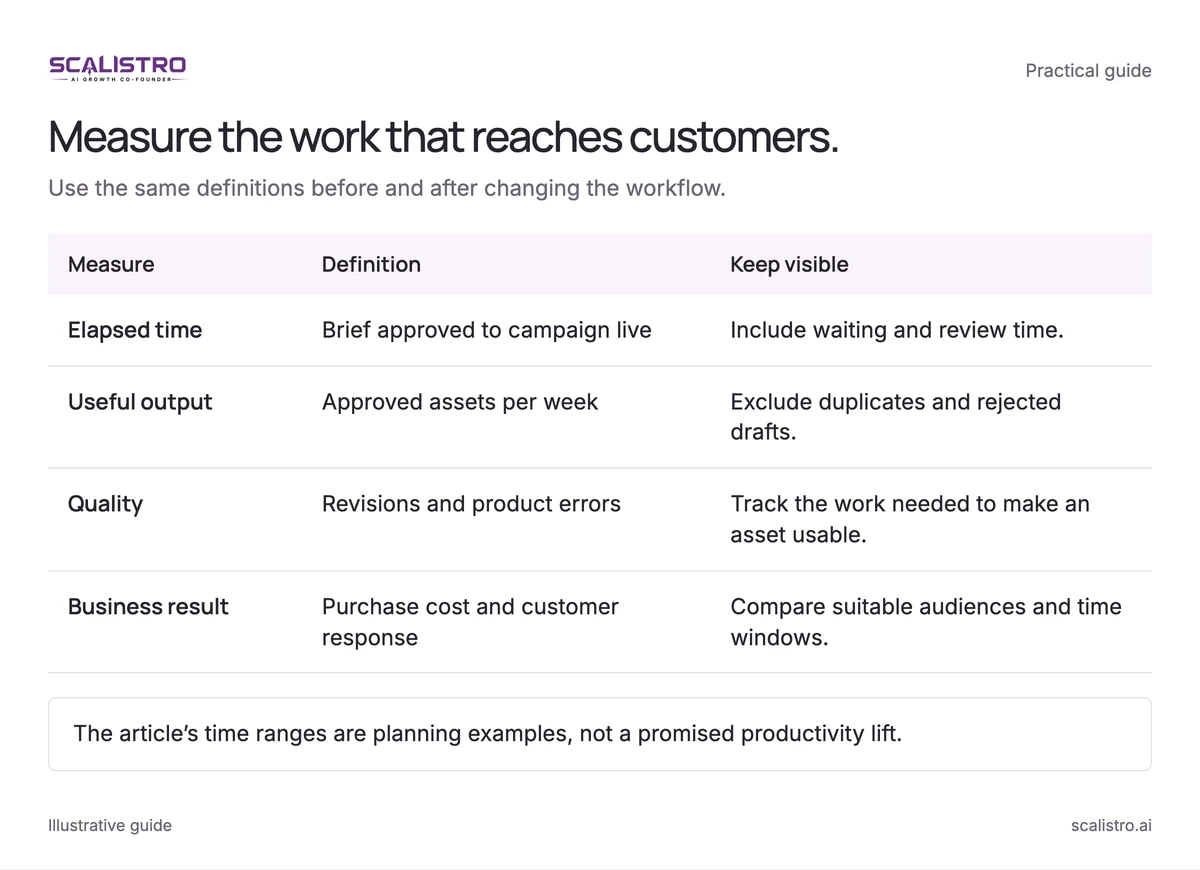
Swipe to explore. Tap to open full size.
Image details: Measure the work that reaches customers.
| Measure | Definition | Keep visible |
|---|---|---|
| Elapsed time | Brief approved to campaign live | Include waiting and review time. |
| Useful output | Approved assets per week | Exclude duplicates and rejected drafts. |
| Quality | Revisions and product errors | Track the work needed to make an asset usable. |
| Business result | Purchase cost and customer response | Compare suitable audiences and time windows. |
The article’s time ranges are planning examples, not a promised productivity lift.
Step 1: Audit Your Current Time Allocation
For two weeks, note how much time goes to drafting, resizing, reporting, review, and decisions. Many teams find that most of it goes to production. Find out what your own number is.
Step 2: Identify the Highest-Impact Automations
Try ad sizes, caption drafts, or report summaries first. Keep ad-platform settings and spend changes with the account owner.
Step 3: Redesign Your Workflows
Write down the handoff: who briefs the work, who checks the draft, and who publishes it. One approved version should be the source for each channel's final asset.
Step 4: Invest Human Time in Strategic Upskilling
Use the saved hours to talk to customers, study results, and improve the next offer. Do not fill them with more approval meetings.
Step 5: Measure and Iterate
Compare time from idea to launch, approved ads per week, purchase cost, and customer response. Keep the workflow only if it improves both speed and results.
Scalistro supports this workflow: Listro helps with creative production, social content, and connected ad analysis. People still set strategy, check quality, and make campaign changes. It is the AI plus human model in practice.
For a creative example of this workflow, see how AI speed and human taste work together.