Can AI Run D2C Marketing? What Needs Human Review
AI can help produce content, analyze performance, and prepare campaigns. Brand strategy, factual claims, spend decisions, and publishing need human review.
On this page
- Introduction
- What AI Can Genuinely Handle Well in D2C Marketing
- What AI Cannot Do Well (and Where Founders Get Burned)
- The Honest Answer: The Best Setup Is AI Execution with Human Oversight
- Comparing Approaches: AI-Only, Human-Only, and AI Plus Human
- What This Looks Like in Practice: A Typical Week with Scalistro
- Who Should Not Use AI for Marketing (Yet)
- Frequently Asked Questions
AI can handle much of the production, analysis, and coordination in a D2C marketing workflow. A person still needs to set the brand's direction, approve claims and creative, handle sensitive customer moments, and decide where money goes. The useful question is which tasks to automate and where to keep an approval step.
This guide divides those responsibilities and shows how to put them into a weekly operating rhythm.
What AI Can Genuinely Handle Well in D2C Marketing
AI works best on tasks with clear inputs, repeatable formats, and measurable outputs. Give it product facts, brand rules, and performance data, then review what it produces.
Content Creation at Scale
AI can draft social posts, ad copy, email subjects, product descriptions, and articles from a clear brief. A good first draft can get most of the way to a usable asset, leaving a reviewer to check voice, product truth, and the offer. For a team publishing many posts a week, that can turn much of the drafting time into review time.
Ad Campaign Structuring and Management
AI can prepare campaign structures, compare audiences, watch performance, and flag budget or setup anomalies. Those checks reduce repetitive dashboard work. Keep budget changes and campaign launches behind an approval step, especially when a wrong number could multiply spend.
Performance Analysis and Pattern Recognition
Connected data can reveal which creative angles correlate with lower CPA, where fatigue is appearing, and when conversion efficiency changes. AI can surface those patterns quickly. Check the underlying date range, attribution window, and sample size before treating a pattern as a decision.
Scheduling and Workflow Automation
AI can draft a content calendar, prepare scheduled posts, and keep a list of approvals and deadlines. Define owners and escalation rules first so a missed approval does not silently delay a launch or publish unreviewed work.
Creative Variation and Testing
From one approved concept, AI can generate 20 to 30 visual and copy variations and adapt them for Feed, Stories, Reels, or Display. A person should discard weak variants and test distinct ideas, not spend money on 30 near-duplicates.
What AI Cannot Do Well (and Where Founders Get Burned)
Some decisions depend on accountability, context, and trust. Keep a named person responsible for these areas even if AI helps prepare options.
Brand Strategy and Positioning
Choose the audience, promise, price position, and point of view yourself. AI can compare options or organize research, but the brand owner has to commit to a direction and decide when it changes.
Crisis Management and Sensitive Moments
Pause automation when a product complaint, public controversy, or sensitive event changes the context. A person must decide whether to respond, what to say, and whether scheduled campaigns should run. Prepare the facts before publishing a statement.
Customer Relationship Nuance
Use AI for routine categorization and first drafts, then escalate exceptions. A loyal customer with a serious problem may need a refund, a personal note, or a decision outside the standard response template.
Ethical and Legal Judgment
Review every generated product claim against evidence and applicable rules before publishing. "Clinically proven" and "clinically tested" have different meanings, and health, financial, and comparative claims can create legal risk. The brand remains responsible for what an ad says.
Creative Breakthrough
People should still propose unfamiliar angles, collaborations, and cultural references. AI is useful for exploring and producing variations, but repeated optimization around the last winner can make a brand sound like everyone else.
The Honest Answer: The Best Setup Is AI Execution with Human Oversight
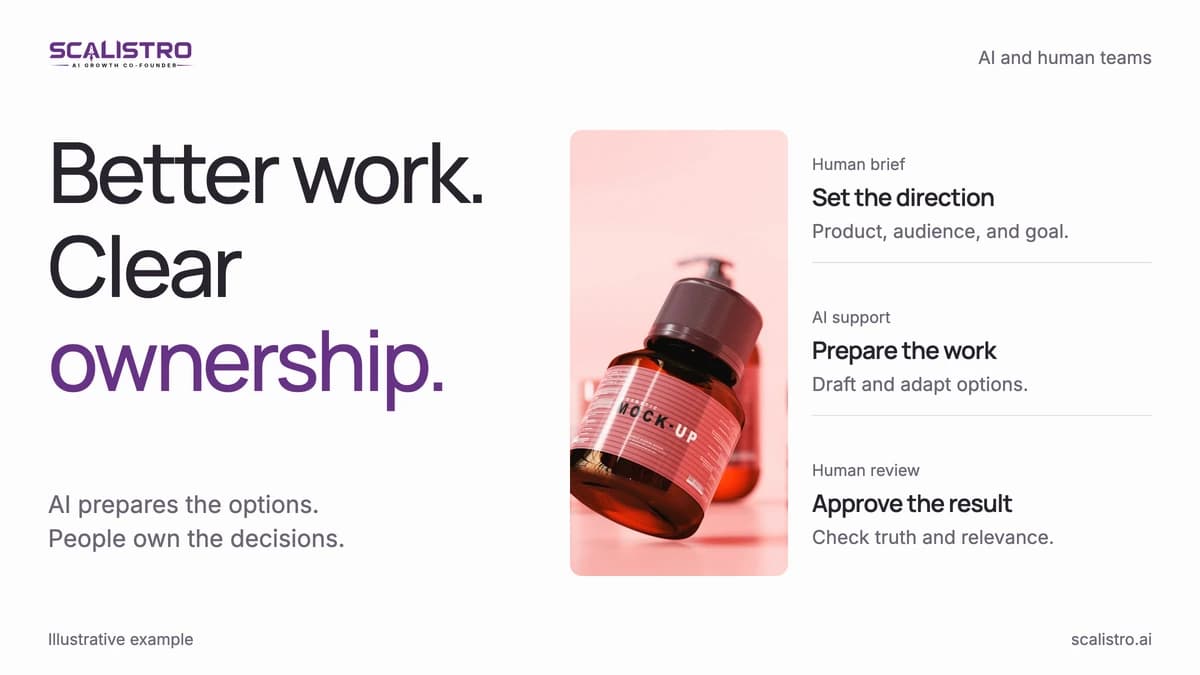
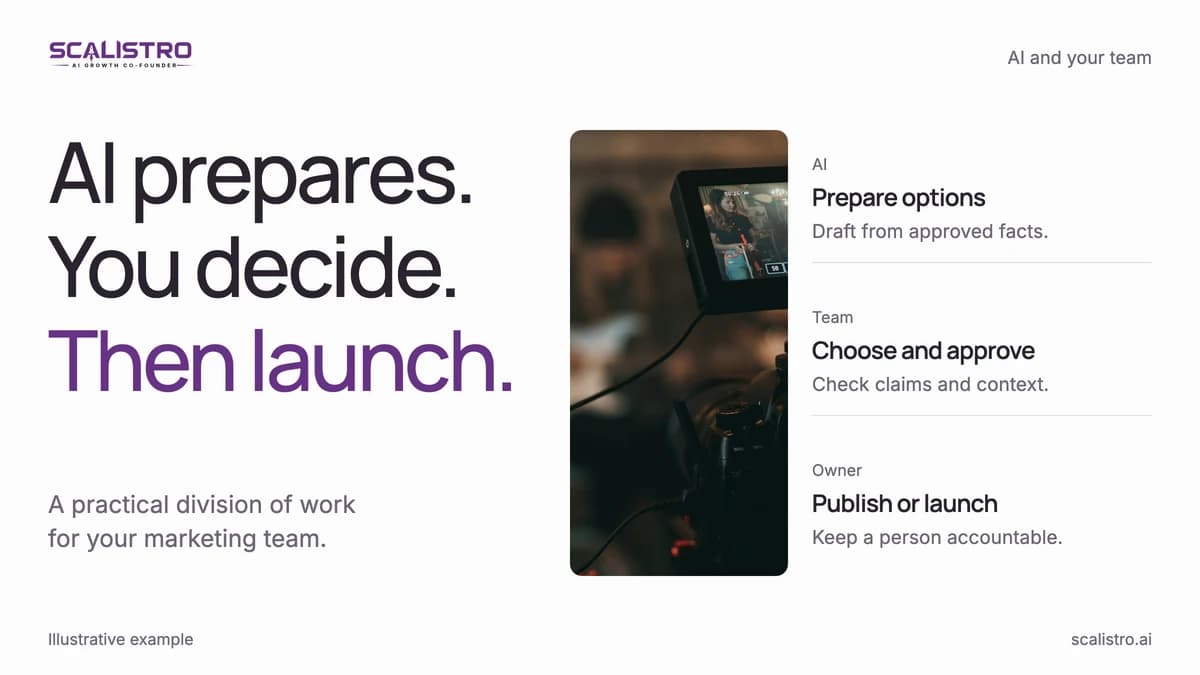
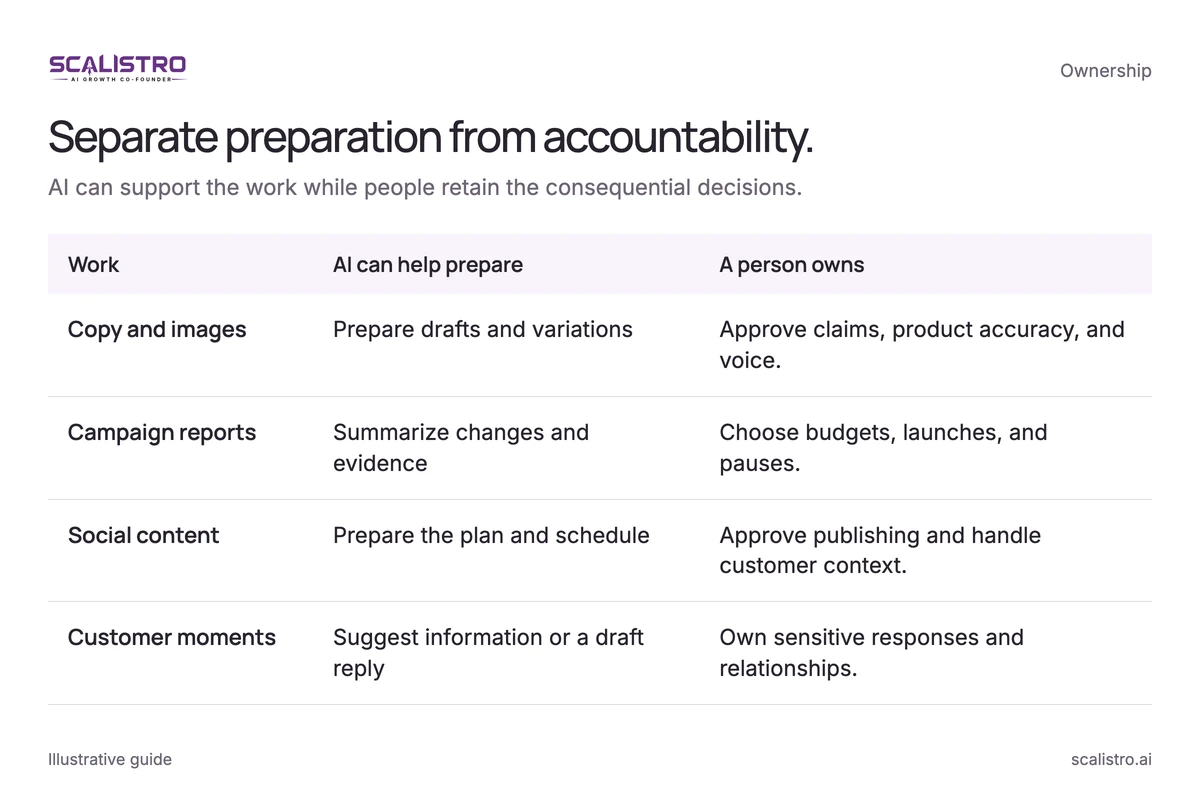
One practical division gives AI the 80 percent of work that is repetitive, operational, or data-heavy and reserves the 20 percent involving strategy, taste, and accountability for people. The exact split will vary by team, but the approval points should be explicit.
Swipe to explore. Tap to open full size.
Image details: Separate preparation from accountability.
| Work | AI can help prepare | A person owns |
|---|---|---|
| Copy and images | Prepare drafts and variations | Approve claims, product accuracy, and voice. |
| Campaign reports | Summarize changes and evidence | Choose budgets, launches, and pauses. |
| Social content | Prepare the plan and schedule | Approve publishing and handle customer context. |
| Customer moments | Suggest information or a draft reply | Own sensitive responses and relationships. |
How Scalistro Structures the AI Plus Human Workflow
Scalistro brings connected Shopify, Meta, and Google Ads data into the workflow. Listro can help the team:
- Prepare content direction from store and audience signals
- Generate social posts and ad creative for review
- Examine connected campaign performance and suggest next tests
- Use results from each cycle to inform the next brief
Review, edit, reject, or approve each generated asset. A person applies any ad recommendation in Meta or Google Ads. Record the decision and result so the next cycle starts with evidence.
Comparing Approaches: AI-Only, Human-Only, and AI Plus Human
Use the comparison to choose where your current process needs help: production volume, strategic direction, quality control, or speed of learning.
| Capability | AI-Only | Human-Only | AI + Human (Scalistro) |
|---|---|---|---|
| Content volume | High | Low | High with quality control |
| Brand consistency | Drifts over time | Strong but slow | Strong and fast |
| Ad creative quality | Generic without data | High but limited volume | High quality at scale |
| Strategic direction | Weak | Strong | Human-led, AI-informed |
| Cost efficiency | Low cost, variable ROI | High cost, reliable ROI | Low cost, compounding ROI |
| Learning and improvement | Fast but undirected | Slow but intentional | Fast and intentional |
| Risk of costly mistakes | High | Low | Low (approval-first) |
| Time to scale | Days | Months | Weeks |
What This Looks Like in Practice: A Typical Week with Scalistro
This sample week shows how a founder could use Scalistro with approval before publication and ad spend:
Monday (30 minutes): Review connected store and campaign results, then approve or adjust Listro's proposed content themes and ad angles.
Tuesday (20 minutes): Review 15 social drafts and 20 creative variations against the approved brief. Edit or reject anything inaccurate or off-brand.
Wednesday to Friday (15 minutes total): Check scheduled content and connected results. Launch selected ads in the ad platform and decide whether a change is warranted.
Weekend: Scheduled, approved content can run without another drafting session.
The example totals 2 to 3 hours a week, compared with the 15 to 20 hours many founders spend switching between scheduling tools, ad accounts, analytics, and design apps. Your review time will depend on volume and how mature the process is.
Who Should Not Use AI for Marketing (Yet)
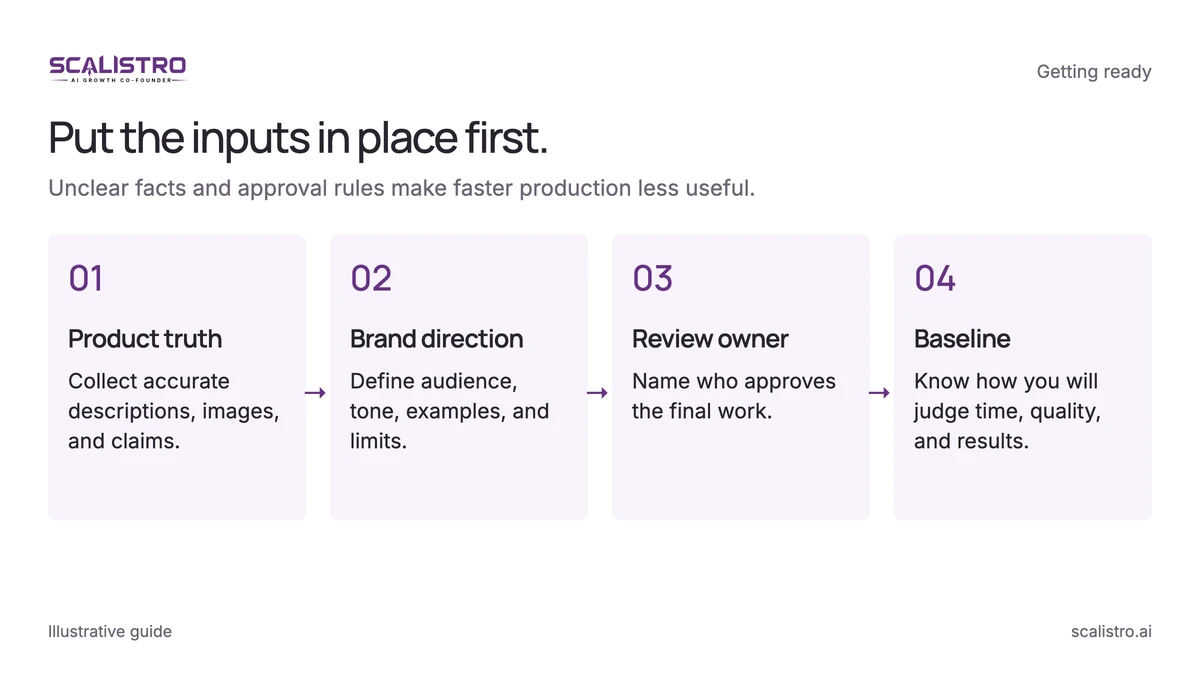
AI support works best when the product facts, audience, and approval rules are already clear. These situations need more groundwork or tighter review:
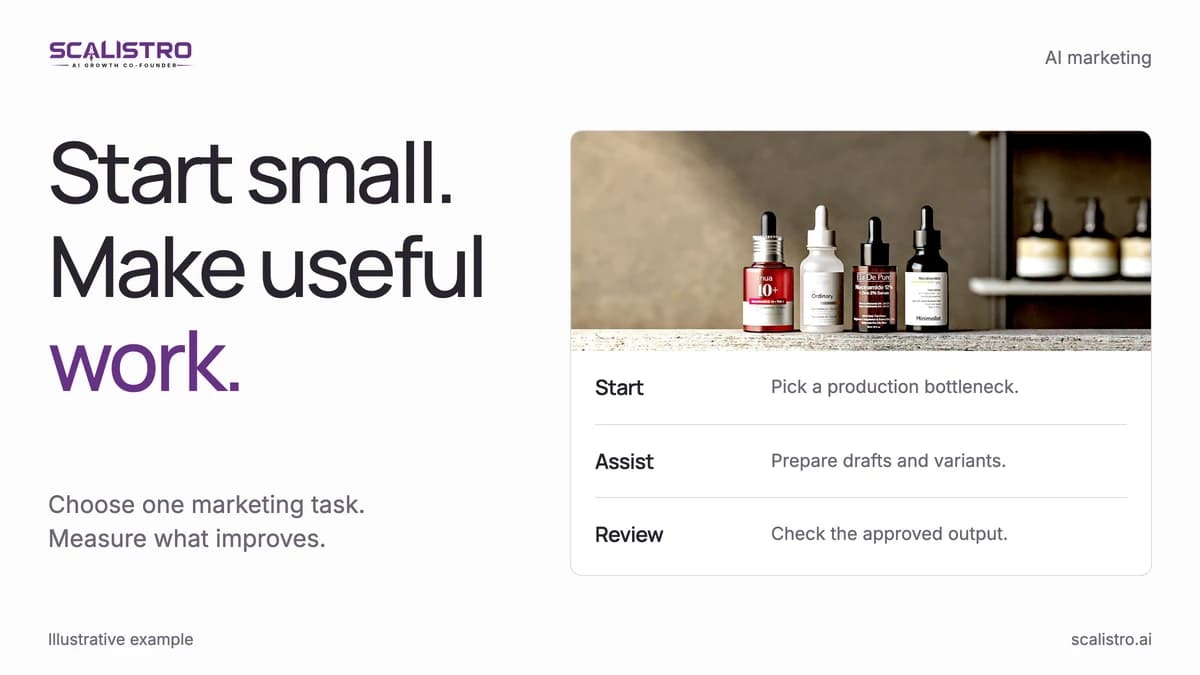
Swipe to explore. Tap to open full size.
Image details: Put the inputs in place first.
Put the inputs in place first. Unclear facts and approval rules make faster production less useful. Product truth - Collect accurate descriptions, images, and claims.; Brand direction - Define audience, tone, examples, and limits.; Review owner - Name who approves the final work.; Baseline - Know how you will judge time, quality, and results.
- Undefined positioning: Set your customer, promise, and tone before asking AI to scale content.
- Regulated products: Build a claim-review process that covers every generated asset before use.
- Relationship-led sales: Use AI to prepare research and drafts, but keep personal outreach and high-stakes conversations with people.
For a Shopify brand with active social and paid channels, begin with one repeatable workflow and explicit approvals. Expand only after you can measure time saved and results maintained or improved.
For more use cases and limits, read the practical guide to AI in D2C marketing.