AI and Human Marketing Teams for D2C Brands
Learn which marketing jobs AI can speed up and which need a person, from ad creation and reporting to product claims and customer replies.
On this page
- Introduction
- What Goes Wrong When AI Publishes Alone
- Where AI Saves a Small Team Time
- Give AI the Repeatable Work
- Keep People in Charge of the Decisions
- What the Team Can Do Together
- Three D2C Team Examples
- How to Set Up the Team
- The Data Behind AI Plus Human Performance
- Common Objections and Why They Are Wrong
- Frequently Asked Questions
An AI and human marketing team lets a D2C brand make more work without giving up control of the brand. AI can draft ads and summarize results. People decide what the ads should say, check product claims, and choose where to spend money.
In a field experiment with 758 Boston Consulting Group consultants, people using AI on suitable tasks completed 12.2 percent more tasks, 25.1 percent faster, with more than 40 percent higher quality (Dell'Acqua et al., 2023). Accenture's 2018 research estimated that companies investing in AI and human-machine collaboration at the rate of top performers could boost revenues by 38 percent by 2022 (Accenture, 2018). The useful question is what work to give AI and where a person must review it.
What Goes Wrong When AI Publishes Alone
AI can write text, make images, and find patterns in reports. It can also make a convincing mistake. These are the problems a review step helps catch.
Hallucinations and Factual Errors
AI may invent a product benefit, price, or study and write it with confidence. An AI-written ad could claim a moisturizer reverses aging by ten years with no trial behind it, which is the kind of claim that draws regulatory complaints. Check every claim against the product facts before an ad goes live.
Brand Voice Drift
Without examples and editing, AI copy starts to sound like every other brand. Give it real brand writing to work from and have a person cut the generic lines. The goal is a post that sounds like you, not like a template.
Tone-Deaf Content and Cultural Blind Spots
A scheduled joke or promotion can land badly after major news. A person can pause the post, understand the context, and decide when to restart. Keep that decision with the team.
Over-Optimization and Creative Stagnation
If every brief asks AI for more clicks, the ads can start using the same hooks and layouts. A creative lead should introduce new customer questions, product uses, and visual ideas. Judge the work on sales and brand fit, not clicks alone.
Where AI Saves a Small Team Time
People can do every step themselves, but repetitive work leaves less time for good ideas and customer conversations.
Speed and Volume Constraints
A copywriter may make 4 to 6 good ad options a day, a social manager 2 to 3 polished posts, and a designer 3 to 5 ads. AI can help produce more options from the same brief. The team should test only as many as its budget can support.
Inconsistency and Fatigue
During a launch week, someone can miss a wrong price or image crop. A shared checklist and AI-assisted first pass help, while a person still signs off on the final asset.
Repetitive Task Errors
A media buyer can miss a budget, date, or audience setting. AI can prepare a list of unusual items to check. Use the ad platform's own spend limits and have a person confirm the live settings.
Cognitive Bias in Decision-Making
It can be hard to stop an ad the team spent weeks making. Decide the success measure before launch, then compare every idea against the same goal. AI can show the numbers; people make the call.
Slow Reporting and Analysis
Gathering a weekly report across Meta, Google, email, and social can take 4 to 8 hours. Connected data can shorten that work so the team has more time to ask why a result changed.
Give AI the Repeatable Work
Use AI where the input and goal are clear, then review the output.
Pattern Recognition at Scale
AI can sort many ad results and surface patterns a person may miss. For example, it may show that product-use photos work better than plain product shots with a certain group of shoppers. A 340% difference in one small group may also be noise, so check the number of purchases before changing the whole plan.
Tireless Monitoring
Ad platforms can send alerts at any hour. Listro can help the team review connected ad results and spot changes worth checking. Put hard spend limits and urgent alerts in the ad platform, and assign a person to act on them.
Production Velocity
AI can draft 50 text options while a person writes three, resize an image for 12 placements, or prepare a week of caption drafts in minutes. The team still picks the few options worth publishing.
Data-Driven Optimization Without Ego
AI does not care how long the team spent on an ad. It can show when a favorite idea misses the target. A person should still check the full picture before changing the budget or stopping the campaign.
Keep People in Charge of the Decisions
These decisions need the product and customer context that the team holds.
Strategic Vision and Brand Direction
People decide whom the brand serves, what it promises, which new market to enter, and what risks are acceptable. AI can bring useful data to the discussion, but the team owns the choice.
Creative Leaps
A new product story may not resemble any past winner. A person can take that creative risk because they know the customer and the brand. AI can help make versions once the idea is clear.
Ethical Judgment and Brand Safety
A person should check sensitive claims, product accuracy, image representation, and the timing of a public post. A model can flag obvious problems, but it cannot approve a campaign for the brand.
Relationship Building
A real person should answer a difficult customer complaint, work with creators, and explain tradeoffs to the team. AI can help prepare information for those conversations.
What the Team Can Do Together
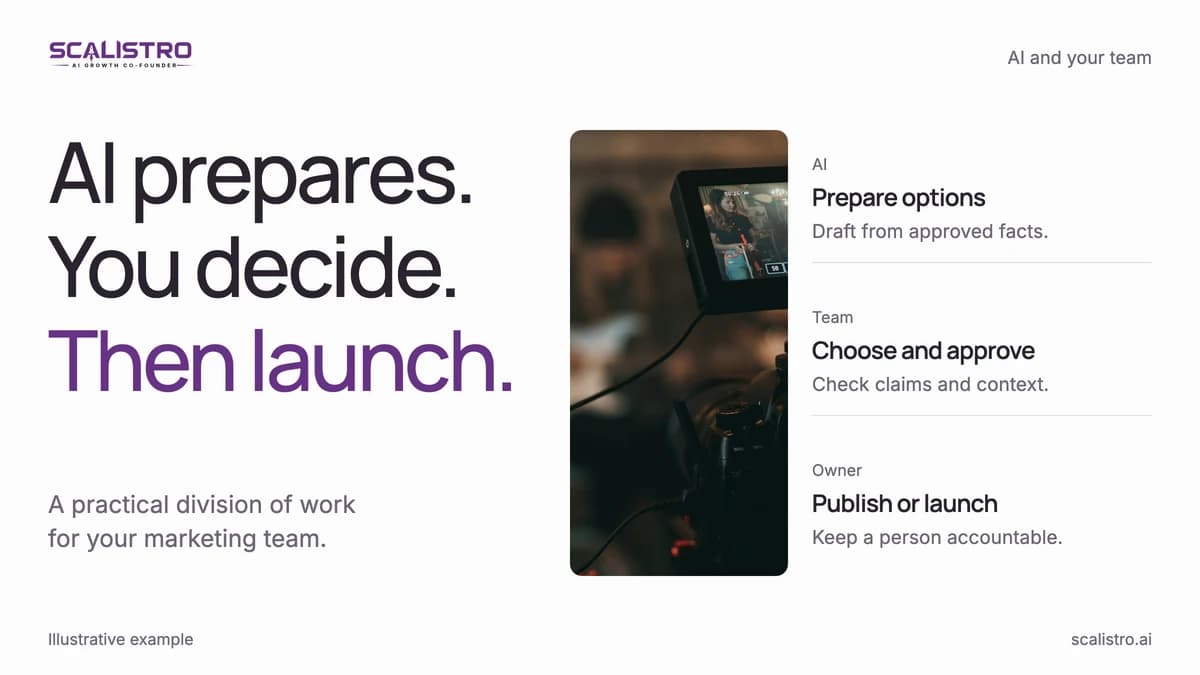
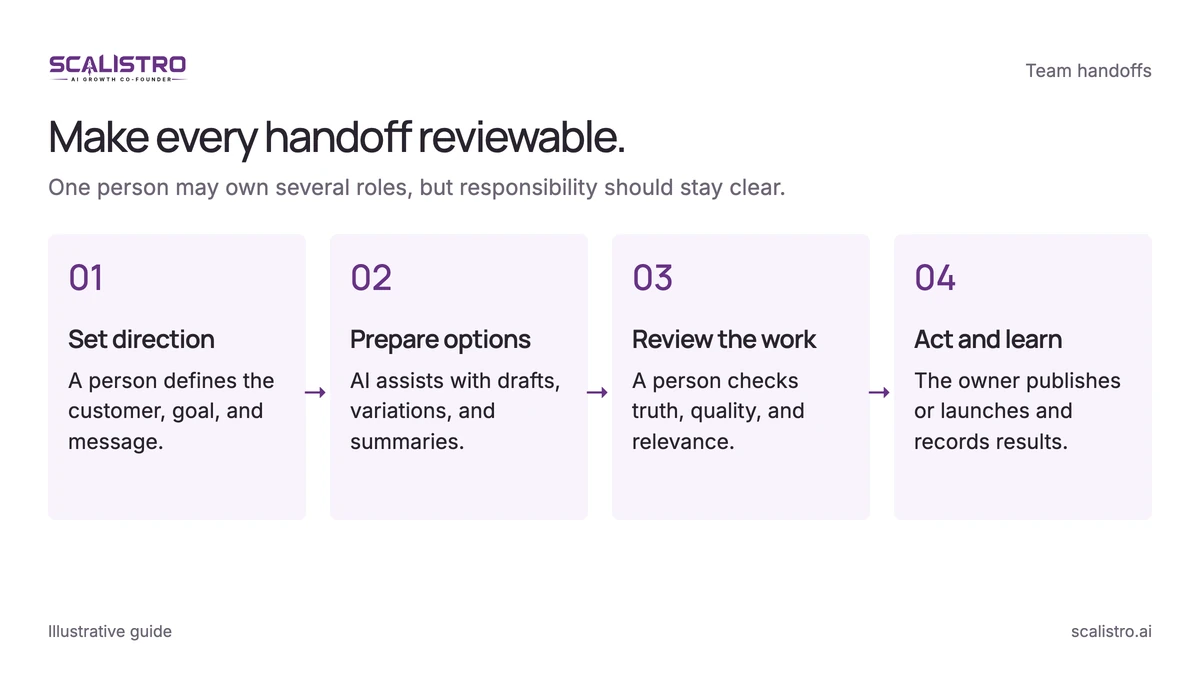
Use the same simple handoff for each job: a person sets the goal, AI prepares options, and a person approves the result.
Swipe to explore. Tap to open full size.
Image details: Make every handoff reviewable.
Make every handoff reviewable. One person may own several roles, but responsibility should stay clear. Set direction - A person defines the customer, goal, and message.; Prepare options - AI assists with drafts, variations, and summaries.; Review the work - A person checks truth, quality, and relevance.; Act and learn - The owner publishes or launches and records results.
Creative Production: More Output, Same Review Standard
A team that once made 5 to 10 ads a week may use AI to draft 30 to 50, then select 15 to 20 to test. That is 3 to 5 times more approved ads. Keep the test count within the budget so each ad can get a fair read.
Campaign Checks: Fewer Avoidable Mistakes
AI can help prepare a checklist and point to odd numbers in connected results. The ad platform holds the budget, targeting, and alerts. A media buyer checks those settings and makes any change.
Reports: Faster Answers to Better Questions
AI can show that the cost of a new buyer rose 23% this week. The team checks the offer, product stock, page, and competitors before deciding why. A report should lead to a question and a test, not an automatic budget move.
Social Media: Volume With Authenticity
AI can draft 20 to 30 post options. A person picks the useful ones, adds real product details, and answers replies. Publish at a pace the team can keep up with.
Three D2C Team Examples
These are illustrative scenarios, not measured customer results.
Scenario 1: A D2C Skincare Brand
A skincare brand with a two-person marketing team was spending $30,000 per month on Meta ads. Their human-only workflow produced 8 to 10 new creatives per week. Creative fatigue was their biggest problem - winning ads would decay within 7 to 10 days, and the team could not produce replacements fast enough.
With AI helping produce options, the team made 35 to 40 ads each week. A person chose the ideas and checked every final ad. The brand had more fresh ads to test and more time to study the results, so it could replace tired ads before results fell.
Scenario 2: A Fashion Brand Scaling Internationally
A fashion brand expanding from India to Southeast Asia needed to produce localized content for five new markets simultaneously. A human-only approach would have required hiring local teams in each market - at least 6 to 12 months of ramp-up time and significant overhead.
AI drafted ads and product text for each market. A bilingual strategist checked language and cultural fit. The brand could launch in several markets in weeks rather than months, while review caught phrases and color choices that did not fit local audiences.
Scenario 3: An Emerging Supplements Brand
A supplements brand was running AI-only ad campaigns using a popular automation tool. The tool optimized aggressively for purchases, and initial results looked promising. But after 8 weeks, the brand noticed a problem: the AI had been making increasingly aggressive health claims in its generated ad copy. Some claims bordered on non-compliant with FDA guidelines. A human compliance review was never part of the workflow.
The brand kept AI for first drafts and used its ad platform for bidding. A person checked every health claim before an ad went live. The team also gave AI a list of claims it could not make. That kept the faster drafting process while reducing the risk of a false claim.
How to Set Up the Team
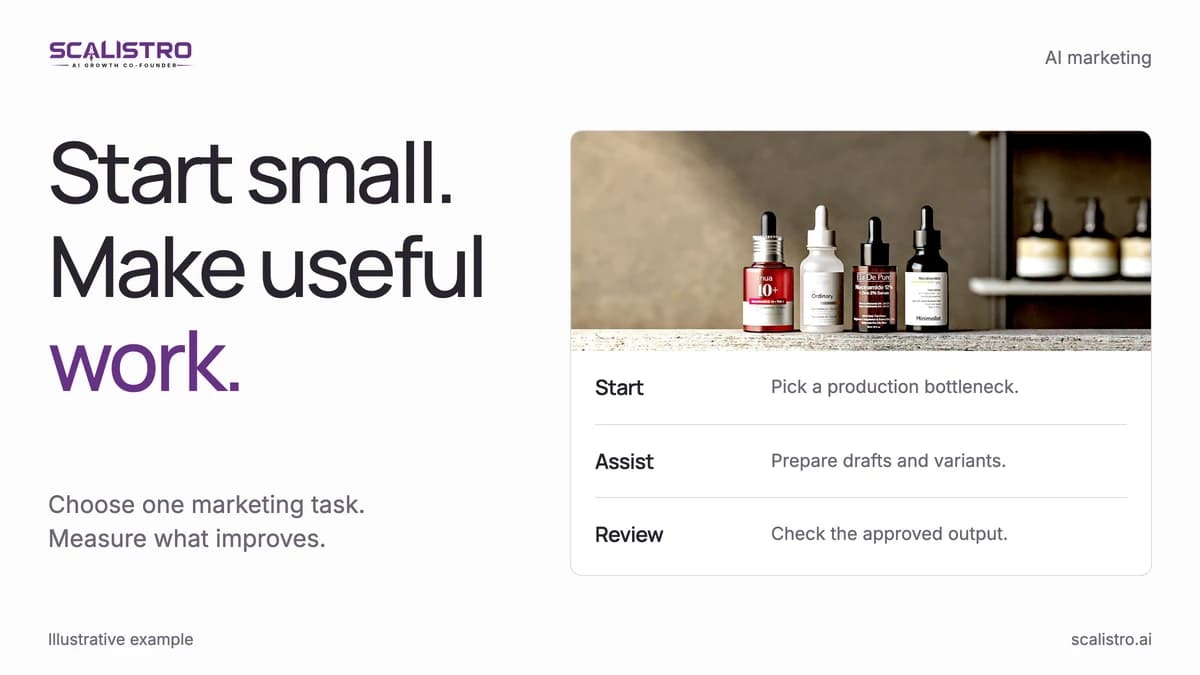
A small brand does not need four new job titles. Assign these responsibilities to the people you already have:
Swipe to explore. Tap to open full size.
Image details: Give the reviewer a concrete checklist.
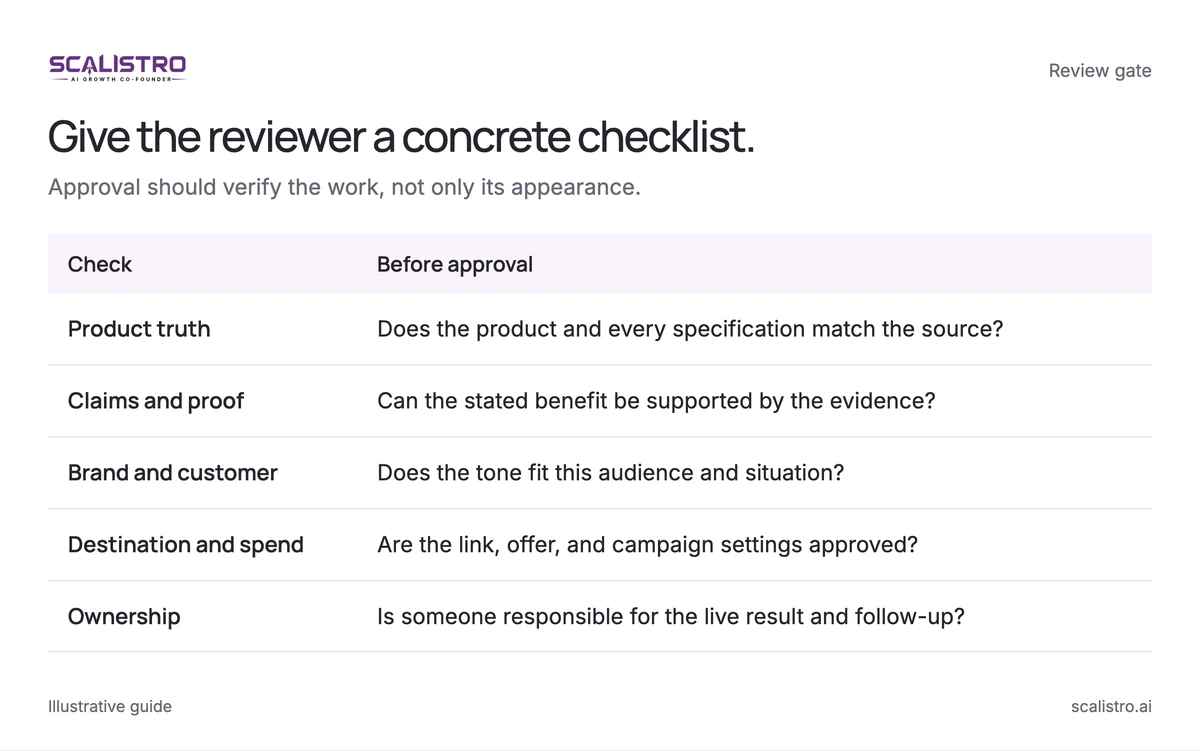
| Check | Before approval |
|---|---|
| Product truth | Does the product and every specification match the source? |
| Claims and proof | Can the stated benefit be supported by the evidence? |
| Brand and customer | Does the tone fit this audience and situation? |
| Destination and spend | Are the link, offer, and campaign settings approved? |
| Ownership | Is someone responsible for the live result and follow-up? |
The Core Roles
- Brand owner: Decides the audience, offer, and product claims.
- Creative reviewer: Chooses and edits AI-made ads, images, and posts.
- Ad owner: Checks results and changes campaigns in the ad platform.
- Customer owner: Handles replies, complaints, and creator relationships.
One person can cover more than one role. Scalistro can help with creative production, social planning, and connected ad analysis.
The Workflow
- A person writes the brief: who the ad is for, what it should say, and what claims are allowed.
- AI drafts images and text.
- A person selects and edits the best options.
- The ad owner launches the chosen ads and sets limits in the ad platform.
- AI helps summarize results; the team decides what to change next.
Repeat the process each week. Save the results so the next brief starts with what the team learned.
The Data Behind AI Plus Human Performance
Controlled studies show why AI works best when people guide the work and review the output. Compare studies carefully because productivity, quality, and business results measure different things.
- Consultants using AI on tasks within its abilities completed 12.2 percent more tasks, 25.1 percent faster, with more than 40 percent higher quality. On a task outside its abilities, they were 19 percentage points less likely to reach the right answer than consultants without AI (Dell'Acqua et al., 2023).
- Professionals using ChatGPT for writing tasks finished 40 percent faster, and their work was rated 18 percent higher in quality (Noy and Zhang, Science 2023, via MIT News).
Common Objections and Why They Are Wrong
"AI is getting so good we will not need humans soon"
AI capabilities are improving rapidly, but so is the complexity of marketing. As AI makes baseline content production trivial, the competitive advantage shifts to the things AI cannot do: original creative concepts, strategic positioning, brand storytelling, and authentic human connection. The bar rises, and humans remain the differentiator above the bar.
"Adding human review slows everything down"
Only if you structure it poorly. In a well-designed AI plus human workflow, human review happens in parallel with AI production, not sequentially. While a human reviews batch one, AI is producing batch two. The throughput is nearly identical to AI-only, but the quality is dramatically higher.
"It is too expensive to have both AI tools and human team members"
Compare the full cost. AI tools cost far less than extra hires, and controlled studies show people using AI on suitable tasks work faster without losing quality. Count review time, tool fees, and the work you no longer outsource before deciding.
For a workflow example, see how AI and human teams can move from idea to launch faster.