Black Friday Marketing for D2C Brands: Practical Plan
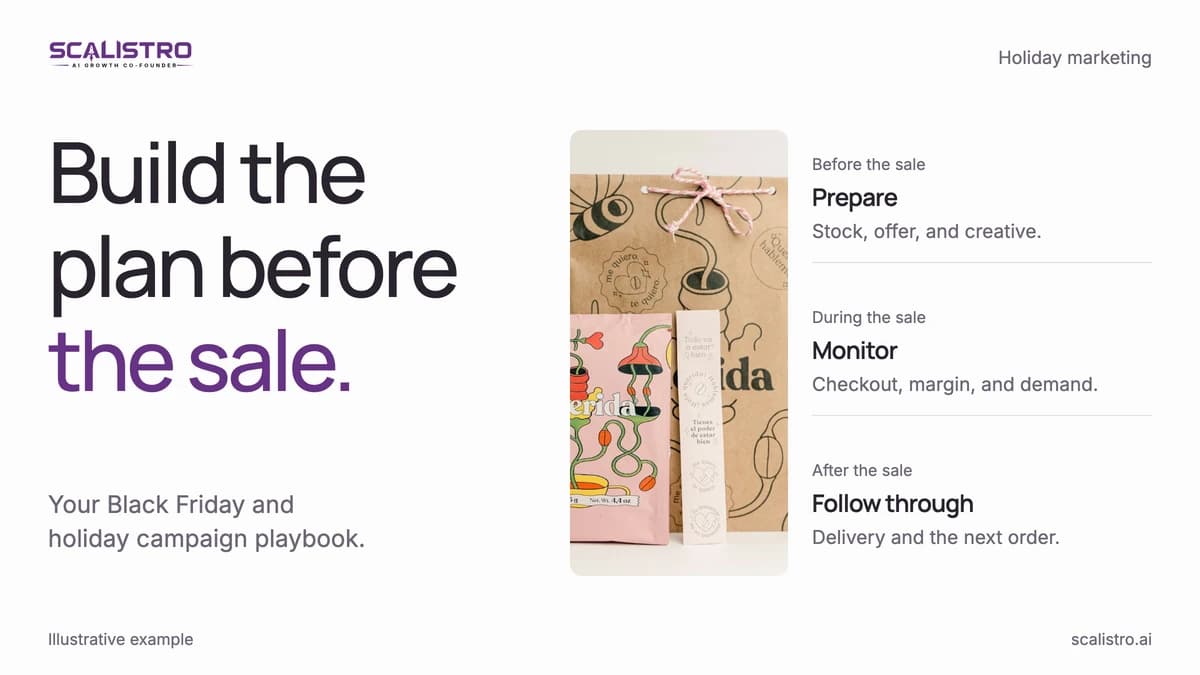
Plan holiday campaigns around inventory, margins, offer rules, creative, email, shipping cutoffs, and retention after Black Friday and Cyber Monday.
On this page
For many D2C brands, the last quarter is the most important sales period of the year, and Black Friday through Cyber Monday (BFCM) sits at its center. US shoppers spent $257.8 billion online from November 1 to December 31, 2025, up 6.8 percent year over year, and Cyber Week alone brought in $44.2 billion (Adobe, 2026).
Demand rises, but so does competition. Ad costs rise as more brands compete for the same shoppers, and inboxes fill up during BFCM week. Start planning 90 days out, pace the sale budget, and prepare retention before the first holiday order arrives.
The 90-Day Holiday Planning Timeline
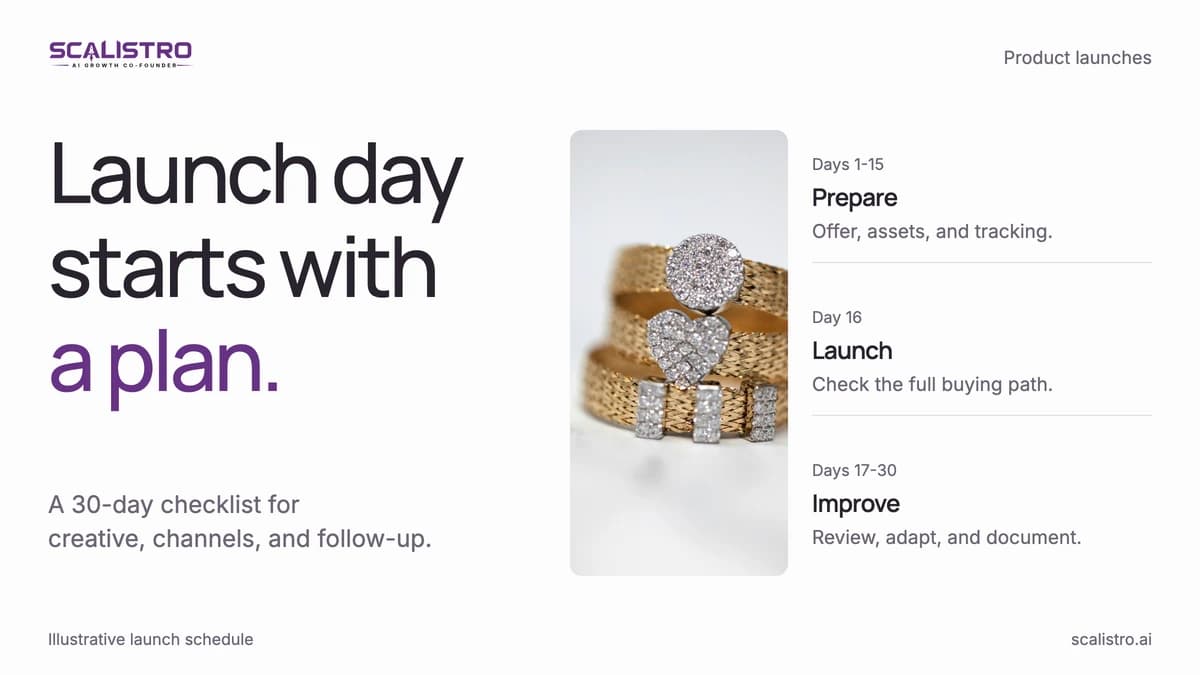
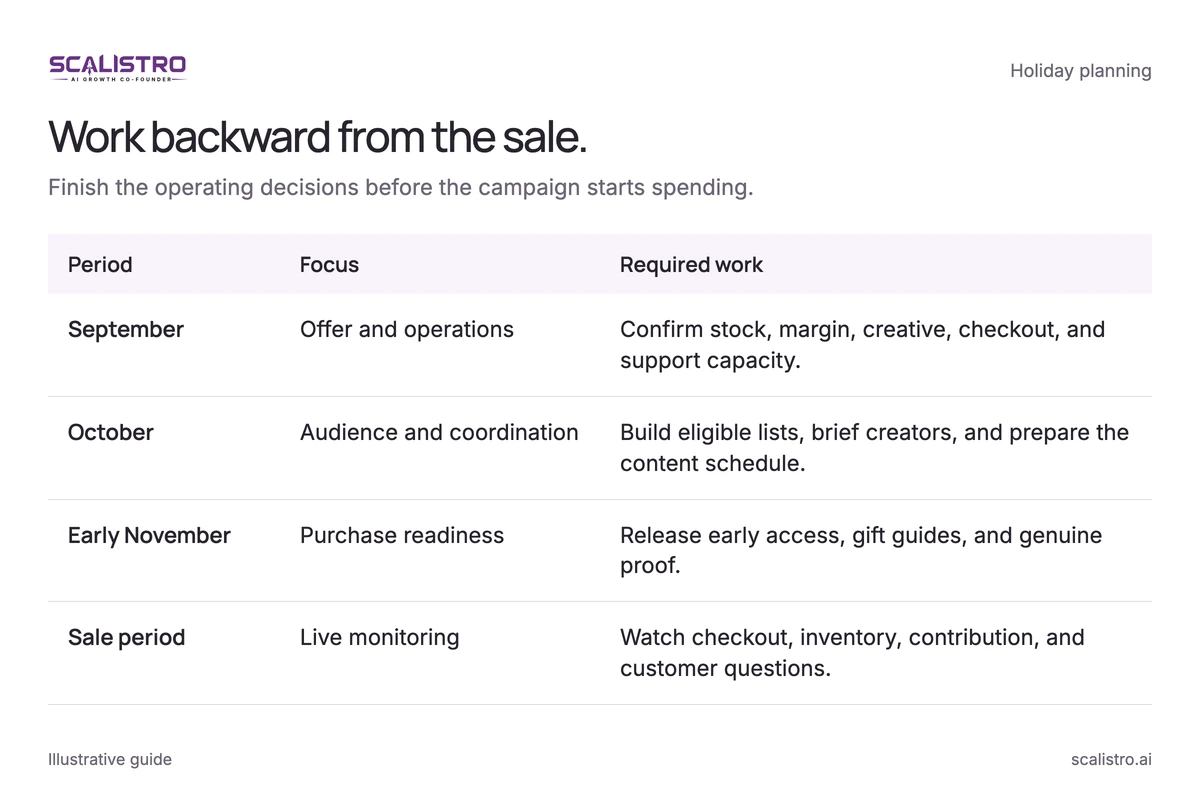
Work backward from the sale. September secures inventory and assets, October builds warm audiences, and early November turns that attention into purchase intent.
Swipe to explore. Tap to open full size.
Image details: Work backward from the sale.
| Period | Focus | Required work |
|---|---|---|
| September | Offer and operations | Confirm stock, margin, creative, checkout, and support capacity. |
| October | Audience and coordination | Build eligible lists, brief creators, and prepare the content schedule. |
| Early November | Purchase readiness | Release early access, gift guides, and genuine proof. |
| Sale period | Live monitoring | Watch checkout, inventory, contribution, and customer questions. |
Phase 1: Foundation (September - 90 Days Out)
Set the offer and operating limits before creative production starts. The team should know which products are in stock, what margin each offer leaves, and how much traffic the site can handle.
- Inventory planning: Forecast demand based on last year's holiday performance plus growth trajectory. Underestimating demand leads to stockouts on bestsellers, so hold a buffer above projected demand for hero products.
- Offer strategy: Decide on your promotional structure. Common D2C holiday offers include tiered discounts (spend $75 get 15% off, spend $150 get 25% off), gifts with purchase, and bundles. Test them against a flat discount and compare order value and margin.
- Creative production: Produce all holiday ad creative, email templates, and landing pages in September. You need 3 to 5 times your normal creative volume for the holiday season - different messaging for early access, main sale, last-chance, and post-holiday phases. AI-powered creative production becomes essential here for generating the sheer volume of variations needed.
- Tech and infrastructure: Load test your website for 3 to 5 times normal traffic. Ensure your checkout process handles surge volume. Confirm payment processors, shipping integrations, and customer support capacity. Site problems during the busiest days are expensive, so fix them before November.
Phase 2: Audience Building (October - 60 Days Out)
Use October to grow owned lists and help new shoppers understand the product before inbox and auction costs peak.
- Email list growth: Run aggressive list-building campaigns. Holiday-themed lead magnets, such as gift guides and "first access to Black Friday deals" signup forms, give visitors a clearer reason to subscribe than a standard newsletter signup. Set a list-growth goal for November 1.
- SMS list building: SMS is useful for a few time-sensitive messages during BFCM. Offer exclusive early access or an additional 5% off for SMS subscribers, and measure revenue per message against your email results.
- Retargeting audience building: Increase top-of-funnel ad spend in October to build large retargeting audiences for November. Shoppers who already know your brand are easier to convert when the sale starts. Run content-focused ads (product education, testimonials, behind-the-scenes) that drive engagement without requiring immediate purchase.
- Influencer coordination: Brief holiday influencer partners in October with content calendars, product details, and posting schedules. Early gifting allows creators to use and genuinely review products before the holiday push.
Phase 3: Pre-Sale (November 1-24 - The Build-Up)
Open the offer to high-intent customers in stages. Early access serves shoppers who are ready before the main sale and gives the team a chance to fix weak links.
- Early access campaigns: Many holiday shoppers start buying before BFCM week. Reward your VIP customers and email subscribers with early access to deals through a "Friends and Family" or "VIP Early Access" campaign.
- Gift guide content: Create and promote curated gift guides segmented by recipient (gifts for her, gifts under $50, gifts for fitness enthusiasts). Gift guide pages help undecided shoppers by narrowing the choice.
- Social proof campaigns: Ramp up review-based and testimonial-based ad creative. Shoppers look for validation before buying from an unfamiliar D2C brand, especially when buying gifts.
BFCM Week: The Main Event (November 25 - December 2)
Manage BFCM as a sequence of offers and checks, not one day of maximum spend. Review stock, checkout, and margin alongside ROAS.
Ad Strategy During BFCM
Meta CPMs and Google Shopping CPCs usually rise during BFCM as competition peaks. Put more budget behind warm demand and high-intent searches, then use prospecting only where the economics hold.
| BFCM Ad Tactic | Starting Budget Split | Key Focus |
|---|---|---|
| Retargeting (warm audiences) | 40-50% of budget | Website visitors, email subscribers, past customers |
| Lookalike prospecting | 25-35% of budget | Lookalikes of purchasers, high-value customers |
| Broad / interest targeting | 10-15% of budget | Category interest, competitor audiences |
| Google Shopping / Search | 15-25% of budget | High-intent product searches, brand terms |
Budget pacing: Allocate 25% to the Monday through Wednesday before Black Friday, 30% to Friday and Saturday, 20% to Sunday, and 25% to Cyber Monday. Check inventory and contribution margin before raising spend.
Email and SMS Strategy During BFCM
Use email for the full offer story and SMS for a few high-value reminders. Segment existing customers, early-access members, and new prospects so every message has a clear reason to arrive.
Plan the following sends, then exclude purchasers from messages that no longer apply:
- Tuesday before BFCM: VIP early access announcement to your best customers.
- Wednesday: Early access opens to full email list. Include countdown timer and bestseller highlights.
- Black Friday morning (6 AM): Main sale launch email. Clear offer, strong hero image, prominent CTA.
- Black Friday afternoon (2 PM): Social proof email - "X items sold today" or "Y customers shopping right now." Creates urgency.
- Saturday: Gift guide email - "Still looking for the perfect gift?" Product recommendations by recipient type.
- Sunday morning: "Last 24 hours" urgency email for early deal expiration or inventory warnings.
- Cyber Monday morning: Fresh email with Cyber Monday-specific offers or extended deals.
- Cyber Monday evening: Final "doors closing" email. Last-chance sends are often among the strongest of the sale.
Limit SMS to 3 or 4 relevant sends: early access, sale launch, Cyber Monday, and a real last chance. Excess messaging raises unsubscribes and reduces the value of the list after the sale.
On-Site Optimization for BFCM
The site must make the offer easy to find and easy to buy on a phone. Test the same pages and checkout steps that your ads and emails link to.
- Dedicated sale landing page: Create a holiday hub page that showcases all deals, bestsellers, and gift guides. Link all ads and emails to this page. A single destination also keeps the offer consistent from ad to checkout.
- Urgency elements: Countdown timers and low-stock indicators ("Only 12 left") can add urgency, but only when they are true. Show genuine deadlines and stock counts.
- Simplified checkout: Speed matters: a Deloitte study for Google found a 0.1 second improvement in mobile site speed raised retail conversion by 8.4 percent (Deloitte and Google via web.dev, 2019 data). Offer guest checkout, reduce form fields, and make mobile checkout easy, since 56.4 percent of US online holiday transactions in 2025 happened on a smartphone (Adobe, 2026).
- Free shipping threshold: Set your free shipping threshold a little above your average order value so it encourages one more item. Example: if your AOV is $65, try free shipping at $75, and check that the extra order value covers the shipping cost.
Post-BFCM: December and Beyond
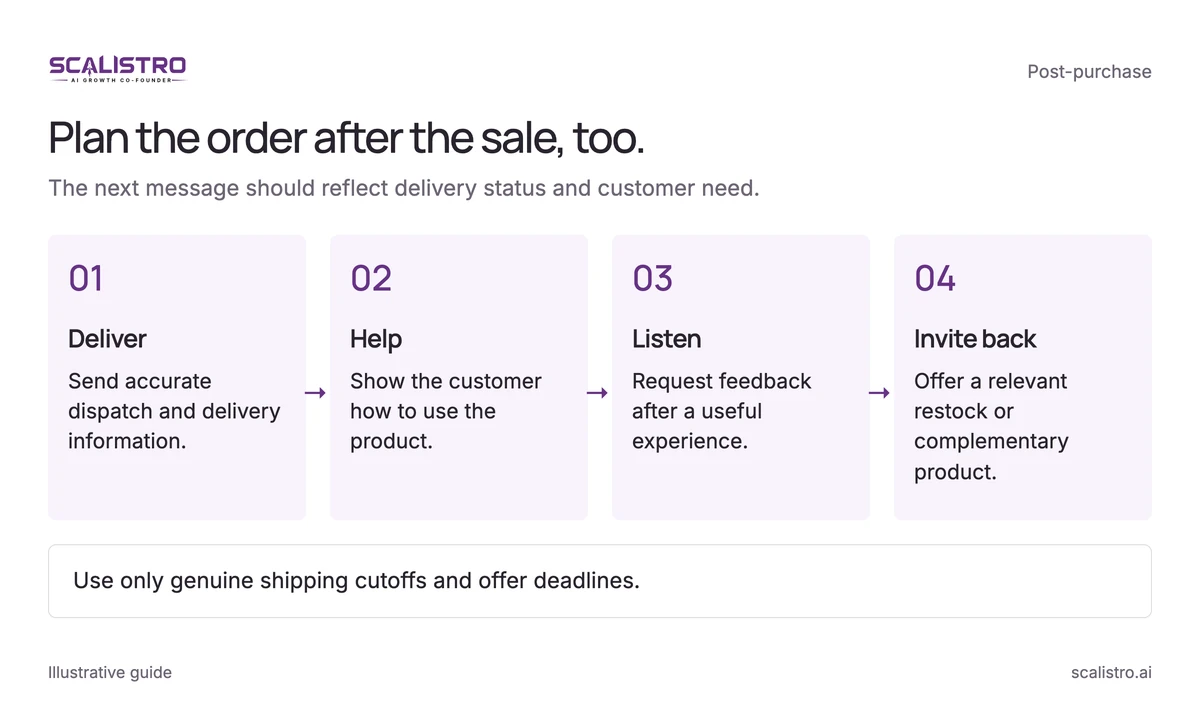
BFCM acquisition pays off only when delivery, gifting, and the second purchase are planned as carefully as the first sale.
Swipe to explore. Tap to open full size.
Image details: Plan the order after the sale, too.
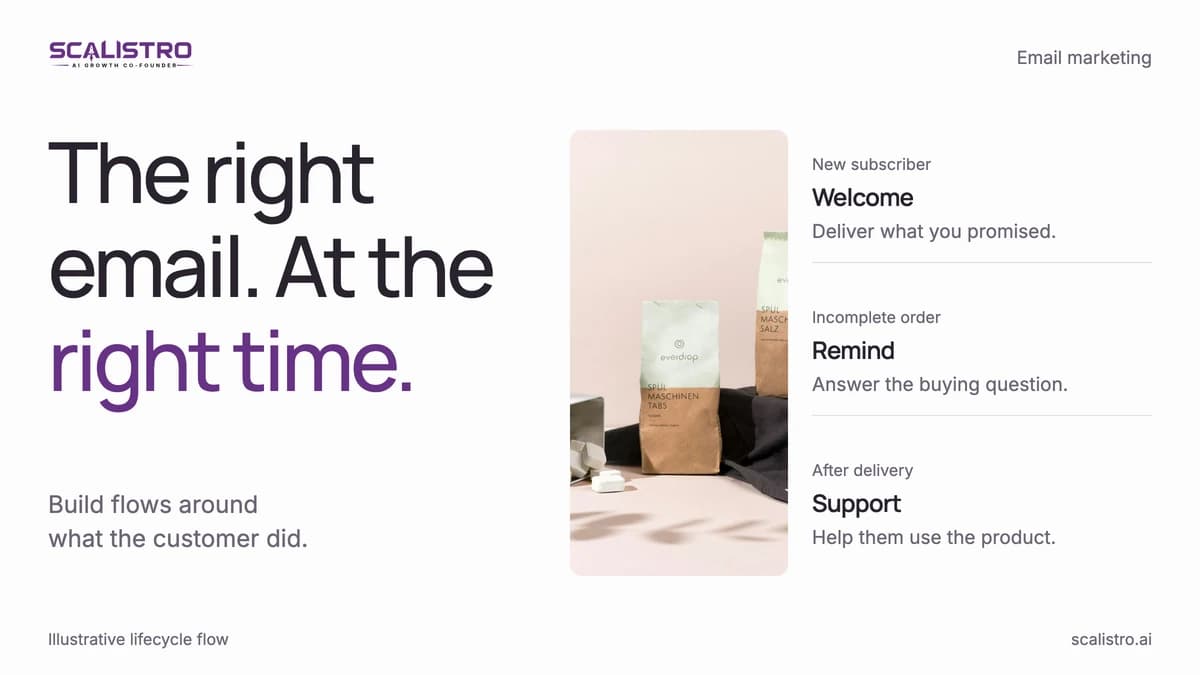
Plan the order after the sale, too. The next message should reflect delivery status and customer need. Deliver - Send accurate dispatch and delivery information.; Help - Show the customer how to use the product.; Listen - Request feedback after a useful experience.; Invite back - Offer a relevant restock or complementary product. Use only genuine shipping cutoffs and offer deadlines.
December Gift-Giving Push (December 1-20)
December gifting can carry a large share of holiday revenue after BFCM. Shift the message from BFCM discounts to availability, delivery dates, and easy gift choices.
- Shipping deadline urgency: "Order by December 15 for guaranteed Christmas delivery" drives significant late-December purchasing. Clearly communicate shipping cutoffs across all channels.
- Gift card promotion: After shipping deadlines pass, pivot to gift card marketing. Digital gift cards give late shoppers an option that does not depend on delivery dates.
- Last-minute bundles: Pre-packaged gift sets with built-in wrapping reduce decision fatigue for last-minute shoppers and can raise order value compared with single items.
Post-Holiday Retention (January)
Many BFCM customers never buy again. Onboarding, relevant replenishment or cross-sell messages, and follow-up after delivery give them a reason to return.
- Welcome series for new customers: Trigger a 5-7 email welcome sequence for every new customer acquired during BFCM. Include brand story, product education, usage tips, and a repeat purchase incentive. Track its effect on second-purchase rate.
- January loyalty offer: Send BFCM customers a "Thank you" email in early January with a 10-15% loyalty discount. Ad costs usually fall after the holidays, which can make January retargeting of holiday buyers efficient.
- Product review requests: Send review requests 14 to 21 days after delivery. New customer reviews gathered post-holiday strengthen social proof for the entire year ahead.
Holiday Season Budget Allocation Framework
Use this allocation as a starting plan. Rebalance from contribution margin and repeat-purchase value, since high reported ROAS can still hide an unprofitable offer.
| Channel | % of Holiday Budget | Key Metric to Track |
|---|---|---|
| Meta Ads (Facebook/Instagram) | 35-45% | ROAS by audience segment |
| Google (Shopping + Search) | 20-30% | ROAS by campaign type |
| Email Marketing | 5-10% | Revenue per email, list health |
| SMS Marketing | 2-5% | Revenue per message, opt-out rate |
| Influencer / Creator | 10-15% | EMV, content repurpose value |
| Creative Production | 10-15% | Variations produced, creative win rate |
Scalistro can help a team prepare the 3 to 5 times normal creative volume needed for the holiday season. Review each asset against the offer, stock, and brand rules before increasing media spend.
Common Holiday Marketing Mistakes D2C Brands Make
Most costly holiday mistakes are predictable. Check these before finalizing the campaign calendar and again when sale week begins.
- Starting too late: Brands that begin BFCM planning in November are already behind. Ad account warm-up, audience building, and creative production need 60 to 90 days of lead time.
- Discounting too aggressively: Deep discounts tend to attract deal-seekers who are less likely to buy again at full price. Protect your margins - focus on value-adds (free gifts, bundles, loyalty points) rather than deep discounts.
- Ignoring post-BFCM retention: Acquiring thousands of new customers during BFCM means little if most never buy again. The real ROI of holiday marketing is measured over the following 12 months.
- Single creative: Running 1 to 3 ad creatives during the highest-competition period of the year is a recipe for creative fatigue by day 3. Plan for 20 to 30 creative variations minimum across formats and messages.
- Poor mobile experience: Most US online holiday transactions now happen on a smartphone (Adobe, 2026). If your mobile checkout is clunky, slow, or requires too many steps, you are losing the majority of potential sales.
To prepare retention before the rush, set up the email flows that support repeat revenue.