7 D2C Email Flows That Drive Repeat Revenue
Start with welcome, abandonment, post-purchase, replenishment, and win-back flows. Measure revenue and customer experience by flow, not sends alone.
On this page
- Introduction
- Email Revenue Breakdown: Flows vs. Campaigns
- Flow 1: Welcome Series
- Flow 2: Abandoned Cart
- Flow 3: Browse Abandonment
- Flow 4: Post-Purchase
- Flow 5: Win-Back
- Flow 6: Replenishment Reminder
- Flow 7: Sunset Flow (List Hygiene)
- Campaign Strategy: The Other Half of Email Revenue
- Email Subject Line Benchmarks and Best Practices
- Measuring Email Program Health
- Frequently Asked Questions
An effective D2C email program combines timely automated flows with useful campaigns. In Litmus's 2025 State of Email research, 35 percent of marketing leaders reported $10 to $36 back for every $1 spent on email, 30 percent reported $36 to $50, and 21 percent did not measure it at all (Litmus, 2025).
Use the seven flows below to welcome a subscriber, recover intent, support the first order, and earn the next one. Where a flow has a published benchmark, the figures come from Klaviyo's 2025 Benchmark Report, which aggregates ecommerce accounts on its platform. Compare the result with your own cohort and attribution settings.
Email Revenue Breakdown: Flows vs. Campaigns
Separate always-on flows from scheduled broadcasts so each has a clear job:
- Flow revenue (automated): Revenue generated by automated email sequences triggered by specific customer actions (signing up, abandoning cart, making a purchase, etc.). In Klaviyo's 2026 benchmarks, flows generated nearly 41 percent of total email revenue from just 5.3 percent of sends (Klaviyo, 2026).
- Campaign revenue (manual): Revenue generated by one-time email sends (product launches, sales, content, newsletters).
If campaigns earn almost all of your email revenue, your flows are probably missing or weak. Check flow share again once the core triggers, exclusions, and messages are working.
Flow 1: Welcome Series
Start the welcome series when someone subscribes, and deliver the promised incentive immediately. Use the remaining messages to answer purchase questions, not to resend the same offer five times. In Klaviyo's 2025 report, welcome flows averaged a 51.26 percent open rate, a 4.92 percent click rate, a 1.97 percent placed order rate, and $2.35 revenue per recipient (Klaviyo, 2025).
Optimal Welcome Series Structure: 5 Emails Over 7 Days
Suppress first-purchase reminders after an order. Adjust the final send to the real expiration of any offer.
Email 1: Immediate (within 1 minute of signup)
- Purpose: Deliver the promised incentive and make the first sale.
- Content: Thank them for joining, deliver the discount code or offer, show your best-selling product, and include a clear CTA to shop.
Email 2: Day 1 (24 hours after signup)
- Purpose: Tell your brand story and build emotional connection.
- Content: Founder story, brand mission, what makes you different. Include social proof (customer count, review ratings, press mentions). Soft CTA to browse.
Email 3: Day 3
- Purpose: Social proof and objection handling.
- Content: Showcase 3 to 5 customer testimonials or reviews. Address the top purchase objection (price, efficacy, etc.). Include a reminder of the welcome offer if unused.
Email 4: Day 5
- Purpose: Education and value demonstration.
- Content: How to use the product, what results to expect, tips for getting the most out of it. Include before-and-after results or usage tutorials.
Email 5: Day 7 (Urgency Close)
- Purpose: Create urgency to convert non-buyers before the welcome offer expires.
- Content: "Your [X]% off expires tonight." Reinforce the offer, show the top product, include a testimonial, and add a countdown element. This is the most direct sales email in the series.
Compare your own welcome flow's revenue per recipient with that average after it has run for a full month, and account for list acquisition costs and discounts.
Flow 2: Abandoned Cart
Baymard Institute's average across 50 studies puts online cart abandonment at 70.22 percent (Baymard Institute, 2025). A cart flow can win back some of those missed orders by reminding the shopper of the exact item and answering a genuine objection. In Klaviyo's 2025 report, abandoned cart flows had the highest revenue per recipient of any flow, $3.07, with a 46.97 percent open rate, a 5.21 percent click rate, and a 2.68 percent placed order rate (Klaviyo, 2025). Stop the sequence as soon as the order is completed.
Swipe to explore. Tap to open full size.
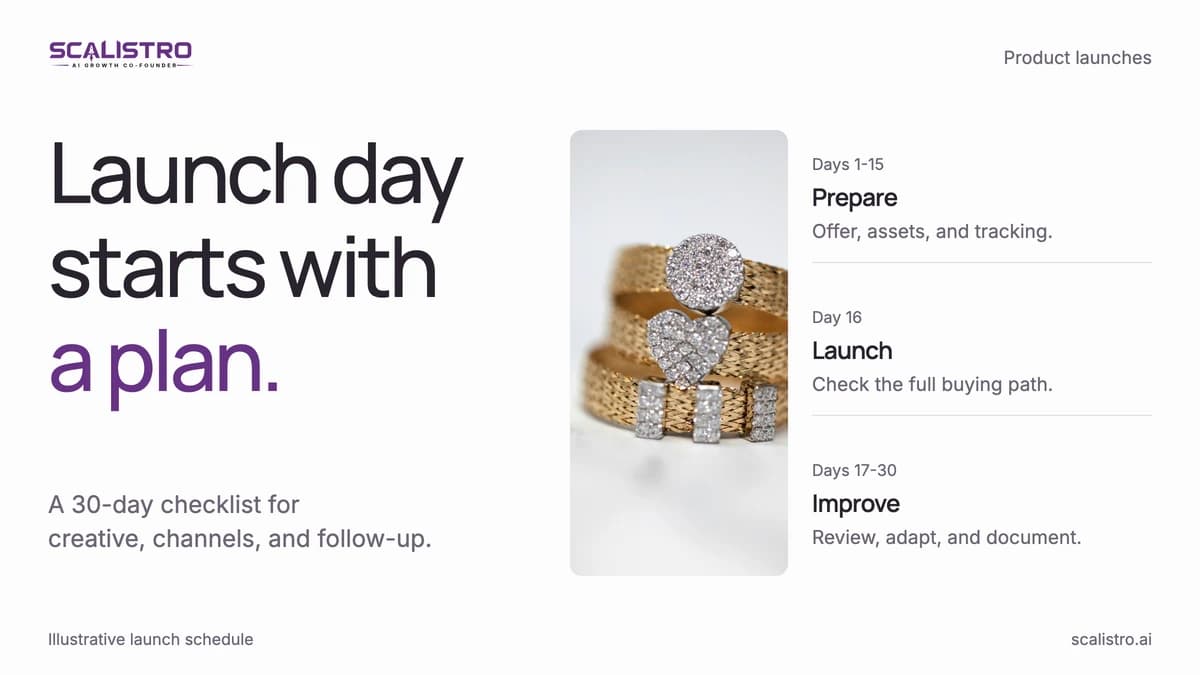
Image details: A cart reminder should answer the next objection.
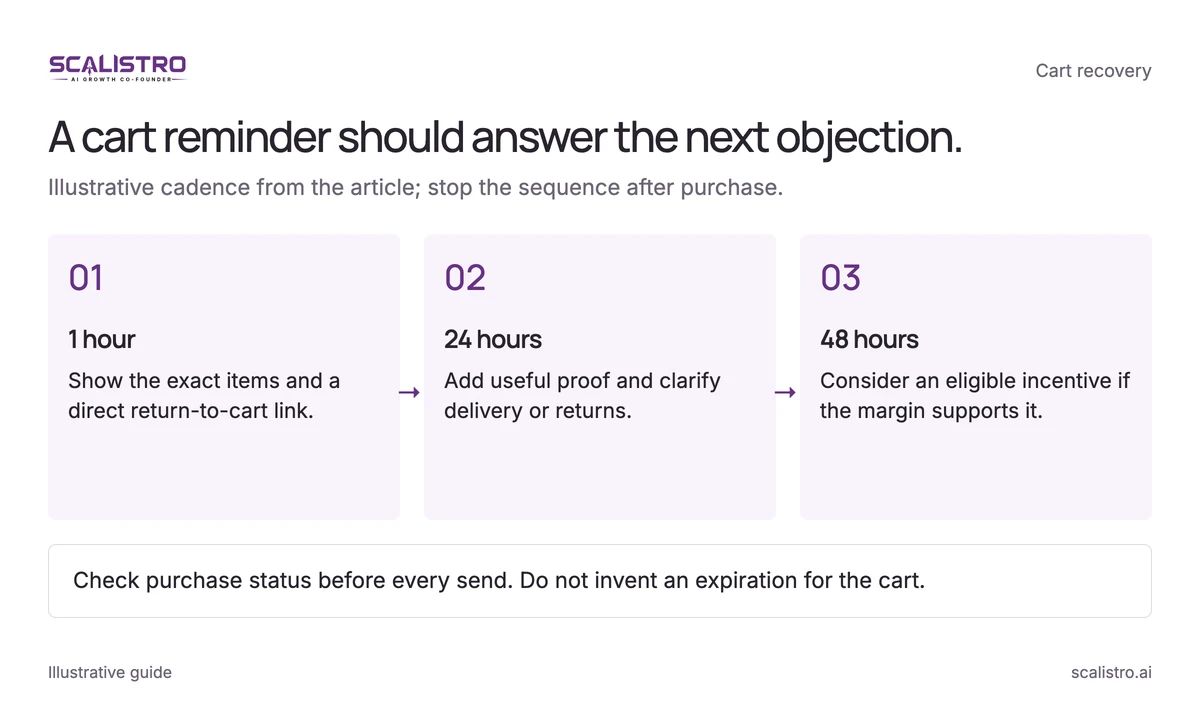
A cart reminder should answer the next objection. Illustrative cadence from the article; stop the sequence after purchase. 1 hour - Show the exact items and a direct return-to-cart link.; 24 hours - Add useful proof and clarify delivery or returns.; 48 hours - Consider an eligible incentive if the margin supports it. Check purchase status before every send. Do not invent an expiration for the cart.
Optimal Cart Abandonment Structure: 3 Emails Over 48 Hours
Begin with a reminder, add useful proof or shipping details, and reserve any incentive for the final eligible send.
Email 1: 1 hour after abandonment
- Purpose: Reminder - they may have been distracted or experienced a technical issue.
- Content: "You left something in your cart." Show the specific product(s) with images and prices. Include a direct link back to their cart. No discount yet.
Email 2: 24 hours after abandonment
- Purpose: Objection handling and social proof.
- Content: "Still thinking about it?" Include 2 to 3 customer reviews for the abandoned product, a benefit callout, and shipping/return policy highlights. Optional: offer free shipping if not already included.
Email 3: 48 hours after abandonment
- Purpose: Final nudge with incentive.
- Content: Use a real offer deadline if one exists. A 10 to 15 percent discount or free shipping can be a final incentive. Include the exact product and a direct checkout link without claiming the cart will expire unless it actually will.
To size the opportunity, multiply your monthly abandoned carts by your own recovery rate and average order value, then subtract discounts and returns.
Flow 3: Browse Abandonment
Product viewers have shown interest but have not taken a cart action. Send a useful reminder only when the visitor is an identified, opted-in contact and the viewed product is clear. Klaviyo's 2025 report puts browse abandonment flows at a 54.10 percent open rate, a 4.74 percent click rate, a 0.82 percent placed order rate, and $0.95 revenue per recipient (Klaviyo, 2025).
Optimal Browse Abandonment Structure: 2 Emails Over 48 Hours
Show the viewed item first, then relevant alternatives if the first message did not lead to an order.
Email 1: 4 hours after browsing
- Purpose: Soft reminder of the product they showed interest in.
- Content: "Caught your eye?" Show the viewed product with a lifestyle image, 1 to 2 customer reviews, and a link to the product page. No discount.
Email 2: 24 hours after browsing
- Purpose: Show alternatives and best sellers.
- Content: "You might also like..." Show the viewed product plus 2 to 3 related products or best sellers. Include a social proof element. Soft CTA.
Flow 4: Post-Purchase
After an order, customers need accurate delivery information and help using the product. That service creates a better foundation for a review request and second purchase than an immediate cross-sell. Post-purchase flows had the highest average open rate of any flow in Klaviyo's 2025 report, 59.77 percent, but the lowest placed order rate, 0.48 percent (Klaviyo, 2025).
Swipe to explore. Tap to open full size.
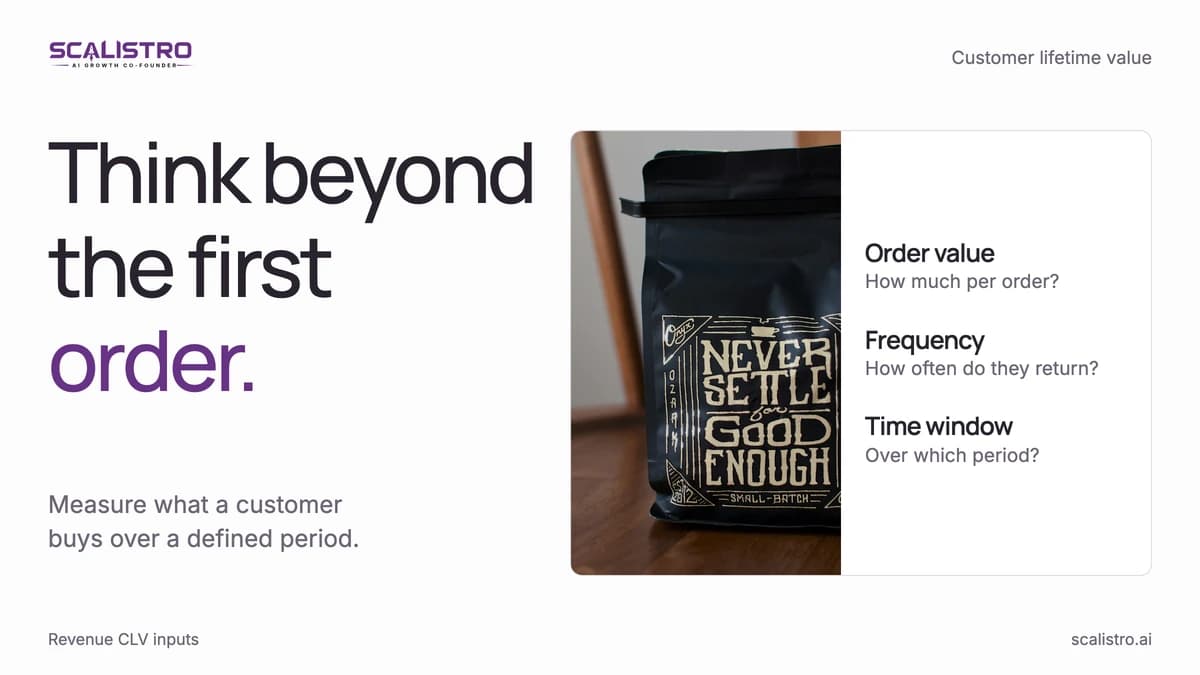
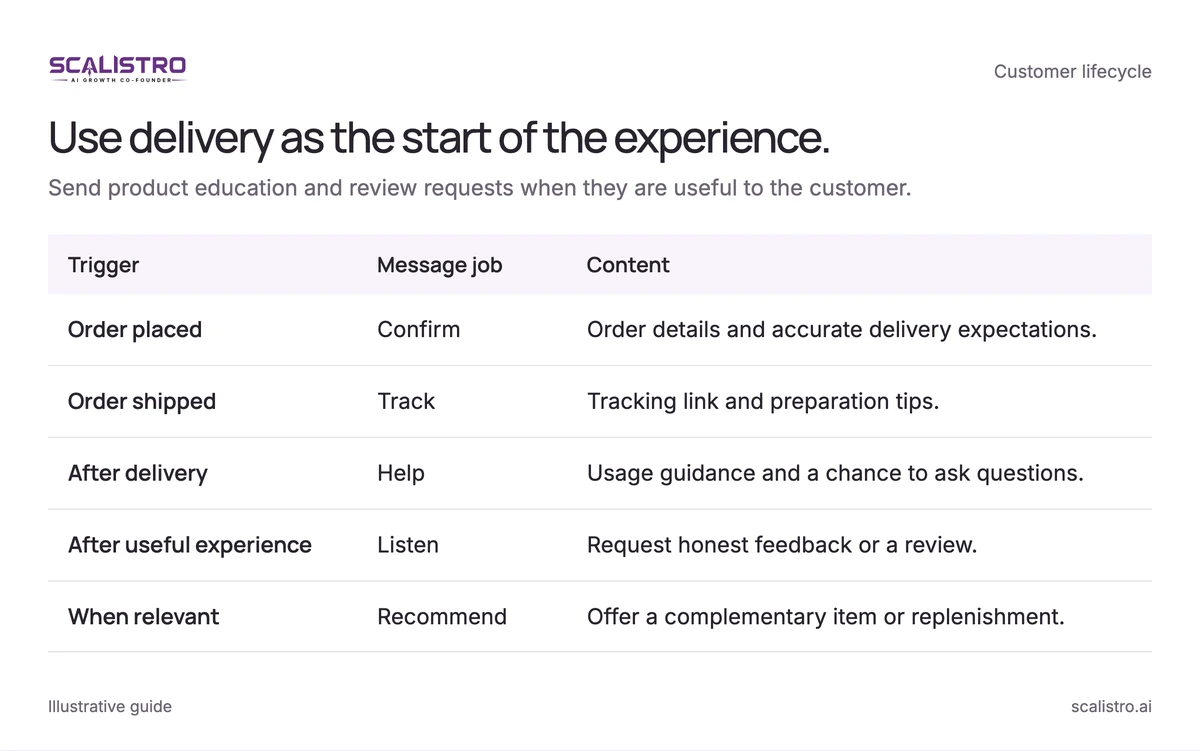
Image details: Use delivery as the start of the experience.
| Trigger | Message job | Content |
|---|---|---|
| Order placed | Confirm | Order details and accurate delivery expectations. |
| Order shipped | Track | Tracking link and preparation tips. |
| After delivery | Help | Usage guidance and a chance to ask questions. |
| After useful experience | Listen | Request honest feedback or a review. |
| When relevant | Recommend | Offer a complementary item or replenishment. |
Optimal Post-Purchase Structure: 5 Emails Over 30 Days
Time the educational and review messages from delivery, not only from the purchase date.
Email 1: Order confirmation (immediate)
- Content: Order details, expected delivery date, what to expect. This is transactional but also an opportunity to reinforce the purchase decision ("Great choice - you are going to love this").
Email 2: Shipping confirmation (when shipped)
- Content: Tracking information, expected delivery date, preparation tips ("Here is how to get the most out of your product when it arrives").
Email 3: Day 3 after delivery
- Purpose: Check in and provide product education.
- Content: "How is it going?" Include tips for product use, common first-week experiences, and a link to a how-to guide or video. Ask for feedback (not a review yet - too early).
Email 4: Day 14 after delivery
- Purpose: Request a review and capture social proof.
- Content: "How are you enjoying [product]? Share your experience." Direct link to leave a review. Incentivize with a small reward (loyalty points, entry into a giveaway, or a 10 percent discount on next order).
Email 5: Day 25-30 after delivery
- Purpose: Cross-sell and drive the second purchase.
- Content: Based on what they bought, recommend complementary products. "Customers who bought [X] also love [Y]." Include a cross-sell incentive (10 percent off their next order, free shipping, or a bundle deal).
Flow 5: Win-Back
Set the win-back trigger from the product's normal repurchase cycle, often 60 to 120 days. Give a reason to return before sending a discount.
Optimal Win-Back Structure: 3 Emails Over 14 Days
Stop the sequence after a purchase, and send the final deadline only if the offer truly expires.
Email 1: Day 60-90 after last purchase (depending on repurchase cycle)
- Content: "We miss you - here is what is new." Highlight 2 to 3 new products, best sellers, or seasonal items. No discount. Appeal to curiosity.
Email 2: 5 days after email 1
- Content: "Here is something special for you." Offer a personalized incentive - 15 to 20 percent discount, free shipping, or a free gift. Include a testimonial from a repeat customer.
Email 3: 7 days after email 2
- Content: "Last chance to save [X]%." Create urgency around the expiring offer. This is your final attempt before the customer is classified as churned and moved to a sunset flow.
Flow 6: Replenishment Reminder
Replenishment works for products people use up. A 30-day vitamin supply might justify a reminder on day 23 to 25. The timing aligns with need, so the reminder arrives when the customer is ready to reorder.
Set the reminder 5 to 7 days before the expected run-out date, based on actual pack size and normal use. Offer a direct reorder path and, if margin allows, a 10 to 15 percent subscription incentive.
Flow 7: Sunset Flow (List Hygiene)
The sunset flow protects deliverability by checking whether an address is still engaged. Look at clicks, purchases, and other reliable signals over 90 to 120 days; opens alone can be distorted by privacy features.
A healthy email list should have:
- Unsubscribe rate: Below 0.3 percent per send is healthy; above 1 percent needs attention.
- Bounce rate: Below 1 percent is healthy; above 2 percent needs attention.
- Spam complaint rate: Below 0.01 percent is healthy; above 0.05 percent needs attention.
These thresholds come from Klaviyo's deliverability guidance. Gmail separately asks senders to keep spam rates below 0.3 percent and recommends staying under 0.1 percent (Google, Email sender guidelines). Treat open rates with caution, since privacy features can inflate them.
Send 2 to 3 useful re-engagement messages, then suppress contacts who show no reliable activity. Keep purchase and preference signals in the suppression decision.
Campaign Strategy: The Other Half of Email Revenue
Campaigns cover launches, promotions, education, and seasonal moments that a trigger cannot. Segment lists so every subscriber does not receive every message. Watch complaints and revenue per recipient as volume rises.
A three-message weekly pattern could be:
- Monday: Educational or content email (tips, how-to guides, ingredient spotlights). Builds engagement without direct selling.
- Wednesday: Product-focused email (new arrivals, best sellers, restocks). Direct revenue driver.
- Friday or Saturday: Social proof or promotional email (customer stories, limited-time offers, weekend deals). Capitalizes on higher weekend shopping intent.
Klaviyo's 2025 report puts the average email campaign revenue per recipient at $0.10, so a 20,000-person send would earn about $2,000 at that average (Klaviyo, 2025). If the result is lower, inspect delivery, click quality, and the destination page before rewriting only the subject.
Email Subject Line Benchmarks and Best Practices
Use these ideas to form tests, but judge subject lines with clicks and orders as well as opens:
- Optimal length: 28 to 45 characters. Subject lines under 28 characters lack context. Long subject lines can be cut off on mobile inboxes.
- Personalization: Test the recipient's first name or a recently viewed product name against a plain subject.
- Emojis: A single relevant emoji can help a subject stand out; several in a row tend to look like spam.
- Urgency words: "Last chance," "Ends tonight," and "Final hours" can lift opens when the deadline is real and used sparingly. Overuse causes subscriber fatigue and reduces the urgency effect.
- Numbers and specificity: Subject lines with specific numbers ("Save $15 today" vs. "Save big today") are clearer and worth testing.
AI can prepare 5 to 10 distinct subject options from an approved offer. Select a small test set and keep the send audience and content comparable so the result is interpretable.
Measuring Email Program Health
Review the full program monthly, including list health, revenue share, and customer repeat behavior:
| Flow metric | Average | Top 10% |
|---|---|---|
| Open rate | 48.57% | 65.74% |
| Click rate | 4.67% | 12.21% |
| Placed order rate | 1.42% | 4.93% |
Source: Klaviyo 2025 Benchmark Report, all ecommerce industries. Track email's share of total revenue, flow versus campaign split, and list growth against your own earlier months.
Measure the effect of these flows with a consistent customer lifetime value calculation.