How Product Pages Get Cited in AI Answers
What makes a D2C product page easy for AI search and assistants to understand and cite: access, direct answers, specific facts, and consistent information.
On this page
When a shopper asks an AI assistant "which running shoe is best for wide feet" or "is this serum safe for sensitive skin", the answer is assembled from pages the system can read and trust. Some of those answers cite their sources. A product page earns a citation the same way it earns a sale: it is easy to reach, it answers the question directly, and its facts hold up.
No one can guarantee that an AI system will cite a specific page. What you can control is whether your page gives it a clear, accurate answer to use. This guide covers the page-level work, in the order it matters.
1. Make Sure the Page Can Be Read
AI search features and assistants that browse the web still need to fetch your page. Check the basics before you edit any copy:
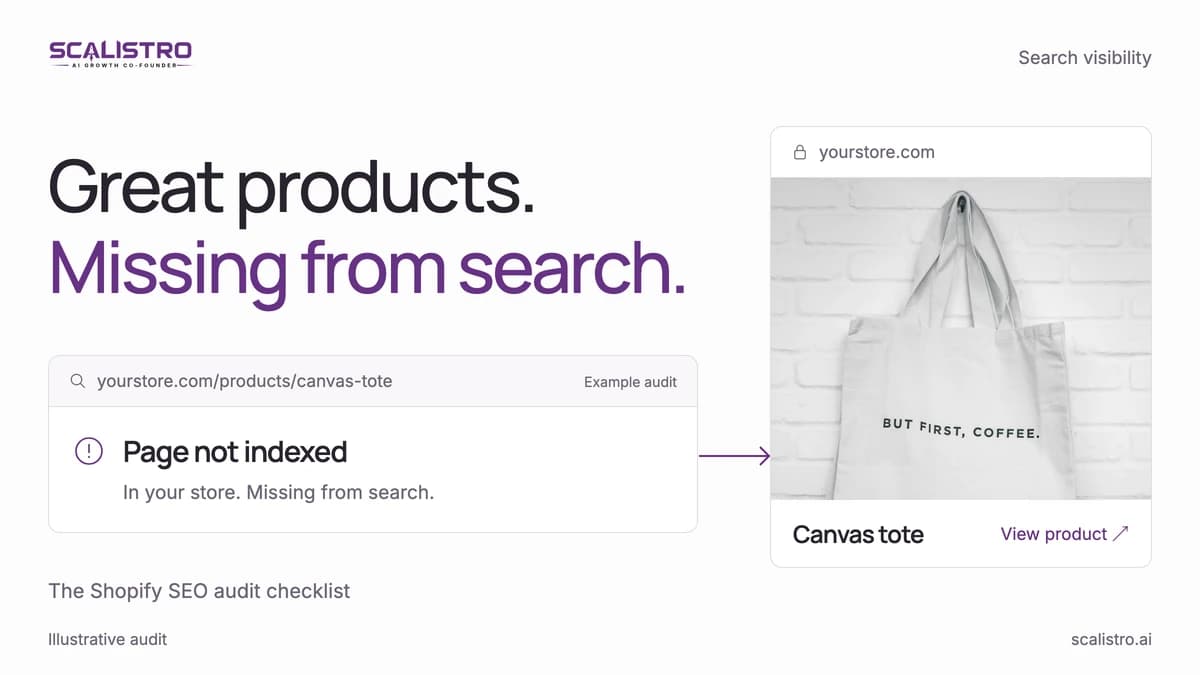
- The product page is indexed in Google Search Console and returns a normal 200 response.
- The important information is in the page's HTML. Details that only appear after a click, inside an image, or in a script-loaded tab may be missed.
- Your robots.txt does not block the search crawlers of the AI services you want to appear in. Several services separate search crawlers from training crawlers, so check each one before blocking anything.
The Shopify SEO audit checklist covers these access checks in detail.
2. Answer the Buying Question in Plain Words
AI answers are built around questions, so pages that state answers plainly are easier to use. Look at your product page and ask what a careful shopper needs to know before buying:
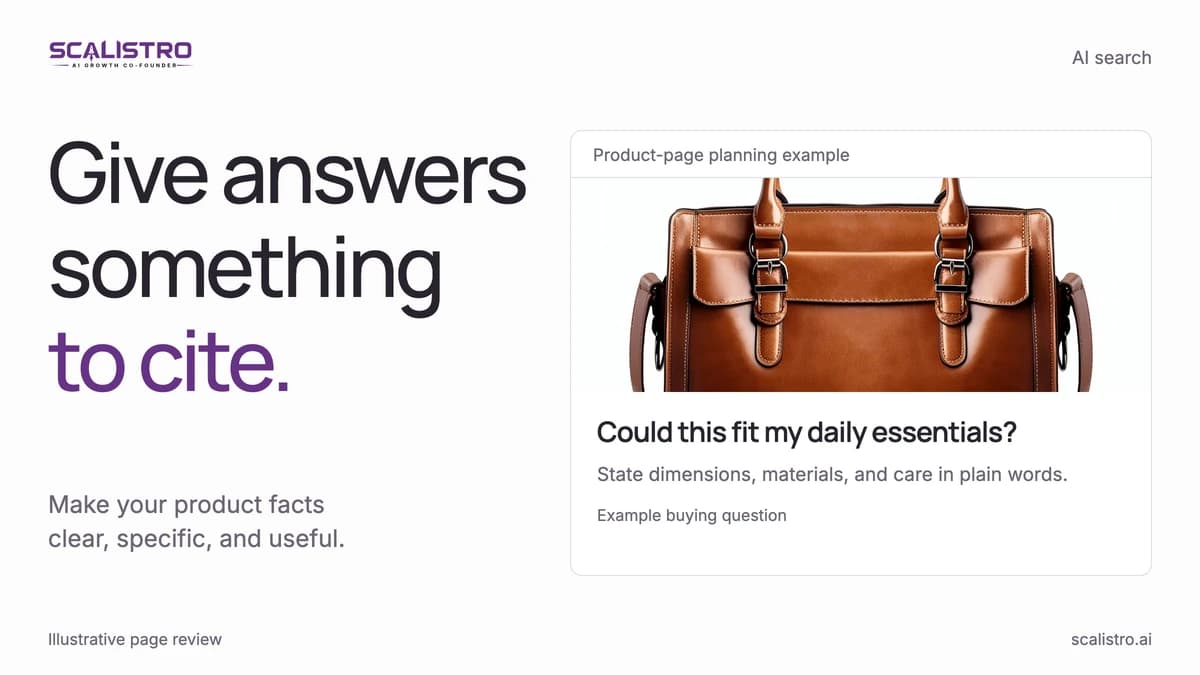
- Fit and sizing. Give the measurement and the recommendation, such as "runs half a size small; order half a size up."
- Suitability. Say who the product is for and who it is not for. "Suitable for sensitive skin; not tested on children under 3" is more useful than "gentle formula."
- Compatibility. List what the product works with by name and model.
- Care, delivery, and returns. State the specifics for this product, not only a link to a policy page.
Lead each answer with the conclusion, then add the detail. A shopper skimming on a phone and an AI system extracting an answer both benefit from the same structure.
3. Replace Vague Claims With Specific Facts
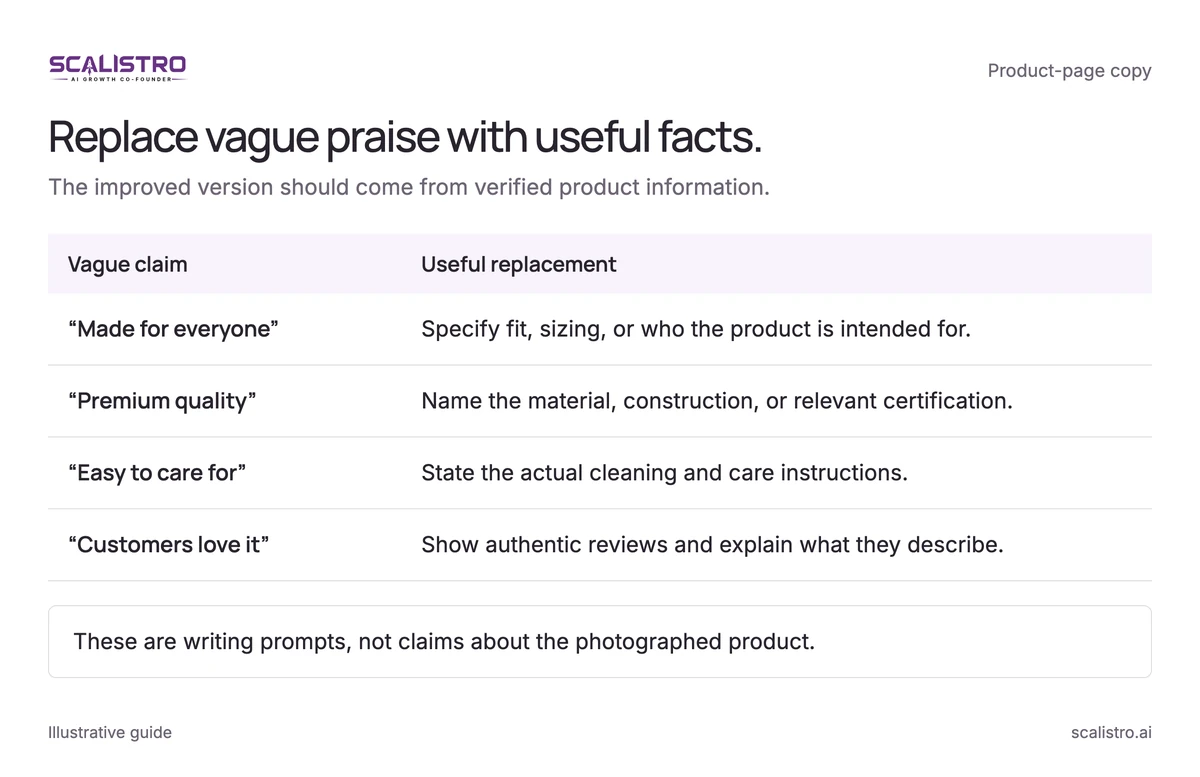
Broad marketing language gives an AI system nothing to quote. Specific, checkable facts do.
Swipe to explore. Tap to open full size.
Image details: Replace vague praise with useful facts.
| Vague claim | Useful replacement |
|---|---|
| “Made for everyone” | Specify fit, sizing, or who the product is intended for. |
| “Premium quality” | Name the material, construction, or relevant certification. |
| “Easy to care for” | State the actual cleaning and care instructions. |
| “Customers love it” | Show authentic reviews and explain what they describe. |
These are writing prompts, not claims about the photographed product.
| Vague | Specific |
|---|---|
| Keeps drinks cold all day | Keeps drinks cold for up to 24 hours in our testing |
| Premium materials | 100% organic cotton, 220 gsm |
| Great for travel | Fits under most airline seats at 40 x 30 x 20 cm |
| Long-lasting | 2-year warranty against manufacturing defects |
Only state what you can support. If a figure comes from your own testing, say so. If it comes from a certification or a lab, name it.
4. Make Your Information Agree Everywhere
When different pages describe the same product differently, AI systems have to choose between conflicting claims, and they may pick the wrong one or skip your brand. Check that these agree:
- The product page, the collection description, and any buying guide that mentions the product.
- Your own site and marketplace listings such as Amazon.
- The visible page and its structured data, especially price and availability.
- Product and brand names across your site, social profiles, and press mentions.
A buying guide that calls a jacket "waterproof" while the product page says "water-resistant" is a common example. Find the verified specification and use it everywhere.
5. Show Real Evidence
AI systems and shoppers both look for signs that a claim is reliable:
- Reviews as visible text, with details such as size purchased and how the product performed.
- Sources for claims, such as a named certification, a test method, or an ingredient standard.
- Original images and video that show the product in use, with alt text that describes what is shown.
- Who stands behind the product, including a clear brand name, contact details, and returns information.
6. Connect the Page to Helpful Guides
Buying guides and comparisons answer the questions shoppers ask before they narrow down to one product. Link each guide to the products it recommends, and link products back to the relevant guide. This helps shoppers and gives search systems a clear picture of which page answers which question. The AEO and GEO guide for D2C brands explains how these pages work together.
A Quick Page Review
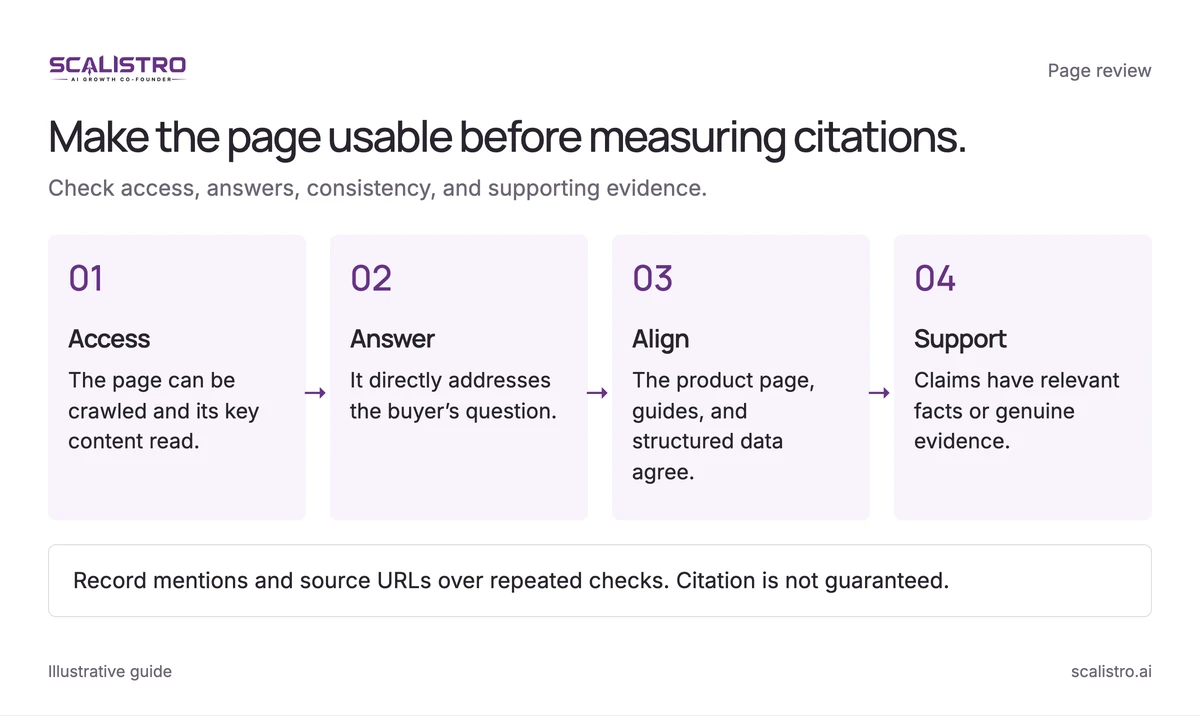
Before you publish a product page, check:
Swipe to explore. Tap to open full size.
Image details: Make the page usable before measuring citations.
Make the page usable before measuring citations. Check access, answers, consistency, and supporting evidence. Access - The page can be crawled and its key content read.; Answer - It directly addresses the buyer’s question.; Align - The product page, guides, and structured data agree.; Support - Claims have relevant facts or genuine evidence. Record mentions and source URLs over repeated checks. Citation is not guaranteed.
- Is the page indexed and readable without clicks or scripts?
- Does it answer the top three questions customers ask about this product?
- Is every claim specific and supported?
- Do the facts match the guide, the collection, the marketplace listing, and the structured data?
- Are reviews and evidence visible as text?
Measuring the Effect
Track search impressions and clicks for the pages you improve in Search Console, and check a fixed set of buying questions in the main AI assistants on a regular schedule. AI answers vary from one run to the next, so record observations over several weeks before drawing conclusions.
Scalistro's search visibility audit reviews your product pages, collections, and guides for missing answers, conflicting facts, and access issues, and recommends what to change first. Your team or our experts then make the agreed updates.