15 Facebook Ad Copy Frameworks for D2C Brands
Use these 15 Facebook ad copy frameworks to match the message to customer awareness, product proof, and the stage of the buying journey.
On this page
- Introduction
- The Anatomy of Meta Ad Copy
- Framework 1: Problem-Agitate-Solve (PAS)
- Framework 2: Before-After-Bridge (BAB)
- Framework 3: Social Proof Lead
- Framework 4: The Founder Story
- Framework 5: The Listicle Hook
- Framework 6: The Testimonial Spotlight
- Framework 7: The Objection Buster
- Framework 8: The Comparison (Without Naming Competitors)
- Framework 9: The Urgency Play
- Framework 10: The How-To Hook
- Framework 11: The Micro-Story
- Framework 12: The Guarantee Lead
- Framework 13: The Question Opener
- Framework 14: The Price Anchor
- Framework 15: The Ingredient/Feature Spotlight
- How to Test Your Ad Copy Systematically
- How Scalistro Helps You Write Better Ad Copy Faster
- Frequently Asked Questions
Good Facebook and Instagram ad copy makes the product, benefit, and next step clear. A striking image cannot carry an unclear offer, and a strong claim cannot rescue a poor product fit. The practical goal is to choose a message that matches what the buyer already knows.
Use these 15 frameworks as briefs for distinct angles. Fill each template with true product details, approved claims, and a real offer. Then test outcomes in your account instead of assuming one framework always wins.
The Anatomy of Meta Ad Copy
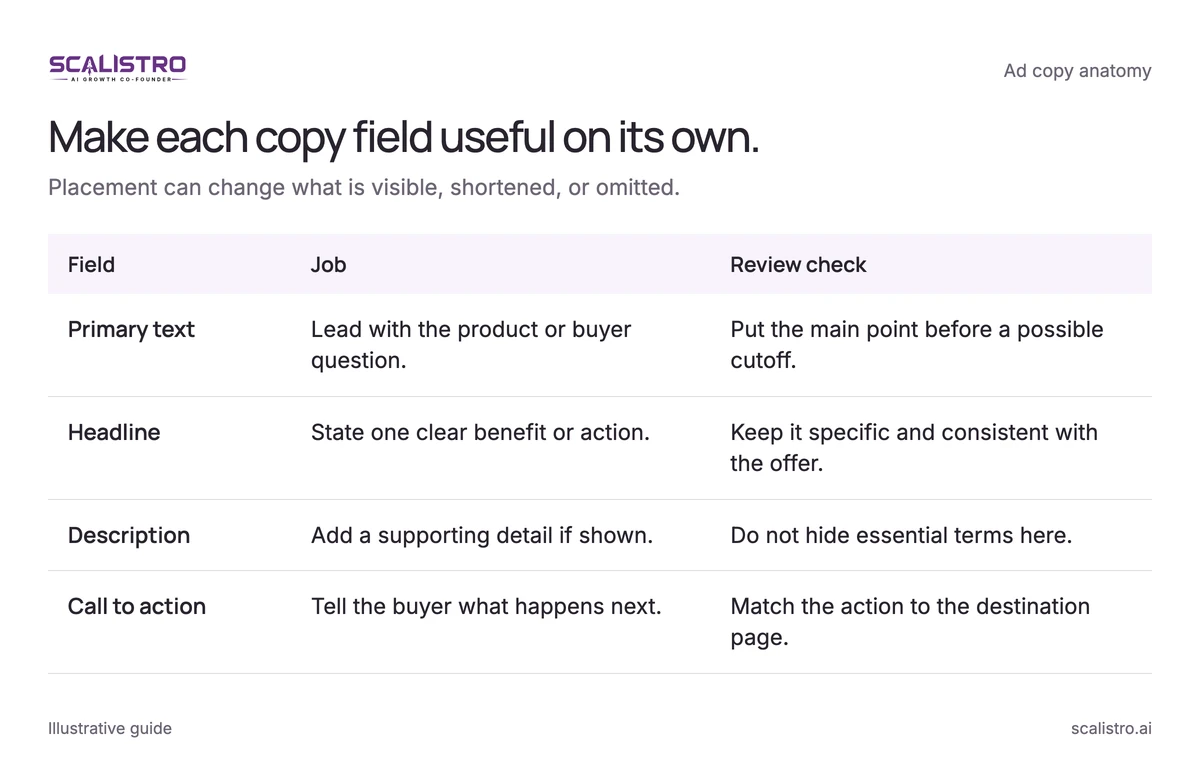
Meta may show different fields across placements. Write each field so the message still makes sense when the others are shortened or hidden:
Swipe to explore. Tap to open full size.
Image details: Make each copy field useful on its own.
| Field | Job | Review check |
|---|---|---|
| Primary text | Lead with the product or buyer question. | Put the main point before a possible cutoff. |
| Headline | State one clear benefit or action. | Keep it specific and consistent with the offer. |
| Description | Add a supporting detail if shown. | Do not hide essential terms here. |
| Call to action | Tell the buyer what happens next. | Match the action to the destination page. |
- Primary text: Lead with the product problem or benefit. Mobile truncation varies, so make the opening line useful on its own.
- Headline: Reinforce one specific benefit or offer. Short headlines tend to survive more placements; preview the final ad before publishing.
- Description: Add secondary context where the placement displays it. Do not put essential terms here alone.
- Call to action: Select a platform button that matches the destination and buyer intent, such as Shop Now for a product page or Learn More for an educational page.
Each example below focuses on primary text and offers a matching headline. Adapt the wording to the product and check claims before testing.
Framework 1: Problem-Agitate-Solve (PAS)
Why it works: It names a problem the buyer recognizes, then explains the product's relevant benefit. Avoid amplifying fear or making an unproven cure claim.
Template:
Tired of [specific problem]?
You have tried [common failed solution] and [another failed solution], but [problem] keeps coming back.
[Product name] helps by [specific, supported mechanism]. [Real proof point: review, rating, or product detail].
[CTA: Shop now and finally solve X.]
When to use: Cold audiences who are problem-aware but not yet solution-aware. Works exceptionally well for skincare, health supplements, home organization, and pet products - categories where the customer has tried multiple solutions.
Best headline pairing: "Finally, [category] that actually works"
Framework 2: Before-After-Bridge (BAB)
Why it works: A clear before-and-after narrative makes a use case easier to picture. Use realistic outcomes and follow platform rules for sensitive categories.
Template:
Before: [Describe the frustrating current reality in vivid detail]
After: [Describe the transformed reality with specific outcomes]
The bridge? [Product name] - [one-sentence description of how it works].
[Social proof]. [CTA]
When to use: Products with visible transformation results - skincare, fitness, home decor, fashion. Also effective for productivity tools and meal kits where the lifestyle change is dramatic.
Best headline pairing: "See how [product] fits your routine"
Framework 3: Social Proof Lead
Why it works: A real review or sales count gives a new buyer a reason to trust the offer. Verify the number and keep it current.
Template:
[Verified number] customers have tried [product].
[Product name] has [specific metric: X 5-star reviews, sold X units, X% reorder rate].
Here's why they love it: [Top 1-2 specific benefits mentioned in reviews].
Join them. [CTA]
When to use: When you have strong review data or impressive sales numbers. Particularly effective in retargeting campaigns where the viewer has already shown interest - the social proof removes the last friction.
Best headline pairing: "Rated [X] stars by [Y] customers"
Framework 4: The Founder Story
Why it works: A true origin story explains the product decision and who made it. Keep the founder's voice and specifics instead of turning the story into a generic testimonial.
Template:
I created [product name] because [personal pain point or observation].
After [X months/years] of [research/development/testing], we finally got it right.
[Specific detail about what makes it different from existing solutions].
[Personal guarantee or mission statement]. [CTA]
When to use: Cold audiences where brand trust is low. Founder stories are among the highest-performing ad types for new D2C brands because they answer the implicit question: "Why should I trust this brand I have never heard of?"
Best headline pairing: "Why I built [product/brand name]"
Framework 5: The Listicle Hook
Why it works: A numbered list makes multiple product benefits easy to scan. Choose the number of points the product actually supports; there is no need to force an odd number.
Template:
[Number] reasons [target audience] are switching to [product name]:
1. [Strongest benefit with proof]
2. [Second benefit]
3. [Third benefit - often addresses a common objection]
[CTA: See why X people made the switch.]
When to use: When your product has multiple distinct advantages over alternatives. Works well for subscription products, bundles, and products in competitive categories where differentiation is key.
Best headline pairing: "[Number] reasons to try [product]"
Framework 6: The Testimonial Spotlight
Why it works: A customer can describe a use case in words the brand might not choose. Get permission, quote them accurately, and do not invent an identity or outcome.
Template:
"[Direct quote from customer review - keep it specific and results-oriented]" - [Customer name], verified buyer
[Product name] helped [customer name] [achieve specific result].
See whether it fits your needs. [CTA]
When to use: Warm and retargeting audiences. The viewer already knows what the product is - the testimonial provides the final social proof push to convert. Also effective for high-consideration purchases where trust is a barrier.
Best headline pairing: "[Customer name]'s results with [product]"
Framework 7: The Objection Buster
Why it works: An honest answer to a likely objection can reduce uncertainty. Acknowledge the tradeoff instead of dismissing a valid concern.
Template:
Think [product category] is [common objection: too expensive / doesn't work / too complicated]?
We thought so too. Until we [discovered/built/tested] [specific proof].
[Product name] is [specific counter to the objection].
[Risk reversal: free trial, money-back guarantee, free shipping]. [CTA]
When to use: Products in categories with high skepticism - supplements, skincare actives, high-ticket items, subscription services. Also excellent for retargeting people who visited your site but did not purchase.
Best headline pairing: "Not what you think"
Framework 8: The Comparison (Without Naming Competitors)
Why it works: A specific comparison helps a buyer understand a real difference. Compare like-for-like features and avoid implying every alternative is inferior.
Template:
Some [product category] options [specific, verifiable tradeoff].
[Product name] is different: [specific differentiator 1], [differentiator 2], and [differentiator 3].
That's why [proof: customers switching, review quotes, awards]. [CTA]
When to use: Established categories where the viewer has likely tried alternatives. Particularly effective for products that have genuine functional advantages - better ingredients, unique technology, superior design.
Best headline pairing: "Not all [category] is the same"
Framework 9: The Urgency Play
Why it works: A real deadline gives shoppers a reason to decide now. The price and end date must match the landing page.
Template:
[Specific offer: X% off / free gift / bundle deal] ends [specific date or timeframe].
[Product name] - [one-line value proposition].
[Social proof to validate the urgency: "Our last sale sold out in X hours"].
[CTA: Claim your X before [deadline].]
When to use: Actual sales events, product launches, seasonal promotions, and limited-edition drops. Never use fake countdown timers or manufactured scarcity - Meta may flag your ad, and customers will lose trust.
Best headline pairing: "[X]% off - ends [day]"
Framework 10: The How-To Hook
Why it works: A useful first step helps buyers understand the product's role. Teach the method honestly; an ad does not need to manufacture a debt of gratitude.
Template:
How to [achieve desired outcome] in [timeframe]:
Step 1: [Actionable step that is genuinely useful]
Step 2: [Another useful step]
Step 3: Use [product name] to [complete the process / get the best results].
[CTA: Learn the full method.]
When to use: Products in categories where education is part of the buying journey - skincare routines, cooking, fitness, home improvement. This framework positions your product as part of a solution rather than the entire solution, which feels less salesy.
Best headline pairing: "The [audience] guide to [result]"
Framework 11: The Micro-Story
Why it works: A short, specific story can show the product in context. Use a real customer or make an illustrative scenario clearly hypothetical.
Template:
Imagine [relatable situation], or share an approved real customer's story.
Show how [product name] fits that situation.
Include only an outcome you can support.
Your turn. [CTA]
When to use: Products with compelling transformation stories. This framework shines in video ads where you can show the story visually, but also works in static image ads where the copy does the storytelling.
Best headline pairing: "[Character]'s [timeframe] transformation"
Framework 12: The Guarantee Lead
Why it works: A clear return policy can remove uncertainty. State the actual terms and limitations rather than implying every purchase is risk-free.
Template:
[Actual guarantee or return policy, including eligibility].
Try [product name] with clear terms. [Verified review or rating].
[Key benefit in one sentence]. [CTA]
When to use: High-consideration purchases, premium-priced products, or new brands with limited awareness. Also effective for products where "it might not work for me" is the primary objection - supplements, skincare, mattresses, shoes.
Best headline pairing: "Explore our [return policy or guarantee]"
Framework 13: The Question Opener
Why it works: A question can surface an unmet need. Ask one your product can answer with evidence in the next line.
Template:
What if [desired outcome] was actually possible?
[Product name] makes it real with [specific mechanism or feature].
[Proof: results, reviews, data]. [CTA]
When to use: Products that solve problems people have given up on. The question reactivates hope and curiosity. Also works as a pattern interrupt in feeds full of declarative statements - a question stands out visually and psychologically.
Best headline pairing: "The answer is yes"
Framework 14: The Price Anchor
Why it works: A fair price comparison helps buyers judge value. Show the basis, period, and conditions for both prices.
Template:
[Alternative solution] costs [high price: "$200/month", "$3,000/year"].
[Product name] offers [specific comparable benefit] for [actual price].
That's [specific savings calculation]. [Social proof]. [CTA]
When to use: Products that replace expensive alternatives - meal kits vs. restaurants, home fitness vs. gym memberships, D2C brands vs. luxury retail equivalents. The math must be honest and verifiable.
Best headline pairing: "Save [X] every [timeframe]"
Framework 15: The Ingredient/Feature Spotlight
Why it works: A named feature makes a benefit concrete. Explain what it does without inferring a health or performance result the evidence does not support.
Template:
Most [category] products use [common inferior ingredient/approach].
[Product name] uses [specific superior ingredient/feature] because [scientific or practical reason].
The result: [measurable benefit]. [Third-party validation if available]. [CTA]
When to use: Products with genuine ingredient or technology advantages. Skincare with specific actives, supplements with bioavailable forms, food products with premium sourcing, tech products with unique engineering. The specificity must be real - educated consumers will fact-check claims.
Best headline pairing: "Powered by [ingredient/technology]"
How to Test Your Ad Copy Systematically
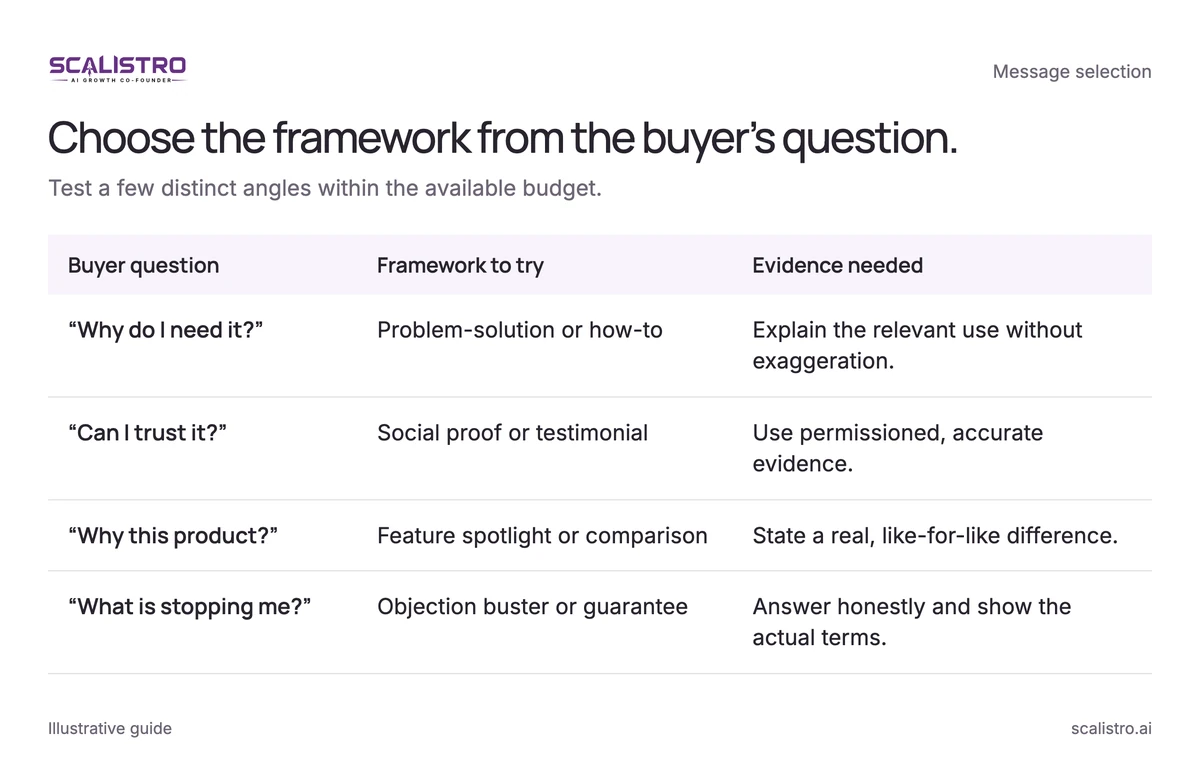
Do not launch all 15 at once. Choose a few angles based on buyer awareness and test them against a meaningful outcome:
Swipe to explore. Tap to open full size.
Image details: Choose the framework from the buyer’s question.
| Buyer question | Framework to try | Evidence needed |
|---|---|---|
| “Why do I need it?” | Problem-solution or how-to | Explain the relevant use without exaggeration. |
| “Can I trust it?” | Social proof or testimonial | Use permissioned, accurate evidence. |
| “Why this product?” | Feature spotlight or comparison | State a real, like-for-like difference. |
| “What is stopping me?” | Objection buster or guarantee | Answer honestly and show the actual terms. |
Step 1: Match Framework to Funnel Stage
- Cold audiences (never heard of you): Start with Frameworks 1 (PAS), 4 (Founder Story), 10 (How-To), and 13 (Question). These educate and build trust.
- Warm audiences (visited site, engaged with content): Use Frameworks 3 (Social Proof), 5 (Listicle), 8 (Comparison), and 15 (Feature Spotlight). These differentiate and convince.
- High-intent audiences (added to cart or viewed a product): Test Frameworks 6 (Testimonial), 7 (Objection), 9 (Real Urgency), and 12 (Guarantee). Past purchasers may need a cross-sell or replenishment message instead.
Step 2: Test One Variable at a Time
Keep the audience, creative, offer, and destination consistent while changing the copy angle. Predefine the success measure, usually purchase cost or contribution per visitor. Five to seven days and $50 per variant may be enough to screen for obvious problems, but are rarely enough to declare a conversion winner. Extend the test when purchase volume is low.
Step 3: Build Your Brand's Copy Playbook
Record each test's angle, audience, creative, offer, spend, purchases, and margin. After several cycles, keep the three or four angles that work repeatedly. Refresh the proof or use case when performance changes instead of rotating copy on a fixed schedule.
How Scalistro Helps You Write Better Ad Copy Faster
Production volume should match test budget. Scalistro can help draft more brand-consistent options and inspect connected ad results; the team still needs to approve claims and publish ads in the ad platform.
The AI layer:
- Insights: Listro helps inspect connected performance data to identify angles worth reviewing.
- Drafts: Listro can draft copy variations from approved brand and product details for a person to edit.
- Organic social: Listro can help plan organic messages around the same product themes.
The human layer:
Where expert support is included in the plan, a specialist can help choose test angles and review results. The brand remains responsible for product evidence, ad approval, and platform changes. Use the copy system to learn which messages produce profitable customers, not simply more clicks.
Pair your copy with the Instagram carousel ad guide when the offer needs a visual sequence.