Meta Ad Creative Testing Calendar: A 30-Day D2C Plan
Build a 30-day Meta creative testing calendar by planning concepts, producing variants, running controlled tests, reviewing results, and planning again.
On this page
Testing 3 to 5 creatives a month gives a D2C team few chances to learn. High-performing teams test 20 to 50, but that pace needs a brief, production schedule, review gate, and a budget that can support the tests.
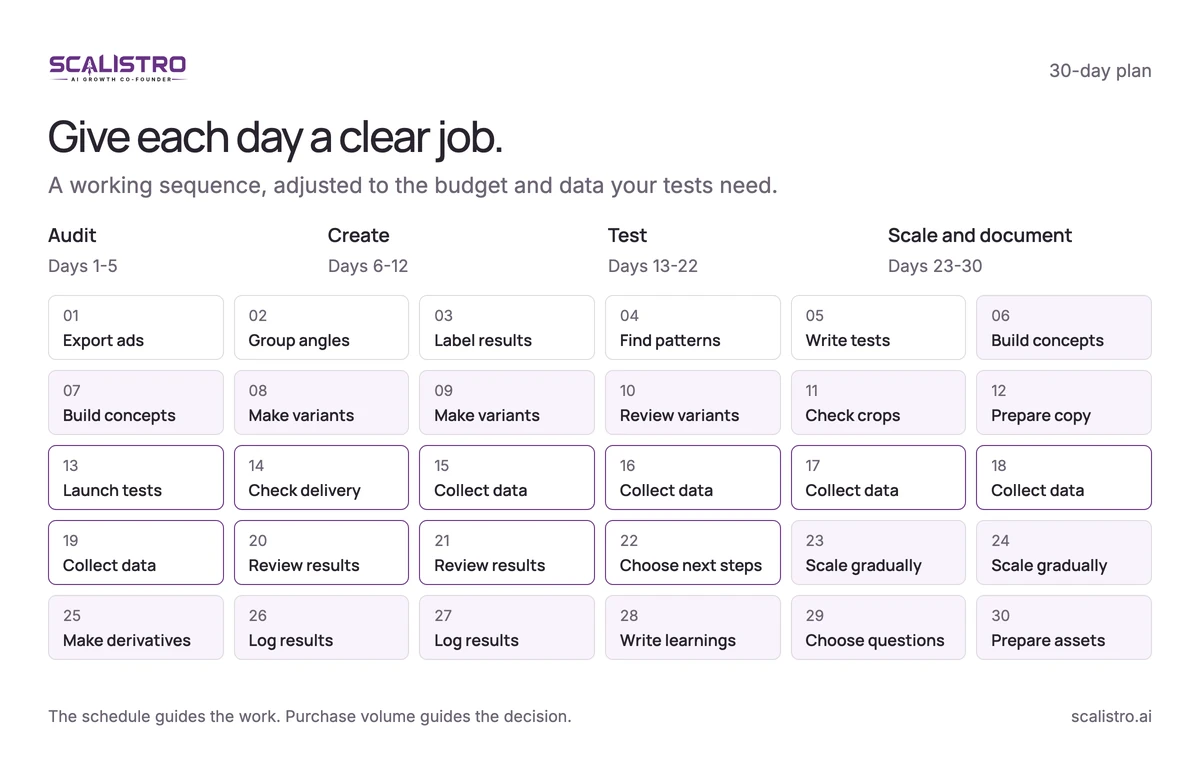
This 30-day Meta calendar turns those steps into a cycle: audit, generate, test, scale, and document. Adapt the number of variants to your spend rather than launching assets that cannot gather enough data.
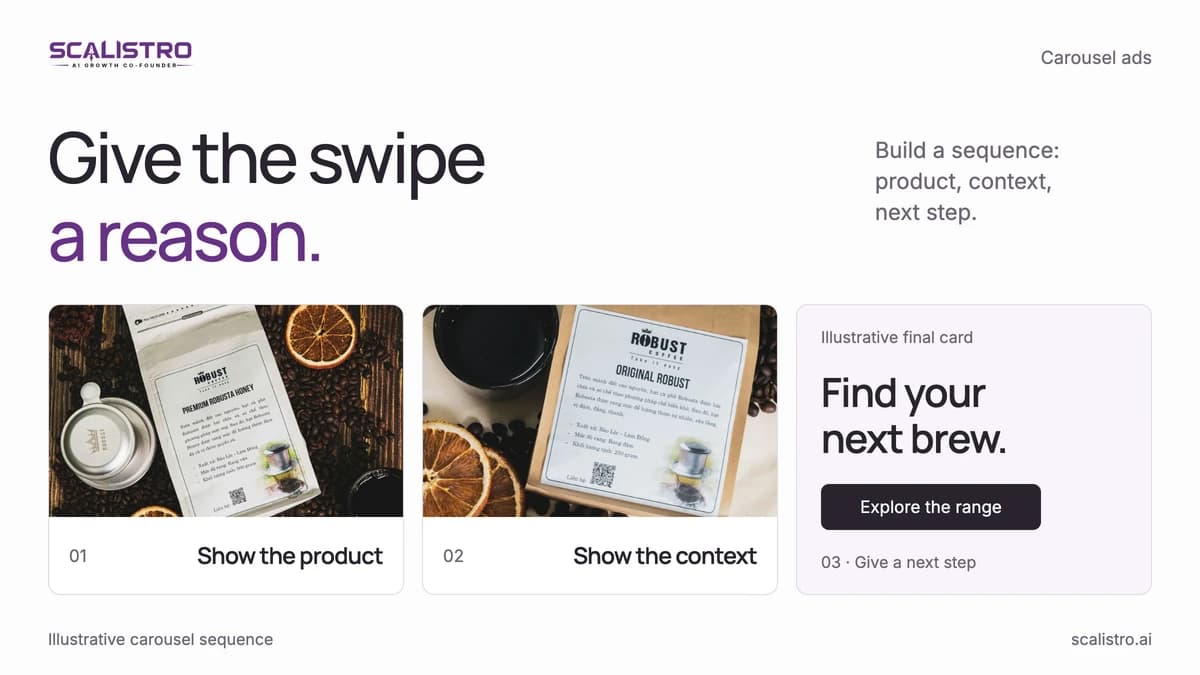
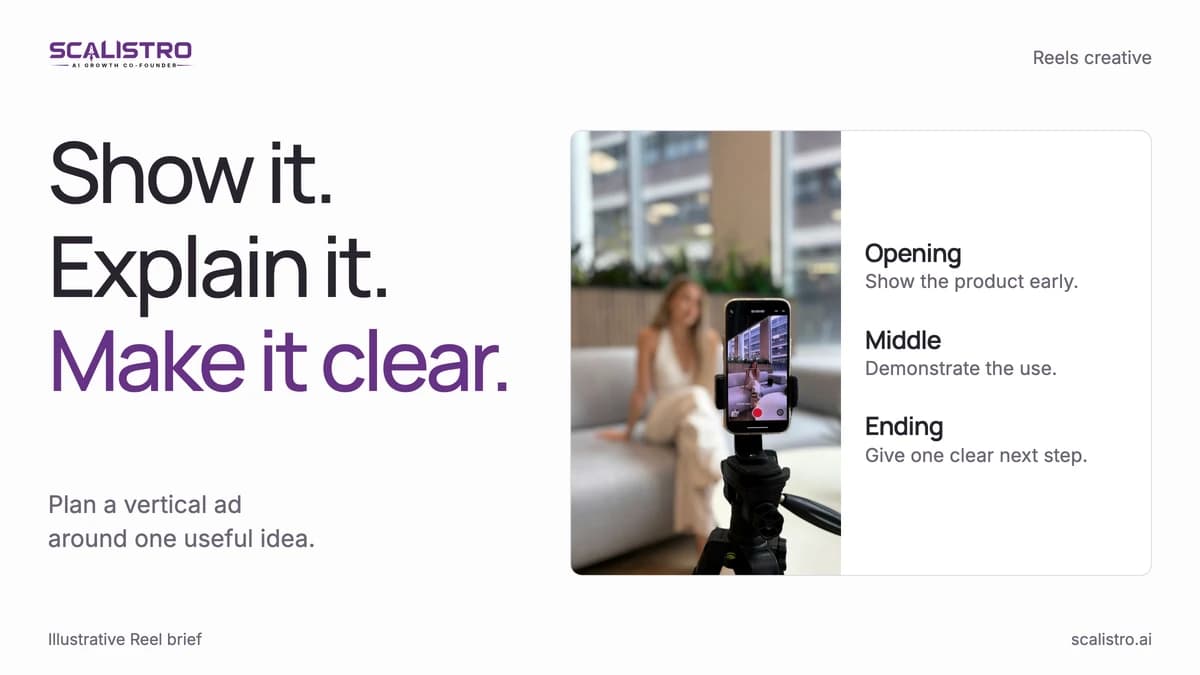
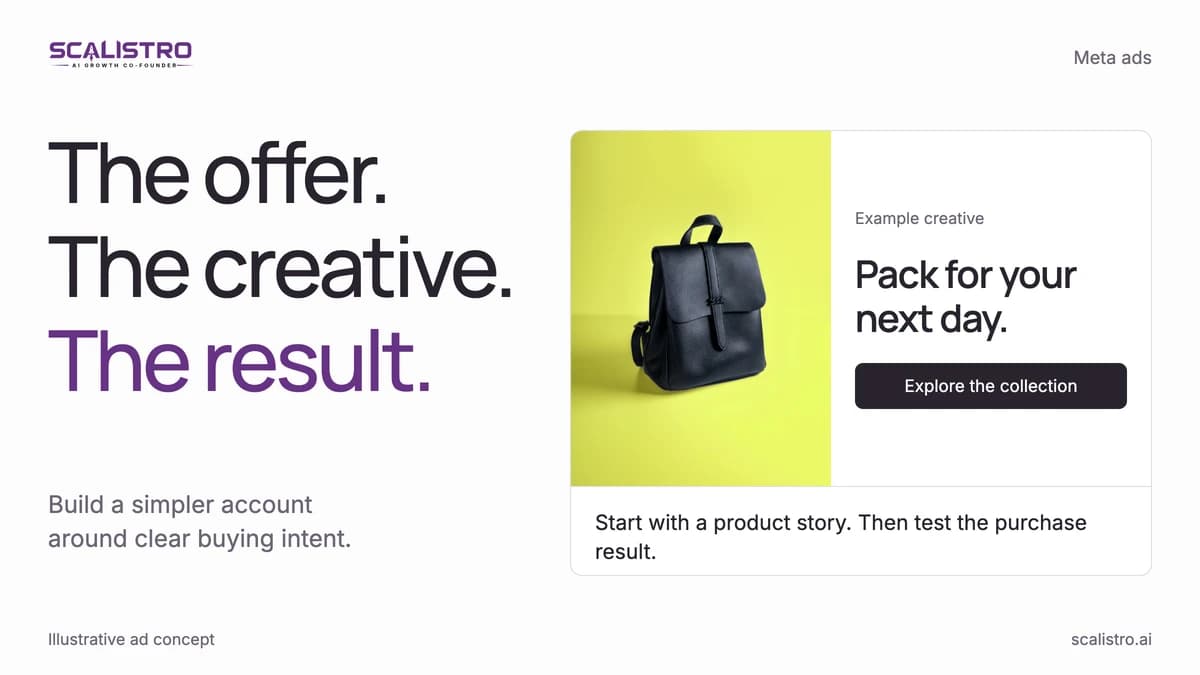
Swipe to explore. Tap to open full size.
The Math Behind Creative Testing
More tests can find more winners when each one is distinct and receives enough delivery to evaluate.
At a 20 percent win rate, three monthly tests produce an average of 0.6 winners, while 20 tests produce four. Over a quarter, that is roughly 12 winners instead of one or two if the win rate and test quality hold.
The example assumes $3,000 to $10,000 monthly Meta spend, with 20 percent reserved for tests and 80 percent for validated creative.
Budget Allocation Example
For a $5,000 monthly Meta ad budget:
- Testing budget: $1,000 (20 percent) - this funds your creative experiments
- Scaling budget: $4,000 (80 percent) - this runs your proven winning creatives
- Per-creative test budget: $50 to $100 - each creative variation gets this much spend before you decide to kill or scale it
- Number of testable creatives: 10 to 20 per month at $50 to $100 each
At $5,000 monthly spend, a $1,000 test budget supports 10 to 20 tests at $50 to $100 each. Use fewer tests if your conversion cost requires more spend to reach a decision.
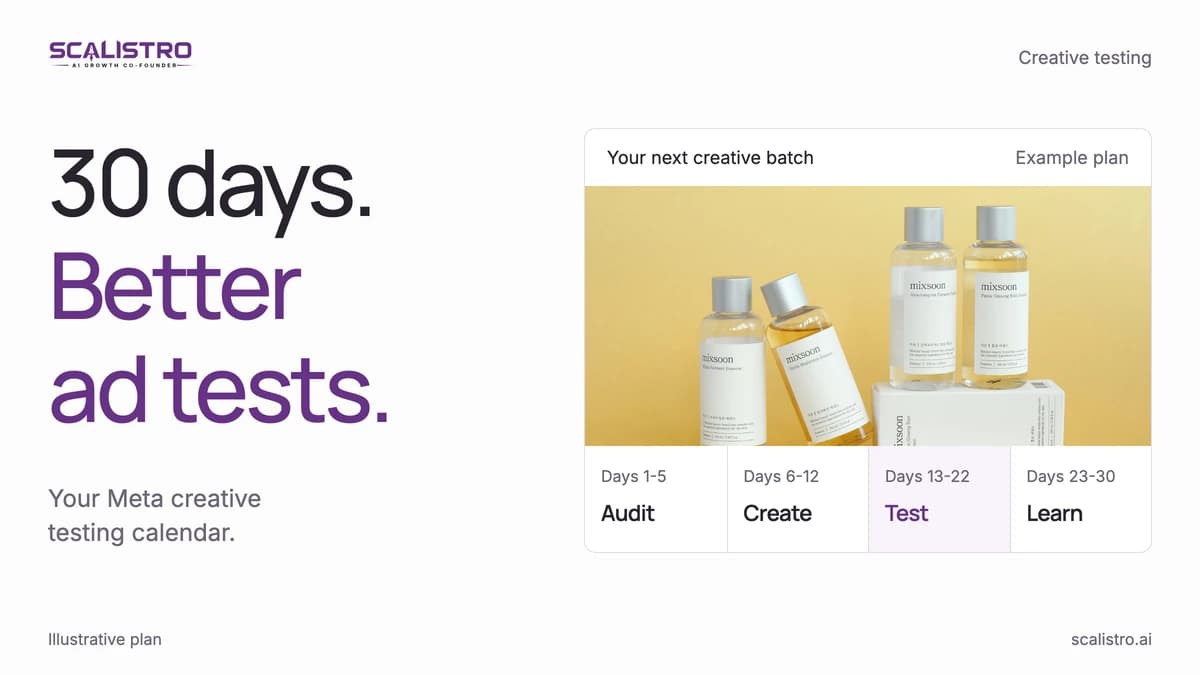
Days 1 to 5: The Audit Phase
Use the first five days to turn existing ad results into specific questions for the next creative batch.
Day 1: Pull Your Performance Data
Export 30 days of Meta ad results. For ads with more than 1,000 impressions, log format, message angle, hook, CTA, click-through, cost per result, and ROAS. Treat 1,000 impressions as an initial screening point, not proof that purchase performance is statistically reliable.
Day 2: Categorize Your Creative Angles
Group ads by message rather than only by static, video, or carousel. Compare benefit, problem-solution, proof, founder story, urgency, tutorial, and lifestyle angles on both engagement and purchase cost.
Day 3: Identify Your Winners and Losers
Label ads that held target CPA or better for at least 3 days as winners. Label ads that spent the planned test budget without meeting the target as losers. Keep a middle group for ideas that need more data.
Day 4: Analyze Patterns
Compare winning ads for repeated formats, openings, product contexts, and claims. A product-in-hand image or creator-style opening might be worth testing again, but avoid assuming correlation alone explains the win.
Day 5: Set This Month's Testing Hypotheses
Write 3 to 5 hypotheses in one sentence each: what will change, what it will beat, and why the existing data supports the test. For example, compare a creator-style product demo with current studio imagery because the strongest recent ads used handheld footage.
Days 6 to 12: The Generation Phase
Produce from the hypotheses, then reject duplicates before spending. The goal is a set of distinct concepts, not a large file count.
Days 6-7: Concept Development
Develop 6 to 8 concepts that change the message or product story. A background color change is a variation, not a new concept.
Six concept frameworks that consistently work for D2C:
- Problem-Solution: Open with the pain point your customer feels, then introduce your product as the resolution
- Social Proof: Lead with a testimonial, review count, or sales milestone that builds instant credibility
- UGC-Style: Authentic, low-production content that feels like a friend recommending a product
- Founder Story: The "why I created this" narrative that builds emotional connection and brand trust
- Product Demo: Show the product in action - unboxing, application, results. Let the product sell itself.
- Urgency/Scarcity: Limited-time offers, low stock alerts, or seasonal relevance that creates immediate action
Days 8-10: Creative Production
Make 3 to 4 variations per concept by changing one main element, such as the opening frame, headline, or hero image. That yields 18 to 32 assets to review. Listro can help a small team prepare the visual and copy options, but only approved assets should enter testing.
Days 11-12: Format and Platform Prep
Export feed, portrait, and vertical versions at 1:1, 4:5, and 9:16. Review every crop, then pair each concept with three useful copy lengths and clear headlines. Name assets consistently in Ads Manager so the result maps back to the brief.
Days 13 to 22: The Testing Phase
Launch only as many concepts as the budget can evaluate. Keep a record of which audience, offer, and placement each asset received.
Days 13-14: Launch Testing Campaigns
Set up your testing campaign with this structure:
- Campaign level: One campaign optimized for your primary conversion event (purchases for most D2C brands)
- Ad set level: Use broad targeting (country-level, age 18-65, no interest targeting). Let Meta's algorithm find your audience based on the creative.
- Ad level: 3 to 5 creative variations per ad set. Each variation tests one element change.
- Budget: $20 to $30 per day per ad set for your testing campaign. This gives each creative $4 to $10 per day.
When fair spend across concepts is the goal, use ad set budgets so an early leader does not absorb all test spend. Check actual delivery anyway; equal ad set budgets do not guarantee equal spend across ads inside each set.
Days 15-19: Monitor and Collect Data
Plan at least 5 days and check for broken links or delivery issues daily. Avoid changing a healthy test too early. A fixed 48 to 72 hours or 1,000 impressions does not establish statistical confidence; base the decision on spend, conversion volume, and the size of the difference.
Track these metrics for each creative variation:
- Impressions (1,000+ for a first engagement read, with conversions needed for a purchase decision)
- Click-through rate (your engagement signal)
- Cost per result (your efficiency signal)
- ROAS (your profitability signal)
- Frequency (ensure it stays below 2.0 during testing)
Days 20-22: Analyze and Decide
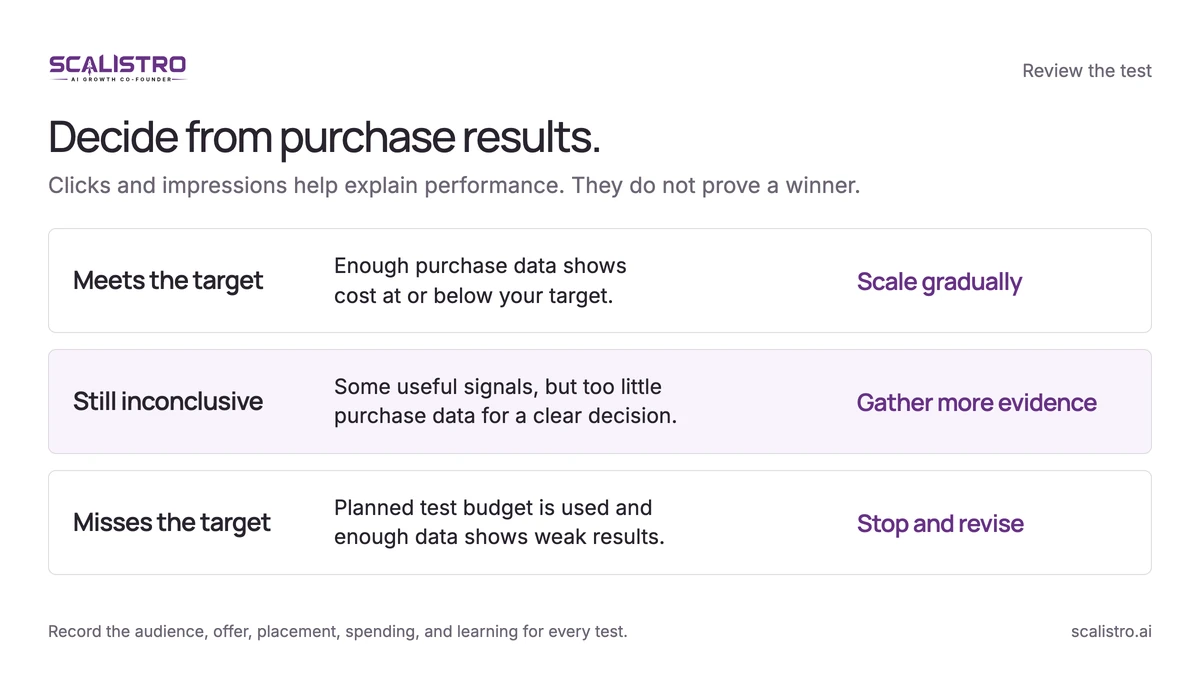
After 5 to 7 days, use the planned budget and target CPA to decide what deserves more spend:
- Winner: Cost per result at or below your target CPA with consistent delivery over 3+ days. Move to scaling.
- Promising: Shows engagement (good CTR, decent thumb-stop rate) but cost per result is 10 to 30 percent above target. Give it 3 more days with a small budget increase.
- Loser: Cost per result more than 30 percent above target after at least $50 of spend and enough conversion data for the account's normal CPA. Stop it and use the budget for the next concept.
Swipe to explore. Tap to open full size.
Days 23 to 30: The Scale and Document Phase
Days 23-25: Scale Winners
Move winning creatives to your main scaling campaign. Increase budget gradually - 20 to 30 percent every 2 to 3 days. Sudden budget spikes disrupt Meta's delivery optimization and can tank performance.
For each winner, also create 2 to 3 derivative variations - same concept and angle but with a different headline, slightly different visual treatment, or new primary text. These derivatives extend the winner's lifecycle before creative fatigue sets in.
Days 26-28: Document Learnings
Record every test so next month's brief can use evidence rather than memory:
- The concept and angle
- The format (static, video, carousel)
- The result (winner, promising, loser)
- Your hypothesis for why it won or lost
- The specific metrics
After 3 months, the log becomes a brand-specific guide to angles, formats, and hooks. Recheck old conclusions as products, audiences, and platform delivery change.
Days 29-30: Prep for Next Month
Choose the next 3 to 5 questions from this month's results and prepare the source assets. Retire concepts that repeatedly miss the target rather than generating another cosmetic variation.
How Scalistro Accelerates the Testing Calendar
Producing 20 or more variants in a week can overwhelm a small team. Listro can help review connected performance, prepare variants, and align organic content. The brand team still chooses the test, approves creative, and launches ads in the ad platform. Expert help with direction and performance is available on eligible plans.
If a winning test later weakens, use the week-by-week creative fatigue guide to decide what to refresh.