Social Media Automation for D2C Brands: Complete Guide
Automate planning, drafting, scheduling, and reporting while keeping human review for brand voice, sensitive replies, approvals, and customer relationships.
On this page
- Introduction
- What Social Media Automation Actually Means in 2026
- The 80/20 Rule: What to Automate and What to Keep Human
- Building Your Content Pillar System
- Scheduling Strategy: When and How Often to Post
- Content Repurposing: Get More Output from Every Piece of Content
- Measuring What Matters: Beyond Vanity Metrics
- Avoiding the Automation Trap
- Frequently Asked Questions
Social media automation helps a D2C team plan, draft, format, schedule, and measure content without repeating the same manual steps every day. Keep strategy, customer replies, and final approval with people. That division gives the team more time for work customers can feel.
This guide shows what to automate, how to build a content pillar system, how to choose a posting schedule, and which results to review each week.
What Social Media Automation Actually Means in 2026
Scheduling is only one part of a useful workflow. Automation can also support:
- Content scheduling: Planning and queuing posts across platforms in advance
- Content generation: Using AI to create first-draft copy, images, and video concepts
- Cross-platform publishing: Publishing to Instagram, Facebook, TikTok, X, Pinterest, and LinkedIn from a single interface
- Analytics aggregation: Pulling performance data from all platforms into a unified dashboard
- Community management: Routing comments, DMs, and mentions to the right team member with suggested responses
- Content repurposing: Automatically adapting content from one format (a blog post) into multiple platform-specific formats (Instagram carousel, Twitter thread, LinkedIn article)
- Trend monitoring: Tracking relevant hashtags, competitor activity, and industry conversations
A team of one or two can use these workflows to produce 30 to 50 assets a month, work that could otherwise take four to five dedicated specialists. Choose the capabilities your current channels need; a brand with two active platforms does not need seven disconnected automations.
The 80/20 Rule: What to Automate and What to Keep Human
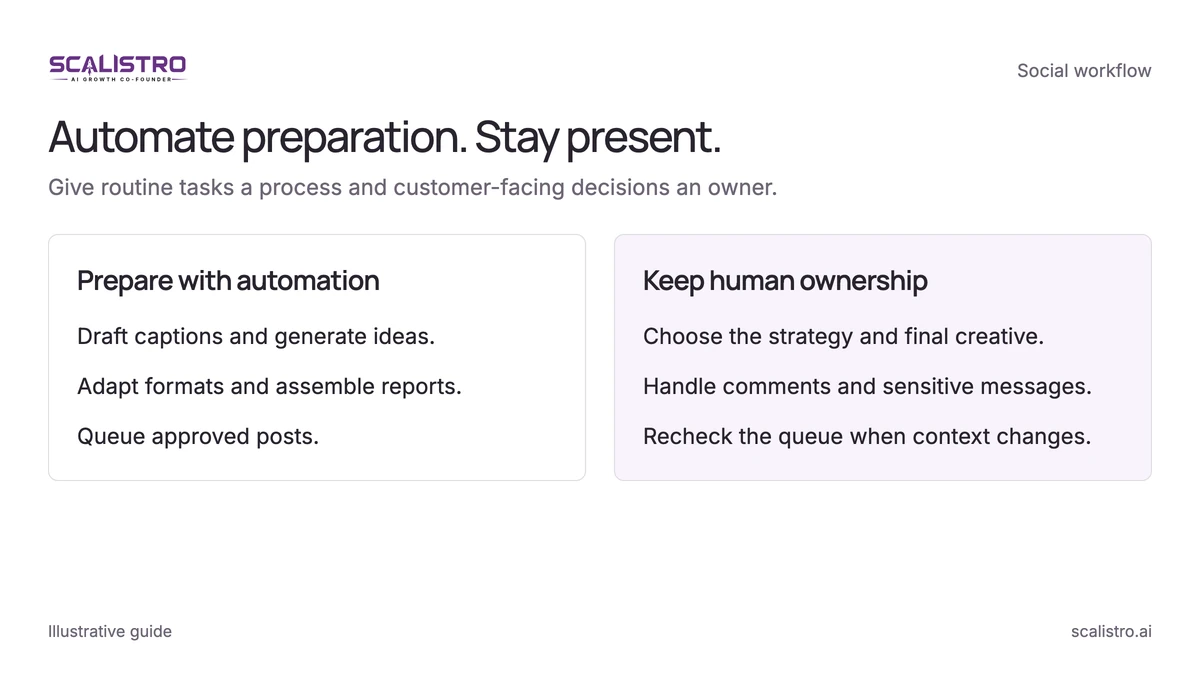
Automate repeatable preparation and reporting. Put an approval or handoff in front of tasks that carry brand, customer, or spending consequences.
Swipe to explore. Tap to open full size.
Image details: Automate preparation. Stay present.
Automate preparation. Stay present. Give routine tasks a process and customer-facing decisions an owner. Prepare with automation - Draft captions and generate ideas. - Adapt formats and assemble reports. - Queue approved posts.; Keep human ownership - Choose the strategy and final creative. - Handle comments and sensitive messages. - Recheck the queue when context changes.
Automate These Tasks
These tasks benefit from a template, schedule, or first draft that a person can check quickly. Listro can help with ideas, first-draft captions, and scheduling, with a person approving each post.
- Post scheduling: Batch-create and schedule all planned content for the week or month ahead. This eliminates the daily scramble of figuring out what to post.
- Cross-platform formatting: When you create a piece of content, automatically adapt it for each platform - square crop for Instagram, vertical for TikTok and Stories, landscape for Facebook and LinkedIn.
- Analytics reporting: Pull together performance data automatically. Manual data compilation is a waste of time that automation eliminates entirely.
- Content ideation: Use AI to generate content ideas based on your content pillars, trending topics, and past performance. You still choose which ideas to pursue, but AI eliminates the blank-page problem.
- Hashtag research: AI tools can analyze which hashtags drive the most reach and engagement for your specific niche, and suggest optimized hashtag sets for each post.
- First-draft copy: Let AI write the first draft of your captions, then edit for voice and accuracy. It is usually faster than writing from scratch.
Keep These Tasks Human
These decisions depend on tone, context, and a relationship with the customer. A suggested reply can help, but someone should own the response.
- Community engagement: Reply to comments personally. Answer DMs with genuine helpfulness. Thank customers who post about your product. These interactions build the relationships that turn customers into advocates.
- Real-time content: Trending moments, cultural conversations, and current events require human judgment. A poorly timed or tone-deaf automated post during a crisis can damage your brand irreparably.
- Strategic decisions: What content pillars to focus on, which platforms to prioritize, how to position your brand - these decisions require market understanding and creative judgment that AI cannot replicate.
- Customer support: When customers reach out with problems via social media, they expect a human response. Automated responses to genuine customer issues feel dismissive and can escalate frustration.
- Brand partnerships and collaborations: Influencer outreach, co-marketing conversations, and brand collaborations require personal relationships and nuanced communication.
Building Your Content Pillar System
Pillars give the team a repeatable set of subjects. They make prompts and calendars more specific because each post has a clear role in the customer journey.
How to Define Your Content Pillars
Most D2C brands can start with four or five recurring themes. For a skincare brand, this mix covers discovery, consideration, trust, and connection:
- Education (30 percent of content): Skincare tips, ingredient deep-dives, routine guides. This content attracts new followers and establishes expertise.
- Product (25 percent of content): Product features, new launches, how-to-use tutorials. This content drives consideration and purchase intent.
- Social proof (20 percent of content): Customer reviews, before-and-afters, unboxing videos, UGC reposts. This content builds trust and reduces purchase anxiety.
- Behind the scenes (15 percent of content): Team introductions, manufacturing process, founder stories, company values. This content builds emotional connection and brand loyalty.
- Entertainment and culture (10 percent of content): Memes, trending audio, relatable content, seasonal themes. This content drives reach and engagement.
Why Pillars Make Automation Work
Pillars turn an empty calendar into specific prompts: which customer question will education answer, which objection will a review address, and which product moment should be demonstrated? Give AI the pillar, product facts, and voice guide to draft 5 to 10 concepts per theme. Select and edit the useful ones. That can reduce a full day of planning and writing to 2 to 3 hours.
Scheduling Strategy: When and How Often to Post
Start with a sustainable cadence, then use your own audience activity and post results to adjust it. A platform-wide "best time" is only a hypothesis until your account confirms it.
Finding Your Optimal Posting Times
Check each platform's audience activity view, then compare actual post performance across the same format and topic:
- Instagram: Check Insights → Audience → Most Active Times. Post 1 to 2 hours before peak activity to allow the algorithm time to start distributing your content.
- TikTok: Check Analytics → Followers → Follower Activity. TikTok's algorithm is less time-dependent than Instagram, but posting during active hours still gives an initial engagement boost.
- Facebook: Check Insights → Posts → When Your Fans Are Online.
- LinkedIn: Generally, business hours on weekdays, especially Tuesday through Thursday between 8 AM and 11 AM. Test your specific audience.
Posting Frequency by Platform
Use these posting frequencies as planning ranges. Reduce them if the team cannot maintain quality or answer the conversations they create:
- Instagram Feed: 3 to 5 posts per week minimum. Daily posting is optimal if content quality is maintained.
- Instagram Stories: 3 to 7 per day. Stories are ephemeral and reward high frequency.
- Instagram Reels: 3 to 5 per week. Reels get significantly more algorithmic reach than feed posts.
- TikTok: 1 to 3 per day. TikTok rewards volume more than any other platform.
- Facebook: 3 to 5 per week. Over-posting on Facebook can actually reduce reach per post.
- LinkedIn: 2 to 3 per week for company pages.
One source asset, such as a product shoot or article, can become 10 to 15 channel-specific posts. Use the range to plan production time, then stop when the adapted versions become repetitive.
Content Repurposing: Get More Output from Every Piece of Content
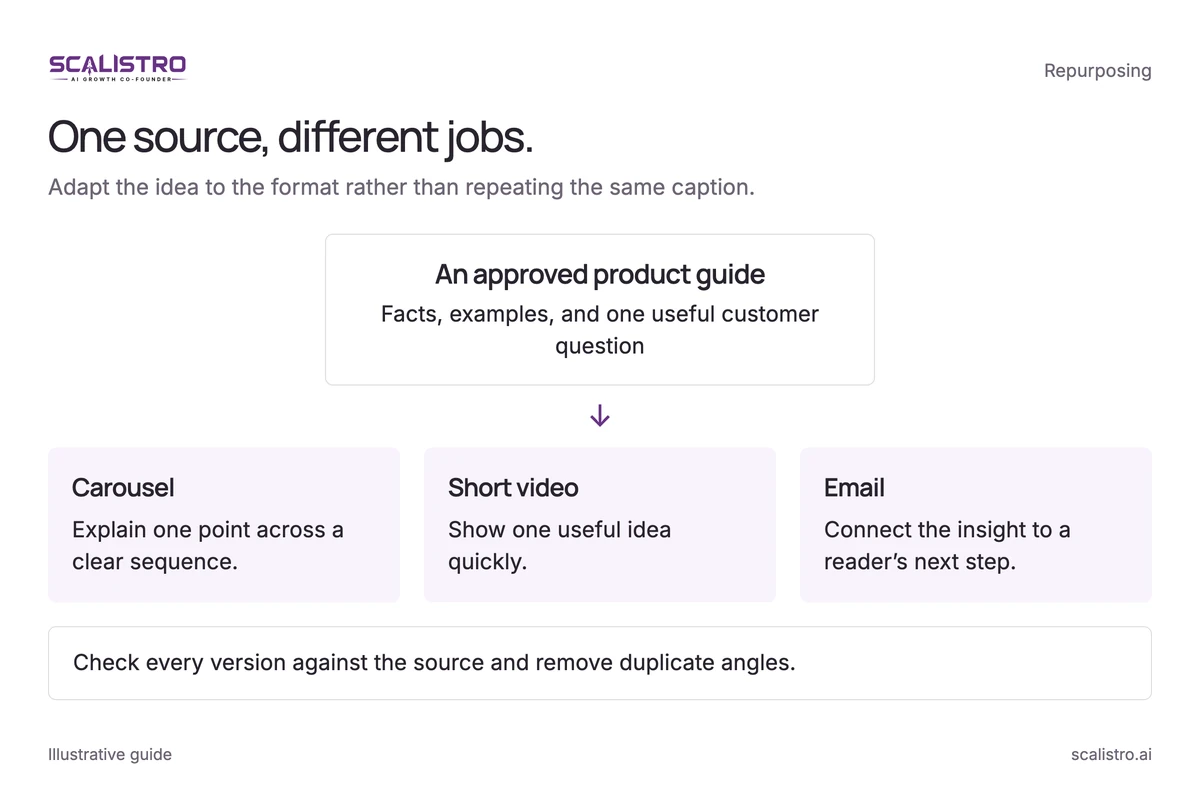
Repurposing starts with a strong source, then changes the form to suit the channel. A carousel should explain one idea slide by slide; a Reel should show or say it quickly. Copying the same caption into both is not an adaptation.
Swipe to explore. Tap to open full size.
Image details: One source, different jobs.
One source, different jobs. Adapt the idea to the format rather than repeating the same caption. Carousel - Explain one point across a clear sequence.; Short video - Show one useful idea quickly.; Email - Connect the insight to a reader’s next step. Check every version against the source and remove duplicate angles.
The Repurposing Framework
Choose an article, tutorial, customer story, or product guide and break it into distinct ideas:
- 1 blog post becomes 3 to 5 Instagram carousel posts (one per key point)
- 1 blog post becomes 5 to 10 short-form video scripts (one stat, tip, or insight per video)
- 1 blog post becomes 1 Twitter/X thread (key takeaways as individual tweets)
- 1 blog post becomes 2 to 3 email newsletter segments
- 1 blog post becomes 5 to 10 Story slides
- 1 customer testimonial becomes a feed post, a Story highlight, a Reel overlay, and an ad creative
AI can draft those versions from the source. Compare every output with the original facts, remove duplicated angles, and adjust the opening for how people consume that platform.
Measuring What Matters: Beyond Vanity Metrics
Track reach and engagement, but connect them to site visits, leads, and sales where possible. Automated reports should make the next content decision easier, not just add dashboard numbers.
Engagement That Matters
Separate quick reactions from deeper actions. Saves and shares show content worth revisiting or passing on; comments and DMs often reveal questions or objections. Read the substance of those interactions, not only the count.
Attribution to Revenue
Tag shared links with UTMs and check conversion events in your analytics setup. Compare platforms and pillars by qualified visits and orders, while remembering that some buyers return later through search or direct traffic.
Automated Reporting
Send a weekly report with reach, engagement quality, link clicks, attributed conversions, and results by pillar. Use the review to keep, change, or stop a format for the following week.
Avoiding the Automation Trap
Reserve 15 to 30 minutes a day for comments, customer posts, and relevant conversations. Check scheduled content when a product issue or public event changes the context. A reliable queue is valuable only if someone is still present to listen and respond.
Start with a D2C content calendar so automated publishing follows a clear plan.