
AI Ad Campaign Checks: Catch Mistakes Before They Cost You
Use AI to spot unusual ad spending, missing settings, and tired creative. Keep a person in charge of budgets and campaign changes.
On this page
A zero added to a daily budget or the wrong purchase event can distort a campaign before anyone sees the report. The useful role for AI is to compare settings and performance against a known baseline, then bring unusual items to a person who can verify them in the ad platform.
This guide covers ten common errors, the checks that can catch them, and the responsibilities that must remain with the media buyer. AI analysis is a second set of eyes, while spend limits, scheduling, and campaign changes still live in the advertising account.
The Anatomy of Human Error in Ad Management
Ad work mixes repetitive configuration with judgment. An error can come from a rushed launch, a stale checklist, or a signal that changed after hours. Build a review process around those conditions instead of treating each mistake as an individual failure.
Attention Fatigue
A media buyer covering 15 to 20 campaigns may inspect hundreds of settings and metrics in a day. Long stretches of detailed decisions wear down attention, and repeated manual checks are more reliable when a checklist and an exception report make the unusual settings easy to see.
The Checklist Problem
A launch checklist should cover the objective, conversion event, budget, schedule, audience, placements, exclusions, bid controls, creative, destination URL, and tracking. Even a low error rate per field compounds when a team launches several campaigns each week. Require another person to review high-impact fields before publishing.
Context Switching
Campaign reviews compete with calls, messages, and reporting. Interruptions make it easy to lose your place, and the practical safeguard is simple: record the last verified state, assign an owner for each launch, and restart the checklist after a handoff.
The 10 Most Costly Human Errors in Ad Campaigns
For each error, pair an automated comparison or alert with a person who owns the final decision.
Swipe to explore. Tap to open full size.
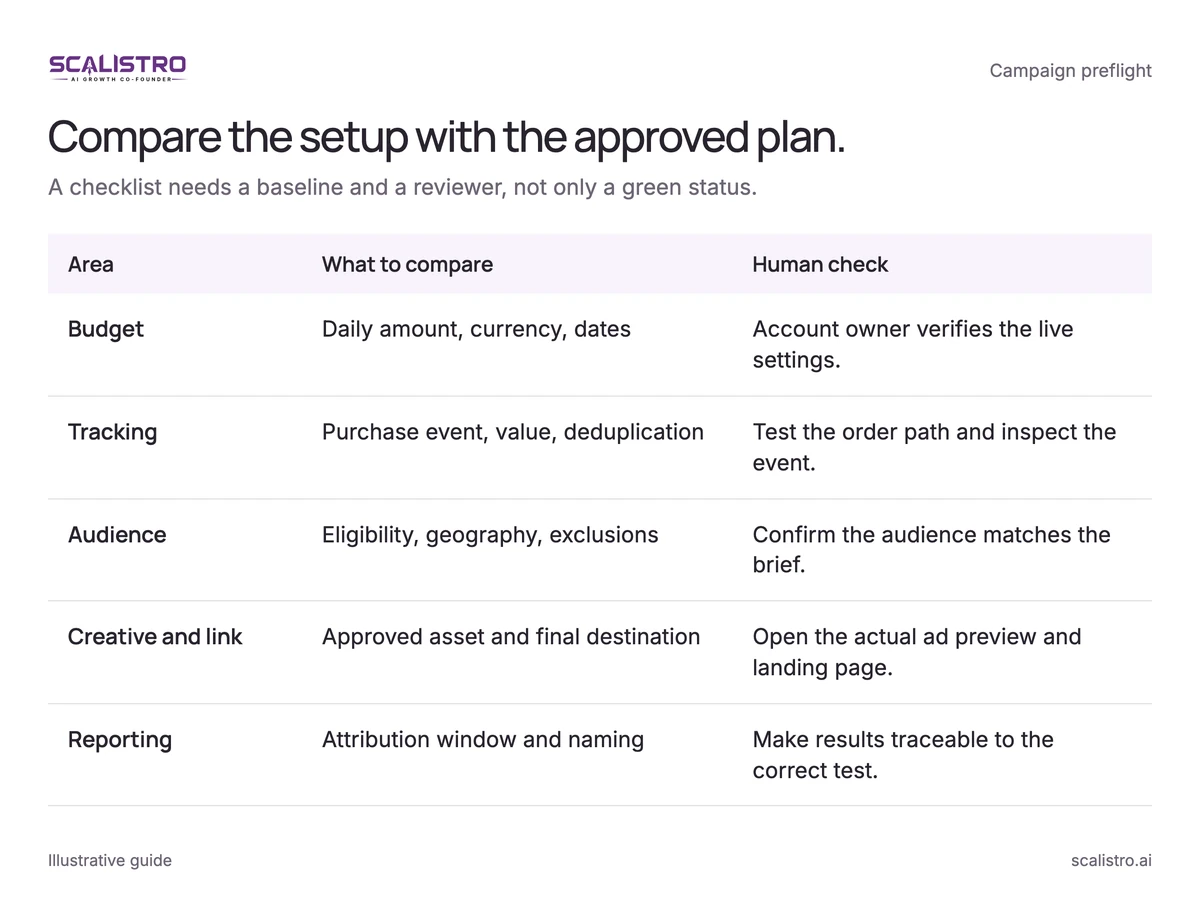
Image details: Compare the setup with the approved plan.
| Area | What to compare | Human check |
|---|---|---|
| Budget | Daily amount, currency, dates | Account owner verifies the live settings. |
| Tracking | Purchase event, value, deduplication | Test the order path and inspect the event. |
| Audience | Eligibility, geography, exclusions | Confirm the audience matches the brief. |
| Creative and link | Approved asset and final destination | Open the actual ad preview and landing page. |
| Reporting | Attribution window and naming | Make results traceable to the correct test. |
1. Wrong Budget Settings
The human error: Setting a daily budget of $5,000 instead of $500, or a lifetime budget when you meant daily. A single decimal point or digit error can drain thousands of dollars in hours.
How AI helps catch it: A review tool can compare a proposed budget with past spend and flag an unusual jump before a person applies it. Listro can help analyze connected performance data, but the hard spend limits and final budget settings belong in the ad platform. Check them there before launch.
2. Forgotten Audience Exclusions
The error: A prospecting campaign includes recent purchasers even though the team intended to reach new customers. Paying for them may be justified in a deliberate cross-sell campaign, but not when the acquisition report counts them as new buyers.
How to reduce the risk: Review audience exclusions before launch and keep customer lists current in the ad platform. Compare prospecting audiences for overlap during routine account reviews. AI can help prepare a checklist, but a person must verify the actual targeting settings.
3. Not Pausing Fatigued Creatives
The human error: A creative that was performing well two weeks ago is still running even though its click-through rate has dropped 60 percent. The media buyer is busy with other priorities and has not reviewed creative performance in days. Meanwhile, the fatigued creative is burning budget with declining returns.
How to reduce the risk: Review click-through rate, cost per click, conversion rate, and frequency against your campaign's recent baseline. A 15 to 20 percent CTR decline over 48 hours alongside increasing frequency may be a prompt to investigate. Decide in the ad platform whether to pause, replace, or keep the creative.
4. Timezone and Schedule Errors
The human error: Setting a campaign to run from 8 AM to 10 PM in Pacific time when your target audience is in Eastern time. Or scheduling a flash sale campaign to start on Thursday instead of Friday. Or forgetting to account for daylight saving time changes.
How to reduce the risk: Check the ad account's timezone against the audience and promotion calendar before launch. For campaigns spanning several timezones, review the schedule for each market and confirm any daylight saving changes.
5. Duplicate Audiences Causing Self-Competition
The error: Several ad sets target audiences that overlap by 40-60%. That can fragment learning and make performance harder to interpret. Overlap alone does not prove auction self-competition, so inspect delivery and results before consolidating.
How to reduce the risk: Compare active audiences using available platform tools. If overlap is material and results are unstable, consider consolidation or exclusions. Document when the overlap is intentional.
6. Bid Cap and Cost Control Mistakes
The human error: Setting a bid cap of $50 instead of $5. Or setting a cost cap that is too restrictive, causing the campaign to barely spend and miss its launch window. Or choosing the wrong bid strategy entirely - using lowest cost when target CPA would be more appropriate for the campaign objective.
How to reduce the risk: Compare a proposed bid cap with the campaign's recent costs and confirm the strategy matches its goal. If a bid cap is more than 3 standard deviations from your historical average, check it again before launch. Use the ad platform's own controls for spend pacing and any automated bid rules.
7. Not Monitoring Overnight or Weekend Performance
The human error: A campaign starts underperforming at 11 PM Friday. The media buyer does not check until Monday morning. By then, a full weekend of spend can go out at a cost per purchase far above target. Or worse - a campaign starts spending abnormally fast due to a platform glitch, and no one notices until the budget is exhausted.
How to reduce the risk: Set spend limits and alerts in the ad platform, then assign someone to review exceptions outside normal hours. For example, a CPA above 2 times target for more than 2 hours or spend at 150 percent of planned pace can trigger a manual check. Decide the threshold from your own data and confirm any automated rule before enabling it.
8. Wrong Conversion Event Selected
The human error: Optimizing a campaign for "Add to Cart" when the objective is purchases. Or selecting "Link Clicks" instead of "Landing Page Views" and optimizing for bot traffic. This error is subtle because the campaign appears to be performing well on the selected metric - it just is not driving the outcome you actually care about.
How to reduce the risk: Add the optimization event to your launch checklist and compare it with the campaign goal. For a purchase campaign, confirm the selected event and tracking setup in the ad platform, then review downstream conversion rates after launch.
9. Ignoring Creative Compliance Issues
The error: An ad uses an unsupported health claim, misleading price, or restricted creative format. Initial approval does not guarantee continued delivery. A later rejection can interrupt a launch or affect the account.
How to reduce the risk: Review copy and imagery against the ad platform's current policies before submission. AI can help draft a checklist, but it cannot guarantee compliance. Have a qualified person review sensitive health, finance, or alcohol claims.
10. Failure to Implement Proper Attribution and Tracking
The human error: Launching campaigns without proper UTM parameters, pixel events, or conversion API integration. The campaigns run, money is spent, but you cannot accurately attribute results to specific campaigns, ad sets, or creatives. Decision-making becomes guesswork.
How to reduce the risk: Use a consistent UTM naming convention and test every destination URL before launch. Verify pixel and conversion API events in the ad platform. If attributed conversions drop without a matching change in spend or traffic, investigate the tracking before changing the campaign.
Where Human Judgment Remains Essential
AI-assisted checks can reduce errors, but they do not replace thinking. Here are the areas where human oversight in ad campaign management is critical.
Strategy and Creative Direction
A model can suggest a new angle from past performance. A strategist decides whether it fits the brand, product, audience, and current business goal. The team then approves the asset and any campaign change before it goes live.
Brand Safety and Contextual Judgment
AI can flag obvious policy language or visual elements. A person must still assess product claims, cultural context, brand voice, and where the campaign may appear. Treat a machine check as a prompt for review, not clearance.
Budget Allocation Across Channels
AI can summarize channel trends, but budget allocation needs margin, inventory, retention, and growth context. A fall in customer lifetime value could justify retention work before more prospecting. The team should make that tradeoff with a single view of business performance.
Crisis Management
A recall or public incident may change which ads are appropriate within minutes. Assign a person who can pause campaigns in the ad platform, communicate with stakeholders, and approve the restart. A scheduled alert cannot make that judgment on its own.
Client and Stakeholder Communication
AI can prepare a report, but the owner must explain uncertainty, tradeoffs, and the next decision to the team. Clear communication matters as much as finding the anomalous metric.
The ROI of Error Prevention
Calculate the value of error prevention from documented incidents, rather than assigning every poor campaign to human error. Waste usually comes from a few areas:
- Audience overlap and self-competition
- Fatigued creatives running too long
- Off-hours performance problems no one sees
- Budget and bid setting errors
- Weak tracking that reduces the platform's optimization signal
Log each issue a check catches, estimate the spend it would have wasted, and add those up over a quarter. That gives you a figure for your own account instead of a general benchmark. Count recovered value only when a check catches a real issue and you can estimate the avoided spend. A budget alert, approval step, or policy review may also prevent a large one-off loss that a monthly average hides.
Implementing AI Error Prevention: A Practical Roadmap
Add checks in phases so the team can tell whether each one catches meaningful errors without generating too many false alarms.
Swipe to explore. Tap to open full size.
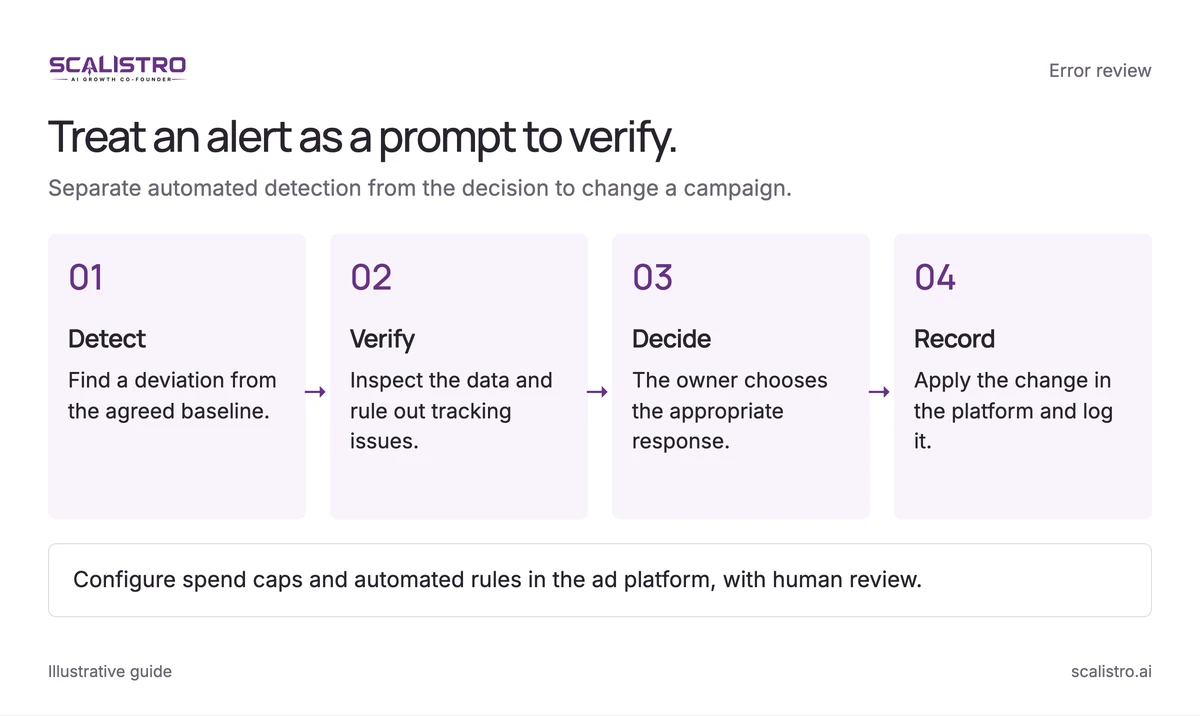
Image details: Treat an alert as a prompt to verify.
Treat an alert as a prompt to verify. Separate automated detection from the decision to change a campaign. Detect - Find a deviation from the agreed baseline.; Verify - Inspect the data and rule out tracking issues.; Decide - The owner chooses the appropriate response.; Record - Apply the change in the platform and log it. Configure spend caps and automated rules in the ad platform, with human review.
Phase 1: Monitoring and Alerting (Week 1-2)
Start by reviewing connected campaign data and setting up spend alerts in the ad platform. Check budget pacing, creative fatigue, audience overlap, and off-hours performance during regular account reviews.
Phase 2: Automated Guardrails (Week 3-4)
Implement spend caps and any appropriate automated rules in the ad platform. Review audience exclusions and creative rotation settings before they go live.
Phase 3: AI-Assisted Optimization (Month 2-3)
Use AI-assisted analysis to compare creative performance and prepare budget or bid recommendations. The human media buyer reviews the evidence and applies any change in the ad platform.
Phase 4: Full AI Plus Human Workflow (Month 3+)
At this stage, repeatable reporting and review checks should take less manual work. Listro supports connected campaign analysis; people still set strategy and execute ad-platform changes.
For a wider view of automation boundaries, read what AI can and cannot run in D2C marketing.