How to Scale Meta Ads Without Losing ROAS
Scale Meta spend gradually, protect measurement quality, monitor marginal returns, and refresh creative before a winning campaign becomes exhausted.

On this page
- Introduction
- Why Scaling Breaks Performance: The Mechanics
- Phase 1: Foundation ($1K to $5K per Month)
- Phase 2: Early Scaling ($5K to $15K per Month)
- Phase 3: Growth Scaling ($15K to $30K per Month)
- Phase 4: Mature Scaling ($30K to $50K+ per Month)
- The 7 Scaling Rules That Protect ROAS
- Common Scaling Mistakes and How to Fix Them
- Frequently Asked Questions
An ad that earns 3x to 5x ROAS at $50 to $100 a day may not hold that result at $300 a day. More spend reaches less responsive buyers faster, accelerates creative fatigue, and can make delivery volatile. Some accounts then see CPA rise sharply within a few days.
Use the four spend phases below to decide when to add budget, creative, and new audiences. Measure contribution profit as well as reported ROAS.
Why Scaling Breaks Performance: The Mechanics
Budget increases change the audience and delivery conditions. Check these three mechanisms before assuming the bid setting is the problem:
1. Audience Exhaustion
As spend rises, delivery reaches more people beyond the strongest early responders. Doubling spend reaches more new people, but those extra people usually convert less often than the first responders. Check reach and marginal CPA, not only the campaign average.
2. Creative Fatigue Acceleration
An ad that lasts 14 to 21 days at $50 a day may weaken within 5 to 7 days at $300 a day. Watch frequency and CTR together. Rising frequency often comes before a rise in CPA, but the useful threshold depends on audience size and creative, so watch frequency and CPA together for each ad set.
3. Algorithm Learning Phase Disruption
About 50 weekly optimization events per ad set is a common learning benchmark. Large budget edits can change delivery and produce several days of volatile results. A 20 percent increase is a cautious pacing rule, not a guaranteed Meta reset threshold.
Phase 1: Foundation ($1K to $5K per Month)
At $1,000 to $5,000 a month, use most of the budget to learn which offer and creative can acquire a customer profitably. Keep the account simple enough to collect results.
Campaign Structure
Start with one prospecting campaign. Add separate testing or retargeting only when each can receive a useful daily budget and the warm audience is large enough:
- Prospecting campaign: Begin broad or with a small number of justified audience tests. Once other campaigns can be funded, plan 60 to 70 percent of spend here.
- Retargeting campaign: Add 7 to 30 day site visitors and eligible social or customer audiences when the group can deliver. Plan 20 to 30 percent at a larger budget.
- Testing campaign: Add a separate $10 to $20 daily test per concept when 10 to 15 percent of total spend can support it. At the $1,000 monthly floor, test new creative inside the single main campaign instead of splitting a few dollars across three campaigns.
Creative Requirements
Build toward 5 to 8 active variations as budget rises. At the low end, test fewer concepts well; at the high end, 3 to 5 new creatives a week may be practical. Promote a variant after it holds target CPA for 3 days and has spent at least $50, with enough purchases to make the result meaningful.
Key Metrics and Targets
| Metric | Target at $1K-$5K/mo |
|---|---|
| ROAS | 3.0x to 5.0x |
| CTR (link clicks) | 1.5% to 3.0% |
| Hook Rate (3-sec video views / impressions) | 25% to 40% |
| CPA | Below your breakeven CPA |
| Frequency (Prospecting) | Below 2.0 |
| Creative test velocity | 3 to 5 new creatives per week |
Phase 2: Early Scaling ($5K to $15K per Month)
At $5,000 to $15,000 a month, expand only after 3 to 5 concepts have produced stable results and margin supports more spend.
The 20 Percent Rule
Try increases of up to 20 percent every 3 to 4 days, then check CPA and contribution margin before the next move. A $167 daily budget becomes about $200 after one step. Repeated steps can take a $5,000 monthly run rate toward $15,000 in roughly 6 to 8 weeks if performance holds.
Creative Velocity Must Increase
Plan for 8 to 12 new variants a week at this level, including new concepts and adaptations of winners. Listro can help prepare them from source assets, but review and test only those that differ meaningfully.
Audience Expansion Strategy
Compare broader delivery with your existing audiences and 1 to 3 percent lookalikes. In 15 A/B tests Meta published in 2022, Advantage+ shopping campaigns drove 12 percent lower cost per purchase than advertisers' existing campaigns (Meta, 2022). Keep the test offer and creative comparable.
Phase 3: Growth Scaling ($15K to $30K per Month)
At $500 to $1,000 a day, keep campaign purposes clear and avoid creating overlapping ad sets only to make the account look more sophisticated.
Horizontal Scaling
Add a parallel campaign only when it tests a different audience, offer, or creative angle. Too many similar campaigns can compete for the same shoppers and divide useful conversion data.
A typical structure at this level:
- Advantage+ sales campaign (formerly ASC): 30 to 40 percent of prospecting budget as a broad-delivery test.
- Manual prospecting campaigns (2 to 3): 30 to 40 percent of prospecting budget. Each campaign tests a different creative angle or audience hypothesis.
- Retargeting campaigns (2 to 3): 15 to 25 percent of total budget. Segment by funnel stage - website visitors, add-to-cart abandoners, past purchasers.
- Creative testing campaign: 10 percent of total budget. Continuous testing pipeline.
The Creative Firewall
Review every active creative at least every 14 days. Flag a 30 percent CTR drop from its first-week average or prospecting frequency above 3.0 for investigation. Confirm purchases and attribution before pausing an otherwise profitable ad.
AI-assisted tools like Listro can help review connected campaign data and surface fatigue signals. A media buyer should verify the evidence and make any budget or campaign adjustment in the ad platform.
Phase 4: Mature Scaling ($30K to $50K+ per Month)
At $1,000 to $1,700 a day, efficiency changes matter. A 10 percent lower CPA at a $50,000 monthly acquisition budget can free roughly $5,000 a month, or $60,000 a year, for the same volume of customers.
Platform Diversification
At this scale, compare Meta with search, shopping, and creator-led video so growth does not depend on one auction. This is a starting allocation:
- Meta (Instagram and Facebook): 50 to 60 percent of total ad spend
- Google (Search, Shopping, YouTube): 25 to 30 percent of total ad spend
- TikTok: 10 to 15 percent of total ad spend
- Emerging or niche channels: 5 to 10 percent (Pinterest, Snapchat, programmatic)
Advanced Creative Strategy
Organize 15 to 25 weekly variants by concept, format, and funnel stage. Aim for 3 to 4 new concepts and 4 to 6 variants of promising ideas, then limit launches to what the test budget can support.
Attribution and Incrementality
Use a broader measurement view or an incrementality test before reallocating large budgets. Last-click reporting tends to give retargeting more credit and prospecting less than an incrementality test would.
The 7 Scaling Rules That Protect ROAS
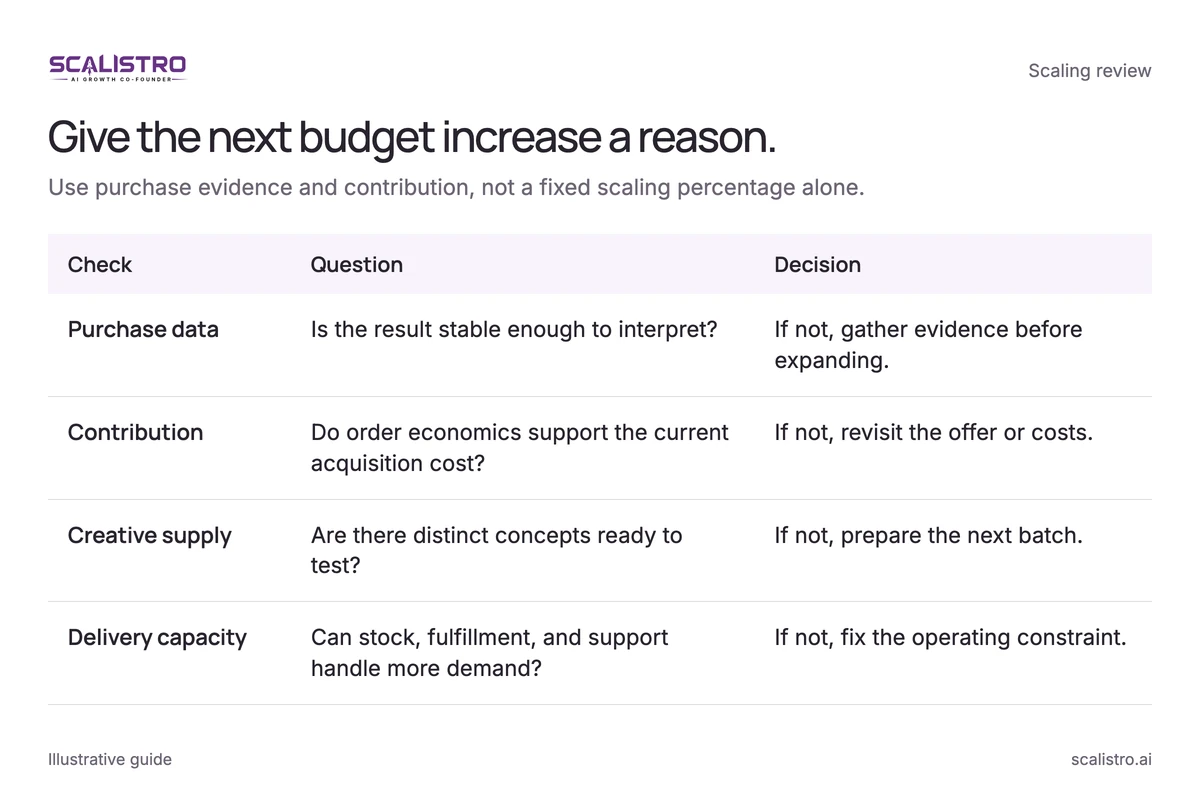
Treat these as decision rules to test against contribution margin and new-customer growth, not fixed platform laws.
Swipe to explore. Tap to open full size.
Image details: Give the next budget increase a reason.
| Check | Question | Decision |
|---|---|---|
| Purchase data | Is the result stable enough to interpret? | If not, gather evidence before expanding. |
| Contribution | Do order economics support the current acquisition cost? | If not, revisit the offer or costs. |
| Creative supply | Are there distinct concepts ready to test? | If not, prepare the next batch. |
| Delivery capacity | Can stock, fulfillment, and support handle more demand? | If not, fix the operating constraint. |
- Never increase budget more than 20 percent at a time. Wait 3 to 4 days between increases.
- Scale creative before you scale budget. If you cannot increase creative production, do not increase budget.
- Monitor frequency religiously. Above 2.5 for prospecting and 5.0 for retargeting, performance declines rapidly.
- Diversify horizontally. Multiple campaigns at moderate budgets outperform one campaign at a large budget.
- Compare absolute contribution. At equal 50 percent gross margin, 2.5x ROAS on $50K monthly spend leaves $12,500 after ad spend, while 4x on $5K leaves $5,000. The higher-spend campaign earns more in this example despite lower ROAS.
- Build a 2-week creative pipeline. Always have 2 weeks of new creative concepts ready to launch. If your pipeline runs dry, your performance will crater within 7 to 10 days.
- Separate tests when budget supports it. Use a dedicated test campaign at sufficient spend; smaller accounts can test carefully within a consolidated structure.
Common Scaling Mistakes and How to Fix Them
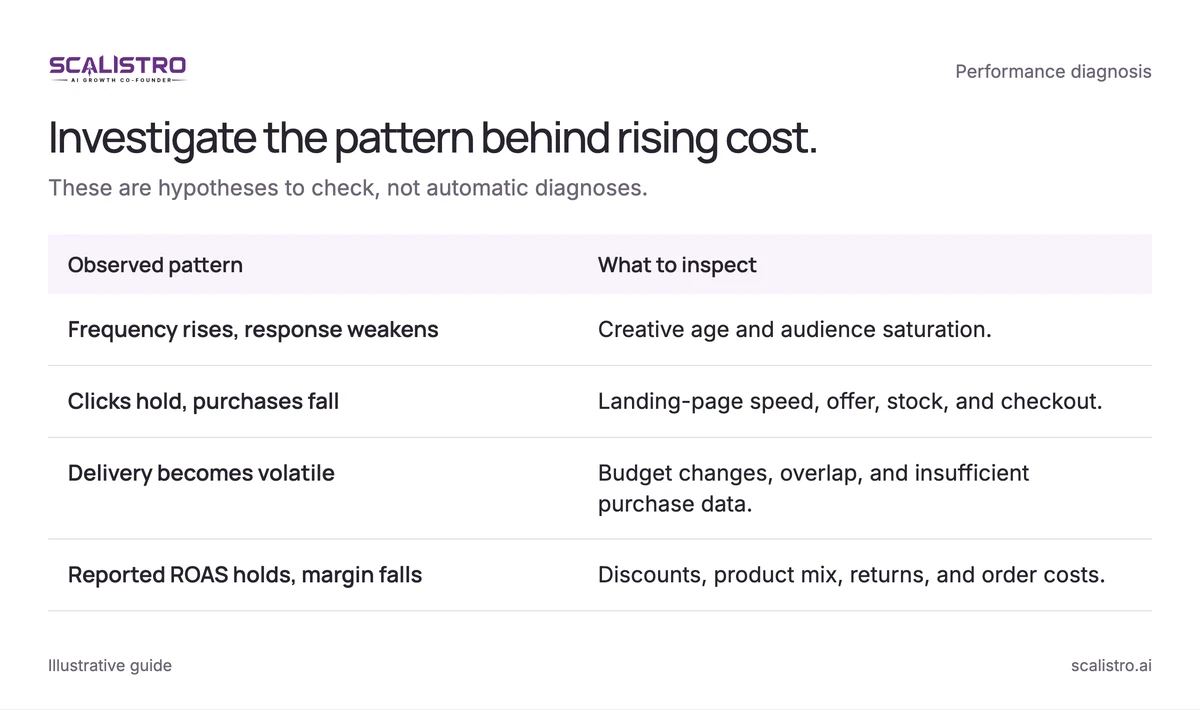
When CPA rises, check creative age, reach, overlap, and page conversion before changing every budget at once.
Swipe to explore. Tap to open full size.
Image details: Investigate the pattern behind rising cost.
| Observed pattern | What to inspect |
|---|---|
| Frequency rises, response weakens | Creative age and audience saturation. |
| Clicks hold, purchases fall | Landing-page speed, offer, stock, and checkout. |
| Delivery becomes volatile | Budget changes, overlap, and insufficient purchase data. |
| Reported ROAS holds, margin falls | Discounts, product mix, returns, and order costs. |
Doubling Budget Overnight
A jump from $100 to $500 daily can push CPA up sharply. Use smaller steps and review actual orders before each increase.
Not Refreshing Creative at Higher Spend
An ad that lasts 2 to 3 weeks at $50 daily might weaken in 5 to 7 days at $500. Prepare new concepts before increasing spend.
Ignoring Audience Overlap
Parallel campaigns can reach the same people and blur the result. Review available audience diagnostics, exclusions, reach, and frequency before adding more segments. Unchecked overlap wastes budget, and the waste grows with spend.
If efficiency drops as spend rises, check the creative fatigue playbook before changing every campaign setting.