Influencer Marketing for D2C Brands: Find the Right Creators
Find creators whose audience fits your product, agree on payment and content rights, and track the sales and usable content each partnership brings.
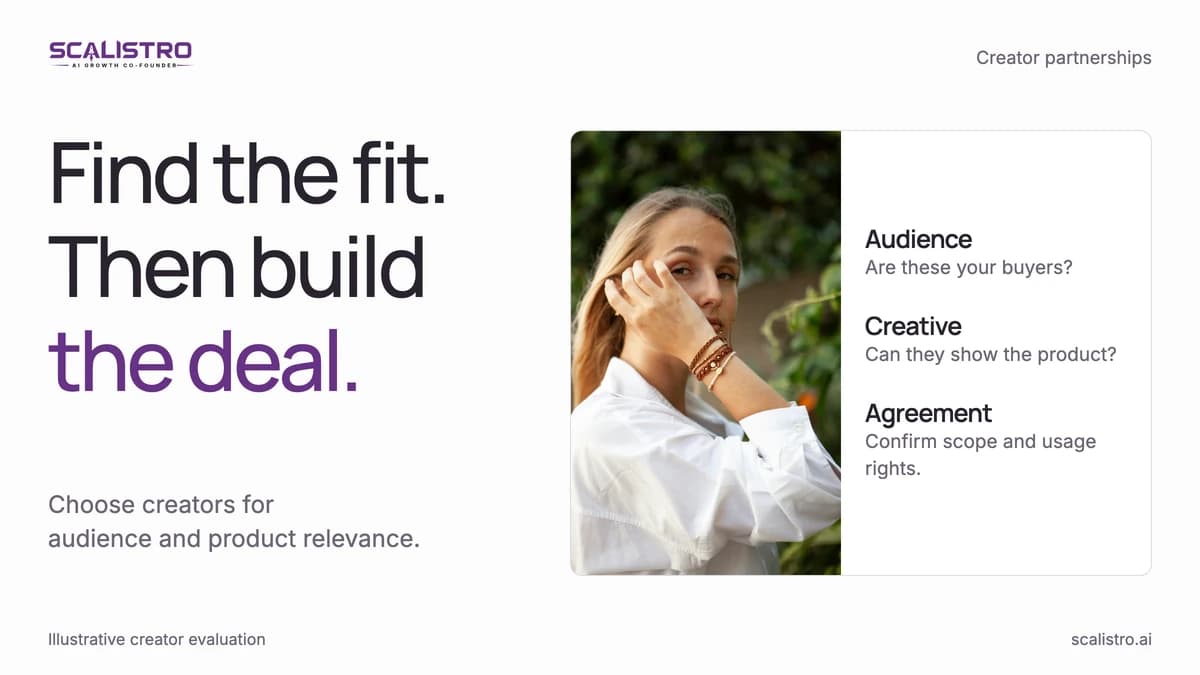
On this page
Influencer marketing for D2C brands works when a creator can show your product to people who may actually want it. The right partnership can bring sales and useful videos you can license for ads. The often-quoted $5.78 in earned media value for each $1 spent comes from Influencer Marketing Hub's survey of 2019 programs (Influencer Marketing Hub, 2020). It describes estimated exposure, not sales or profit.
Start with audience fit. Then agree on the post, payment, disclosure, and whether you may reuse the content. Track what the creator brought in before booking them again.
What D2C Creator Partnerships Cost
Follower count is only a price guide. A smaller creator with the right buyers can be more valuable than a large account with the wrong audience.
Influencer Tiers and What They Cost
Fees vary widely by niche, content format, and usage rights; treat these as rough planning ranges, not measured benchmarks.
| Tier | Follower Count | Typical Asking Fee Per Post (Instagram) | Best For |
|---|---|---|---|
| Nano | 1K-10K | $50-$250 | Authentic UGC, product seeding, niche communities |
| Micro | 10K-100K | $250-$1,500 | Targeted reach, high credibility, strong conversion rates |
| Mid-Tier | 100K-500K | $1,500-$5,000 | Broader reach with niche authority, brand campaigns |
| Macro | 500K-1M | $5,000-$15,000 | Mass awareness, product launches, brand positioning |
| Mega / Celebrity | 1M+ | $15,000-$100,000+ | National brand awareness, major launches, cultural moments |
With $5,000-$25,000 a month, try several small creators instead of putting the full budget into one large post. Several small creators also give you more content to test. Check the total fee and quality of the content too.
Finding the Right Influencers for Your D2C Brand
Method 1: Your Own Customer Base
Start with customers who already use and like the product. Their experience can make the content more useful. Gifted and paid posts still need a clear disclosure.
How to find creator-customers:
- Review customers who have tagged the brand. A smaller, engaged audience can still be valuable.
- Ask willing customers for a social handle in a post-purchase survey. Make participation optional and separate it from a review request.
- Look for detailed product feedback. Someone who explains how they use a product may make strong content even without a large following.
Method 2: Competitor Analysis
Look at category posts and competitor partnerships to find creators who can explain products like yours:
- Search brand tags, category terms, and sponsored posts. Shortlist creators whose product demonstrations feel credible.
- Use a discovery tool if it saves enough research time. A 2.5% engagement threshold is a starting filter, not proof of sales potential.
- Ask about category exclusivity. Many creators work with competing brands, and an existing contract may prevent a specific partnership.
Method 3: Platform-Specific Discovery
Platform marketplaces can supplement your own search. Features and eligibility vary by region and account, so confirm access before designing a workflow around one tool:
- Instagram: Search Creator Marketplace and category content for audience fit and recent sponsored work. Instagram can suit product explanation and social proof.
- TikTok: Search the available creator marketplace and native category trends. TikTok rates are often lower than comparable Instagram posts, but assess content quality and audience overlap.
- YouTube: Look for product reviews and tutorials. A relevant review can keep sending traffic for months through search, while many Instagram posts get most of their views within a day or two.
Method 4: Influencer Platforms and Marketplaces
Consider software when manual tracking starts to obscure rights, shipping, payments, or results. Vendor pricing and features change, so confirm a current quote before budgeting:
- Modash: Creator discovery and audience analysis; plans started at $199 a month at the time of writing (Modash pricing).
- Aspire: Partnership workflow from discovery through payments, useful when several collaborations run at once.
- Grin: Ecommerce-oriented creator operations and product seeding; pricing is quoted on request.
- Collabstr: A marketplace for individual content bookings, useful for testing a brief before building a recurring program.
Vetting Influencers: The 7-Point Evaluation Framework
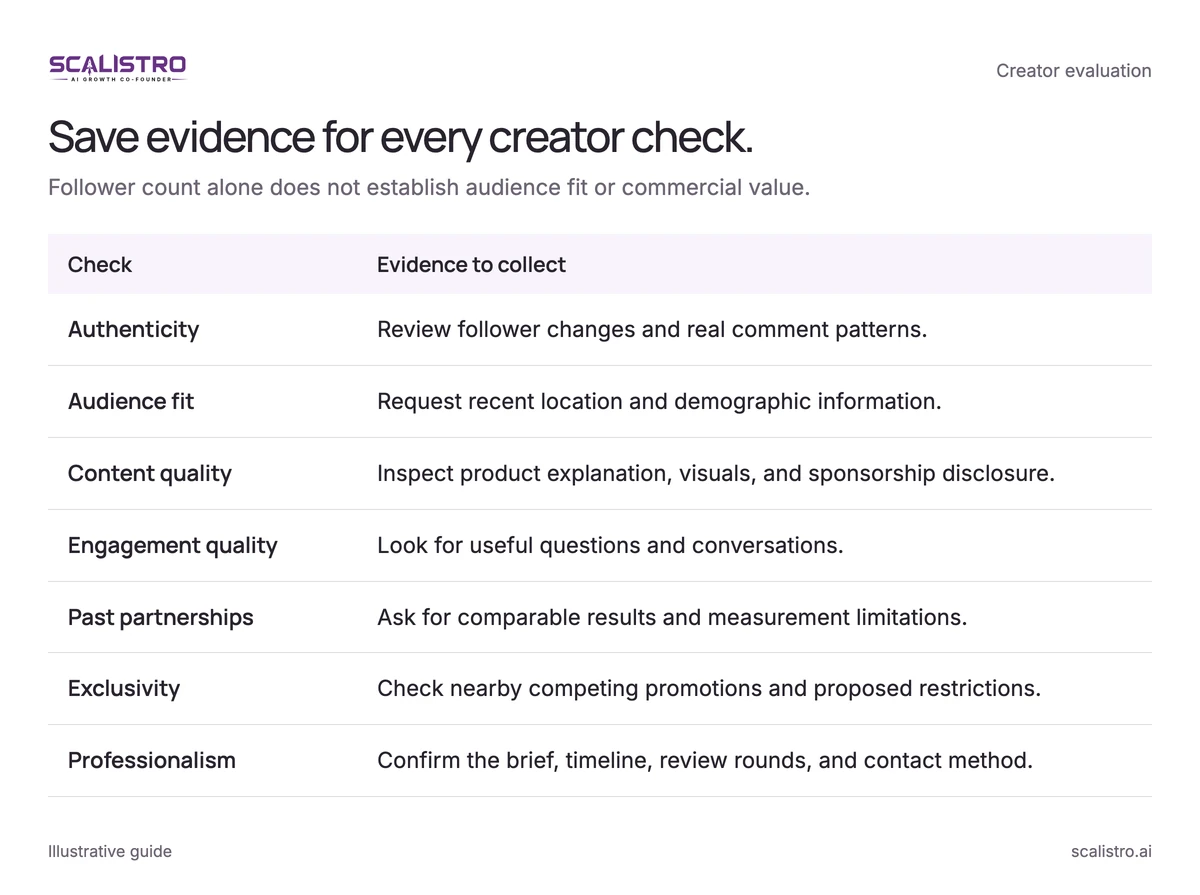
Use the same seven checks for every shortlisted creator. Save evidence and note what you still do not know; a polished profile is not proof of audience quality.
Swipe to explore. Tap to open full size.
Image details: Save evidence for every creator check.
| Check | Evidence to collect |
|---|---|
| Authenticity | Review follower changes and real comment patterns. |
| Audience fit | Request recent location and demographic information. |
| Content quality | Inspect product explanation, visuals, and sponsorship disclosure. |
| Engagement quality | Look for useful questions and conversations. |
| Past partnerships | Ask for comparable results and measurement limitations. |
| Exclusivity | Check nearby competing promotions and proposed restrictions. |
| Professionalism | Confirm the brief, timeline, review rounds, and contact method. |
1. Audience Authenticity Check
Fake followers can make a creator look bigger than they are. Fake and bot followers are a known problem across Instagram. Look across several posts and ask for audience data before paying:
- A follower spike without an identifiable viral post or collaboration.
- Engagement below 1% on a sub-100K account, especially across many posts.
- Repeated generic comments from accounts with little real activity.
- Unusual follower and following patterns. Following 3,000 accounts is a prompt to check, not proof of manipulation.
2. Audience Demographics Match
Request recent audience insights for location, age, and other relevant characteristics. A premium skincare brand targeting US women aged 25-40 should question a creator whose audience is mostly outside that market. Reach is worth little if the viewers cannot buy or are unlikely to need the product.
3. Content Quality and Brand Alignment
Review 20-30 recent posts for product explanation, visual clarity, caption quality, and the way sponsorships are disclosed. Check whether the creator's tone fits the brand without asking them to imitate the brand's own ads.
4. Engagement Quality
Read the comments. Do people ask real product questions? A save rate above 3% of views can suggest useful content, but it does not guarantee buyers. Ask the creator which posts started helpful conversations.
5. Past Partnership Performance
Ask for results from comparable partnerships, including reach, engagement, clicks where measured, and what the creator learned. Some creators cannot see a brand's purchases, so missing sales data is not automatically a warning. Agree on the tracking method before the new campaign starts.
6. Content Exclusivity and Frequency
Check how frequently the creator posts sponsored content and whether competing products appear nearby. Engagement often drops when sponsored posts make up a large share of a creator's feed. Agree on any exclusivity window in writing and pay for that restriction.
7. Communication and Professionalism
Notice whether the creator understands the brief, asks for product details, and confirms timelines. Agree on review rounds and a contact method so a late delivery does not derail a launch.
Structuring Influencer Deals That Drive ROI
Swipe to explore. Tap to open full size.
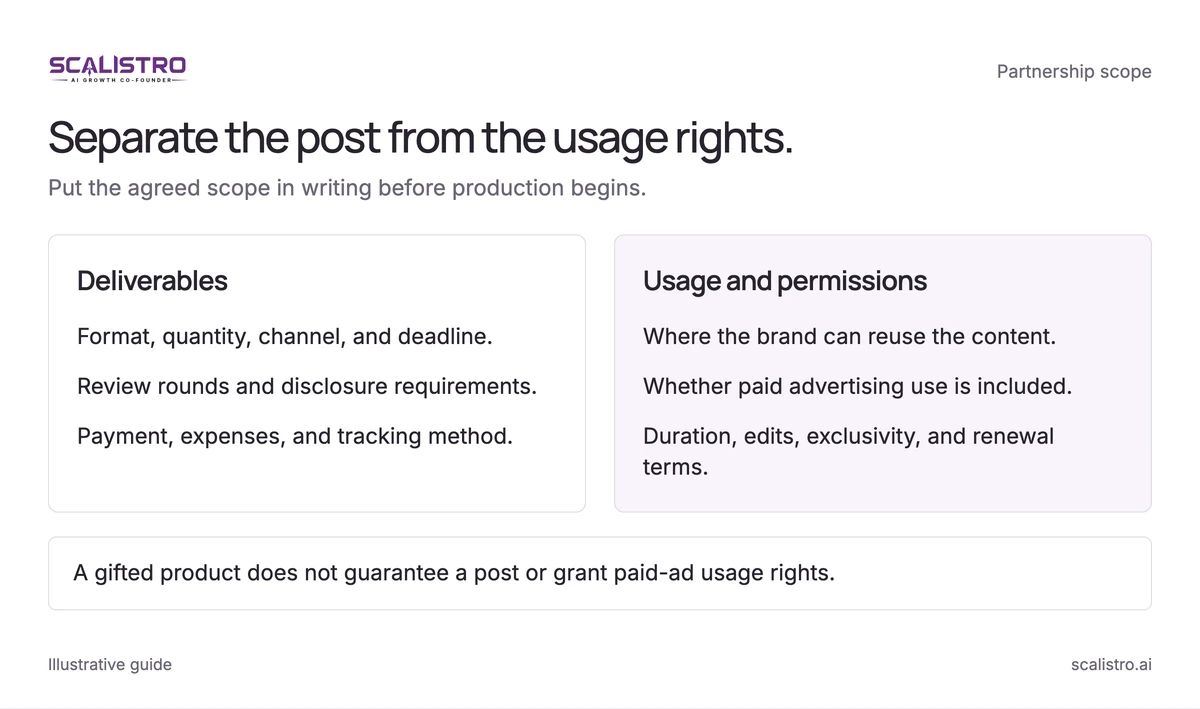
Image details: Separate the post from the usage rights.
Separate the post from the usage rights. Put the agreed scope in writing before production begins. Deliverables - Format, quantity, channel, and deadline. - Review rounds and disclosure requirements. - Payment, expenses, and tracking method.; Usage and permissions - Where the brand can reuse the content. - Whether paid advertising use is included. - Duration, edits, exclusivity, and renewal terms. A gifted product does not guarantee a post or grant paid-ad usage rights.
Payment Models
| Model | How It Works | Best For | Risk Level |
|---|---|---|---|
| Flat Fee | Fixed payment per deliverable | Macro influencers, brand campaigns | Higher (no performance guarantee) |
| Affiliate / Commission | 10-25% commission per sale via unique link or code | Nano/micro creators, performance focus | Lower (pay only for results) |
| Hybrid (Base + Commission) | Small flat fee + commission on sales | Micro/mid-tier, ongoing partnerships | Medium (shared risk) |
| Product Seeding | Gifted product with no guaranteed post unless a deliverable is contracted | Nano creators, initial product testing | Product and shipping cost; uncertain output |
| Revenue Share | Creator gets % of all sales from their audience | Long-term partnerships, brand ambassadors | Low (aligned incentives) |
Gift products only when you are comfortable with no post in return. If you need a post, agree on it and pay for it. A creator who has sold well might get $200-$500 upfront plus 15% of tracked sales in this example. Renew only when the full cost is worth it.
Content Rights and Usage
Get permission before using a creator's photo or video in your own ads. Posting on their account does not give your brand that right. Creator-made ads are worth testing against brand-made ads. Test the result in your own account.
Content rights to negotiate:
- Organic reposting: Name the channels and whether edits or translations are permitted.
- Paid use: Set the platforms, ad account, duration, and whether the brand may run creator-handle ads. Paid rights usually add to the base fee.
- Term and territory: Write the start date, end date, geographic scope, and renewal rate. Perpetual rights cost more upfront.
- Exclusivity: Define competing products and the restricted period. Expect to pay more for it.
- Disclosure and claims: Require clear sponsored or gifted-content disclosures and approve factual product claims before publication.
Scaling Your Influencer Program
Phase 1: Testing (Month 1-2) - Budget: $2,000-$5,000/month
At $2,000-$5,000 a month, gift products to 30-50 suitable nano creators and contract 5-10 micro creators if the budget supports their fees. Give each a brief, a trackable link or code, and disclosure guidance. Rank the output by usable content and measured sales, not views alone.
Phase 2: Optimization (Month 3-4) - Budget: $5,000-$15,000/month
At $5,000-$15,000 a month, renew creators who meet the agreed goals and negotiate one or two monthly deliverables where a retainer makes sense. Record the usage rights for each asset. Scalistro can help create variations inspired by approved concepts, but only reuse a creator's actual image, voice, or likeness within the licensed terms.
Phase 3: Scaling (Month 5+) - Budget: $15,000-$50,000+/month
At $15,000-$50,000 or more monthly, a 30-50 creator portfolio may support always-on discovery and testing. An affiliate program can give additional creators a way to participate. Set the share of creator content in paid creative from your own controlled tests and rights budget.
Measuring Influencer Marketing ROI
Use a scorecard that separates attention from orders. A code or link will miss some later purchases, while earned media value is only a reach estimate:
- Earned media value: Impressions multiplied by a comparable paid CPM. The $5.78 per $1 figure from Influencer Marketing Hub is an estimate of equivalent exposure, not cash return.
- Attributed revenue: Track link, code, and UTM orders on consistent 7- and 30-day windows. Note where attribution overlaps other campaigns.
- Acquisition cost: Divide the complete partnership cost, including product, shipping, rights, and fees, by attributed new customers. Compare it with your allowable CPA from your margins.
- Content value: Compare licensed, usable assets with the cost of commissioning equivalent work. Avoid counting both the same asset's production value and its ad result as separate revenue.
- Brand signals: Monitor branded search, mentions, and direct traffic alongside the partnership period. Other marketing can contribute to any lift.
Before buying usage rights, compare UGC and professional ad creative for your campaign goal.