Brand Consistency for D2C: How to Keep It at Scale
Keep a D2C brand recognizable by carrying the same promise, voice, visual rules, and product facts across ads, pages, email, and social content.
On this page
Customers see a large number of brand messages every day. A recognizable color, voice, product presentation, and service experience help them connect the ad they saw with the store they reached. In a 2016 Demand Metric study for Lucidpress, organizations estimated that always presenting their brand consistently would raise revenue by 23 percent on average (Demand Metric, 2016).
This guide turns consistency into specific rules for visual design, writing, customer experience, and messaging, then shows how a growing team can apply them across channels.
What Brand Consistency Actually Means
Consistency means a buyer can recognize the same promise and standards in an Instagram ad, a product page, the package, and a support reply. It has four parts:
1. Visual Consistency
Document the repeatable design decisions a team needs to make:
- Color palette: Primary, secondary, and accent colors used consistently across all materials
- Typography: Specific fonts for headings, body text, and accent text, used consistently in all contexts
- Photography style: Consistent lighting, composition, color grading, and subject treatment across all product and lifestyle imagery
- Graphic elements: Consistent use of shapes, patterns, icons, and illustration styles
- Layout patterns: Consistent grid systems, spacing, and compositional approaches across digital and print materials
- Logo usage: Correct sizing, spacing, color variations, and placement rules followed everywhere
Compare ad creative with the destination page side by side. A shopper should recognize the product and brand before reading the headline.
2. Voice and Tone Consistency
Voice rules should guide captions, ads, product copy, packaging, and support messages. Replace vague adjectives with examples of approved language, especially for common situations:
- Instead of: "Your order has been shipped." Your brand might say: "Your goodies are on their way! Track them here."
- Instead of: "We apologize for the inconvenience." Your brand might say: "We dropped the ball on this one, and we are sorry. Here is what we are doing to fix it."
Approved examples give staff, freelancers, and AI tools a standard they can apply. Keep the wording honest and useful for the customer rather than forcing personality into every message.
3. Experience Consistency
Match the service experience to the expectation marketing sets. A premium pack shot paired with a confusing checkout or delayed delivery creates a gap the customer will remember more than the ad.
4. Message Consistency
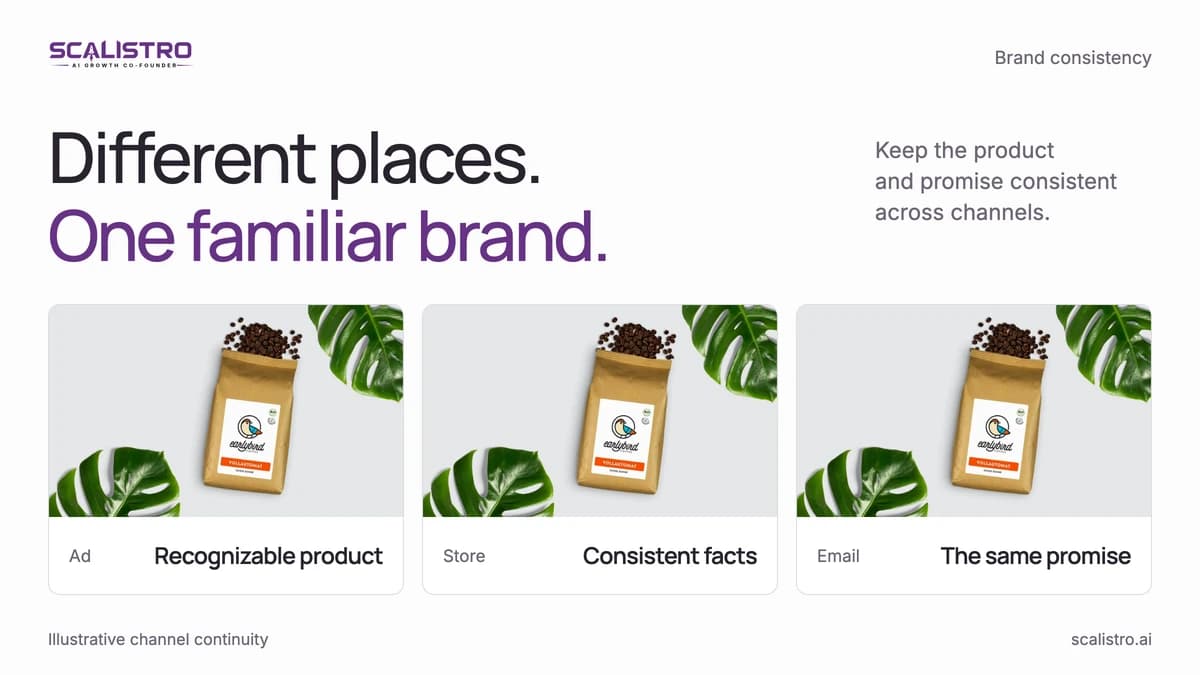
Keep the same core promise while changing the format for each channel. If the promise is professional-quality skincare at an accessible price, the ad, product page, welcome email, and support response should all reinforce that idea without repeating one tagline.
Why Consistency Drives Revenue
That estimated lift has three useful explanations: familiarity, perceived quality, and easier decision-making. It is an association, so judge your own changes through brand search, conversion, and repeat behavior.
Recognition Builds Trust
When a person sees the same brand cues in an ad, search result, and product page, the destination feels familiar. That matters online, where a shopper must buy without first handling the product. Keep the product and offer consistent as well as the design.
Consistency Signals Quality
Clear, repeated design choices can signal care and quality before a shopper can assess the product. This is especially relevant at $50 or $100 price points, where presentation helps explain why the item costs more than an alternative.
Recognition Reduces Decision Effort
Recognition can shorten the work of choosing between similar products. Compare ad click-through and direct or branded search over time to see whether repeated brand cues are building familiarity.
Where Consistency Breaks Down
Consistency usually slips when more people, channels, and tools make assets without one shared source of truth.
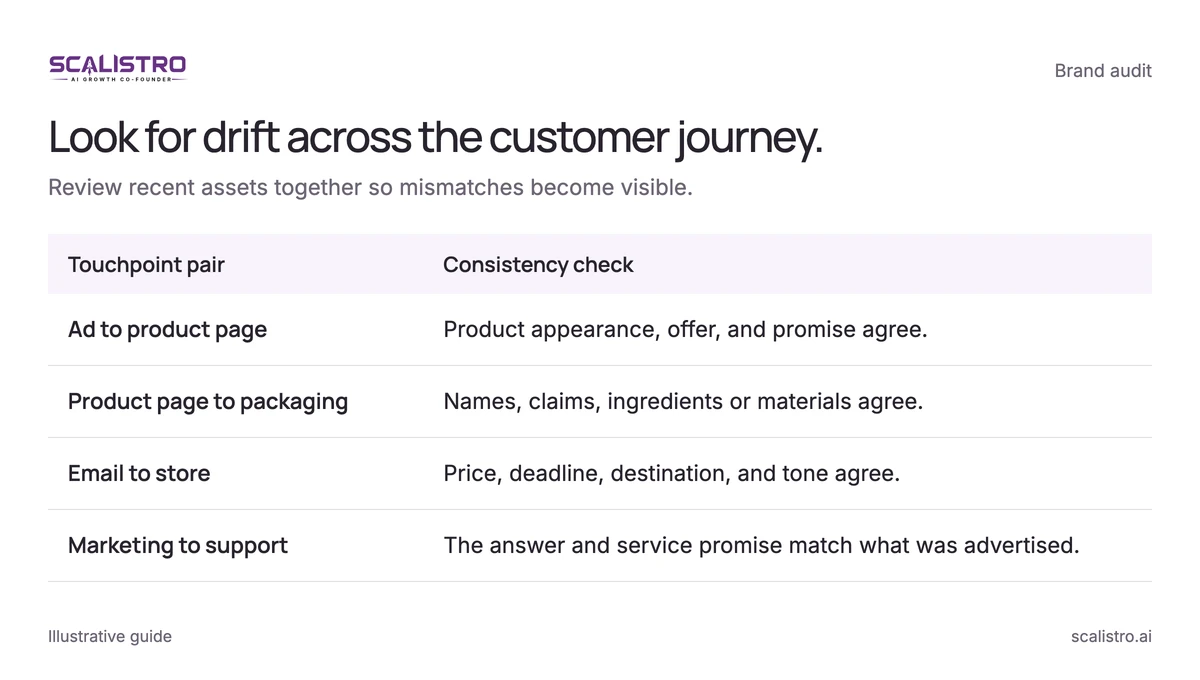
Swipe to explore. Tap to open full size.
Image details: Look for drift across the customer journey.
| Touchpoint pair | Consistency check |
|---|---|
| Ad to product page | Product appearance, offer, and promise agree. |
| Product page to packaging | Names, claims, ingredients or materials agree. |
| Email to store | Price, deadline, destination, and tone agree. |
| Marketing to support | The answer and service promise match what was advertised. |
Team Growth
As writers, designers, and agencies join, each needs the same examples and approval criteria. Give new contributors real assets to compare, not only a logo file.
Channel Proliferation
Adapt the format for TikTok, email, or the website without changing the underlying promise. Review all channel versions together before a campaign launches.
Speed Pressure
Use templates and a short approval checklist when deadlines are tight. Speed should not make the product claim or offer change between channels.
Tool Fragmentation
Canva, Figma, email builders, and agency files can each carry different defaults. Store current colors, fonts, and export examples centrally, then compare finished assets before publication.
How to Build and Maintain Brand Consistency
Give contributors a usable guide, working templates, and a review rhythm.
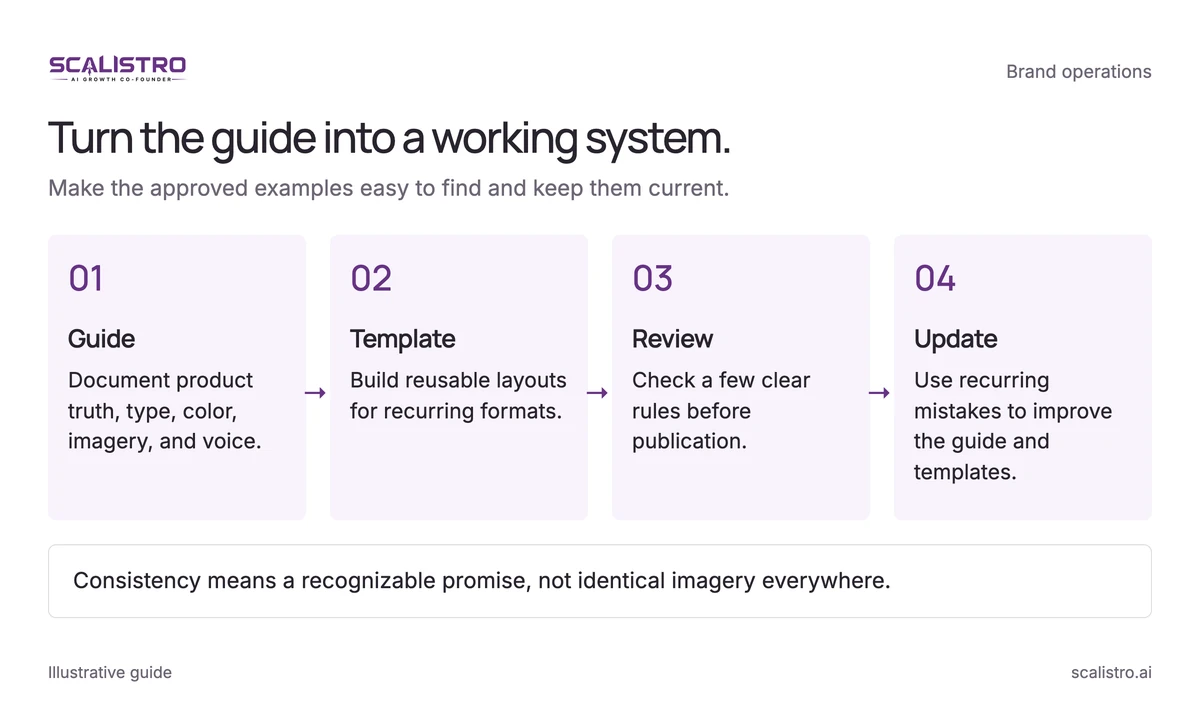
Swipe to explore. Tap to open full size.
Image details: Turn the guide into a working system.
Turn the guide into a working system. Make the approved examples easy to find and keep them current. Guide - Document product truth, type, color, imagery, and voice.; Template - Build reusable layouts for recurring formats.; Review - Check a few clear rules before publication.; Update - Use recurring mistakes to improve the guide and templates. Consistency means a recognizable promise, not identical imagery everywhere.
Create a Living Brand Guide
Put the guide where contributors already work and keep it current. Include:
- Logo files in every format and color variation, with clear usage rules
- Color palette with exact hex codes, RGB values, and CMYK values for print
- Typography with font files, size scales, and usage rules for each typeface
- Photography guidelines with example images showing the correct and incorrect style
- Voice and tone guide with specific examples of brand-appropriate and brand-inappropriate phrasing
- Templates for common content types - social posts, email headers, ad layouts, presentation slides
Build Templates, Not Just Guidelines
Turn frequently made assets into templates with approved layout, type, and spacing. A template reduces the number of small decisions each contributor must remake.
Implement Review Checkpoints
Check a draft against 3 to 5 rules before publication: product truth, colors, type, imagery, and voice. Make the reviewer and deadline clear so approval does not become a bottleneck.
Audit Regularly
Every quarter, put recent ads, emails, product pages, packaging, and support replies side by side. Identify drift, update the guide, and fix the template or process that caused it.
How AI Maintains Brand Consistency at Scale
AI can apply the same examples across many drafts. It can also distort a product or flatten the voice, so make review part of the process rather than assuming consistency from a prompt.
AI for Visual Consistency
Use palette, photo examples, and composition rules to brief image generation. Listro can help create variants from existing assets; compare every selected image with the real product and guide.
AI for Voice Consistency
Give the writing tool approved captions, email subjects, and ad examples. Fifty examples provide more guidance than saying the brand is "friendly." An editor still checks tone, facts, and context.
AI for Cross-Channel Consistency
Start every channel version from the same approved message and source assets, then adapt the format. Review the Instagram, TikTok, Meta, and email versions together to catch contradictions.
The Compounding Value of Consistency
Recognition grows through repeated, coherent encounters. Look for customers naming the brand unprompted, rising branded search, and stronger conversion from returning visitors. Keep the promise accurate across every channel as the team grows.
Use the practical AI marketing guide to see where automation can support brand consistency.