D2C Retargeting: Audience and Creative Strategies
Segment retargeting by shopper intent and recency, match the message to each group, exclude recent buyers, and measure incremental value.
On this page
Retargeting reaches people who have already shown interest, so it usually reports a higher ROAS than prospecting, though some of that credit belongs to sales that would have happened anyway. The gain disappears when every visitor sees the same ad for a month. Separate audiences by what they did and when they did it, then match the message and frequency to their level of intent.
This guide covers five segments, a 15 to 25 percent retargeting budget, creative by stage, and frequency controls. Retargeting can drive a meaningful share of ad revenue, but prospecting still has to bring new people into the funnel.
Why Basic Retargeting Underperforms
A single 30-day site-visitor audience with 2 or 3 ads is easy to launch, but it combines shoppers with very different intent. It usually fails for three reasons:
- It treats all visitors equally. Someone who spent 15 seconds on your homepage and bounced is fundamentally different from someone who added a product to their cart and abandoned checkout. They need different messages, different offers, and different creative approaches.
- It ignores the time dimension. A visitor from 2 days ago is usually far more likely to buy than a visitor from 28 days ago. Showing them the same ad at the same frequency is wasteful.
- It lacks creative variety. Running 2 to 3 creatives for 30 days means your retargeting audience sees the same ads 15 to 30 times. Click-through rates fall as the same people see the same ads again and again, and shoppers start to tune them out.
The Retargeting Funnel: 5 Audience Segments
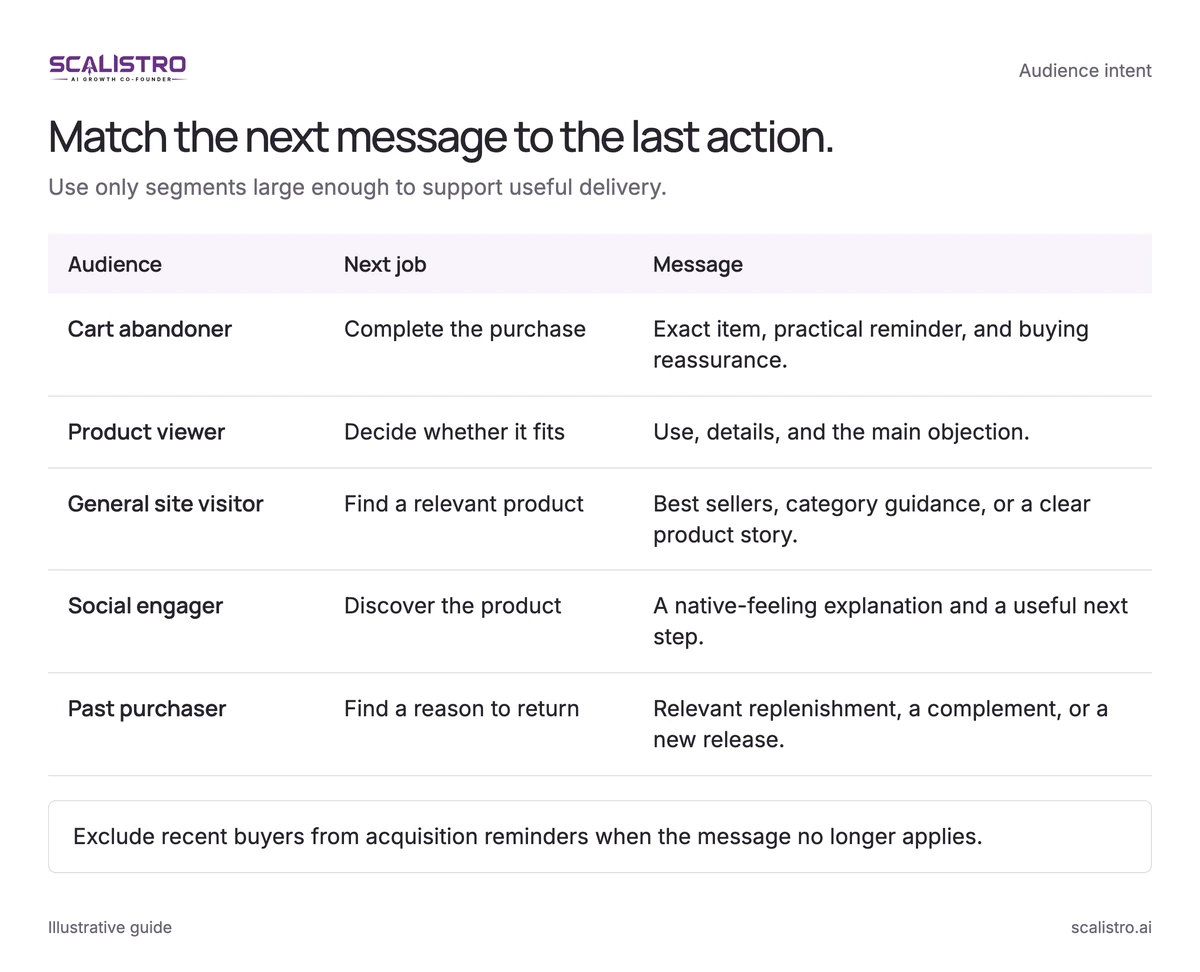
Use the smallest set of segments your audience size can support. Keep buyers and recent purchasers excluded from acquisition reminders, and give each remaining group a clear next step.
Swipe to explore. Tap to open full size.
Image details: Match the next message to the last action.
| Audience | Next job | Message |
|---|---|---|
| Cart abandoner | Complete the purchase | Exact item, practical reminder, and buying reassurance. |
| Product viewer | Decide whether it fits | Use, details, and the main objection. |
| General site visitor | Find a relevant product | Best sellers, category guidance, or a clear product story. |
| Social engager | Discover the product | A native-feeling explanation and a useful next step. |
| Past purchaser | Find a reason to return | Relevant replenishment, a complement, or a new release. |
Exclude recent buyers from acquisition reminders when the message no longer applies.
Segment 1: Cart Abandoners (Highest Intent)
Cart abandoners show the clearest purchase intent. Baymard Institute's average of 50 studies puts ecommerce cart abandonment at 70.22 percent (Baymard Institute), making this a valuable audience when it is large enough for delivery.
Window: 1 to 7 days. Purchase intent fades quickly after that.
Creative approach: Show the exact product they abandoned (dynamic product ads work exceptionally well here) with a direct reminder. Include social proof - star rating, number of reviews, or a customer testimonial - to overcome the objection that caused them to leave.
Offer strategy: Days 1 to 3: no discount, just a reminder and social proof. Days 4 to 7: introduce a small incentive - free shipping, 5 to 10 percent off, or a bundle deal. Discounting immediately can teach customers to abandon carts to get a discount, so delay the offer.
Expected ROAS: Usually the highest of the five segments. Confirm it with a holdout test, because many of these shoppers would buy anyway.
Segment 2: Product Page Viewers (High Intent)
Product viewers need help deciding whether the item fits. Show the product they saw and answer the most common objection before asking for another click.
Window: 1 to 14 days.
Creative approach: Focus on overcoming objections. Show the product with benefit callouts, ingredient or material details, and customer reviews. Use carousel ads to provide the detailed information they did not find on the product page. Test dynamic product ads showing the specific product they viewed against generic brand ads for this segment.
Expected ROAS: Usually second to cart abandoners.
Segment 3: Website Browsers (Medium Intent)
General site visitors know the brand but may not have found a product. Lead with best sellers, a useful category guide, or a clear explanation of what makes the brand different.
Window: 1 to 21 days.
Creative approach: Showcase your best-selling products or your most visually compelling product photography. Use carousel ads featuring your top 5 products or a "best sellers" collection. The goal is to help them discover the product that fits their needs.
Expected ROAS: Lower than product viewers, since intent is weaker.
Segment 4: Social Engagers (Medium-Low Intent)
Use an eligible engagement audience on the platform where the interaction happened. A video view or saved post signals interest, but it is weaker than a product-page view, so the ad should make product discovery easy.
Window: 1 to 30 days.
Creative approach: Bridge the gap between social engagement and website visit. Use content that feels native to social (UGC-style, storytelling) but includes a clear product showcase and CTA. Highlight your most shareable or conversation-starting product.
Expected ROAS: The lowest of the five segments. Judge it partly on new site visits.
Segment 5: Past Purchasers (Retention)
Past purchasers need a relevant reason to return, such as replenishment, a complementary item, or a new release. Harvard Business Review cites estimates that acquiring a new customer is 5 to 25 times more expensive than retaining an existing one (HBR, 2014).
Window: 30 to 180 days after last purchase (exclude recent purchasers from 0 to 30 days to avoid annoying them immediately after buying).
Creative approach: Show complementary products, new arrivals, or restocks of their previously purchased items. For consumable products, time your retargeting to when they are likely running low - if your product lasts 45 days on average, start retargeting at day 35.
Expected ROAS: Often high, because these buyers already trust the brand. Check it against orders they would have placed anyway.
Budget Allocation Across Retargeting Segments
Allocate by audience size and purchase intent. The percentages below are starting ranges, so do not force five tiny ad sets when a segment lacks enough people to deliver.
| Segment | % of Retargeting Budget |
|---|---|
| Cart Abandoners | 25 to 30% |
| Product Page Viewers | 25 to 30% |
| Website Browsers | 15 to 20% |
| Social Engagers | 10 to 15% |
| Past Purchasers | 10 to 15% |
Keep total retargeting spend around 15 to 25 percent of ad budget. Below 10 percent may under-serve warm demand; above 30 percent can over-credit retargeting while starving the prospecting that creates future warm audiences.
Frequency Management: The Silent Performance Killer
Watch reach and frequency together. Higher frequency can raise cost and irritate shoppers even when the campaign still reports conversions:
- Frequency 1 to 3: Optimal performance. CTR and conversion rates are at their highest.
- Frequency 4 to 5: Watch for falling CTR.
- Frequency 6 to 8: Expect CTR to fall and CPA to rise. Refresh creative or widen the audience.
- Frequency 9+: Your ads are now creating negative brand sentiment. Customers start hiding your ads, which signals to the algorithm that your content is low quality.
Frequency guidance: Cart abandoners: 1 to 2 per day, up to 10 per week. Product viewers: 1 per day, up to 7 per week. Site browsers and social engagers: 3 to 5 per week. Past purchasers: 2 to 4 per week. Apply caps where the platform supports them; otherwise monitor and adjust delivery.
AI-assisted tools like Listro can help review frequency and performance by segment, then suggest where a creative refresh may be worth testing. Review the data before changing delivery or rotating an ad.
Creative Strategy by Retargeting Segment
Write the next ad for the action a person has already taken. A cart reminder, product explainer, and loyalty offer should not look like three versions of the same generic sale ad.
Creative for Cart Abandoners
Remind them of the item and answer a checkout objection without claiming false scarcity.
- Dynamic product ads showing the exact item they abandoned
- Social proof overlays - "4.8 stars from 2,000+ reviews"
- Urgency messaging - "Still in your cart" or "Selling fast"
- Direct CTA - "Complete your order"
Creative for Product Page Viewers
Help them compare, understand, and trust the product before showing an incentive.
- Benefit-focused ads explaining why the product is worth buying
- Customer testimonial videos or quote overlays
- Comparison content - how your product differs from alternatives
- Product demo or tutorial content showing the product in use
Creative for Website Browsers
Make category discovery simple for someone who has not chosen a specific product.
- Best-seller collections and curated product carousels
- Brand story content - why your brand exists and what makes it different
- Category-level value propositions rather than specific product pitches
Creative for Social Engagers
Bridge from a familiar social format to a clear product benefit and site destination.
- Social-native content that bridges to product discovery
- UGC-style product showcases
- Limited-time offers to create urgency for the first purchase
Creative for Past Purchasers
Use order history and timing to make the next offer relevant.
- Cross-sell and complementary product recommendations
- New arrival announcements
- Replenishment reminders for consumable products
- Loyalty rewards or repeat customer discounts
Cross-Platform Retargeting
Buyers move across channels. A shopper might discover the brand on TikTok, search on Google, visit the store, and later see a Meta ad. Retarget only audiences each platform can actually identify, then compare the full customer path with platform-reported results.
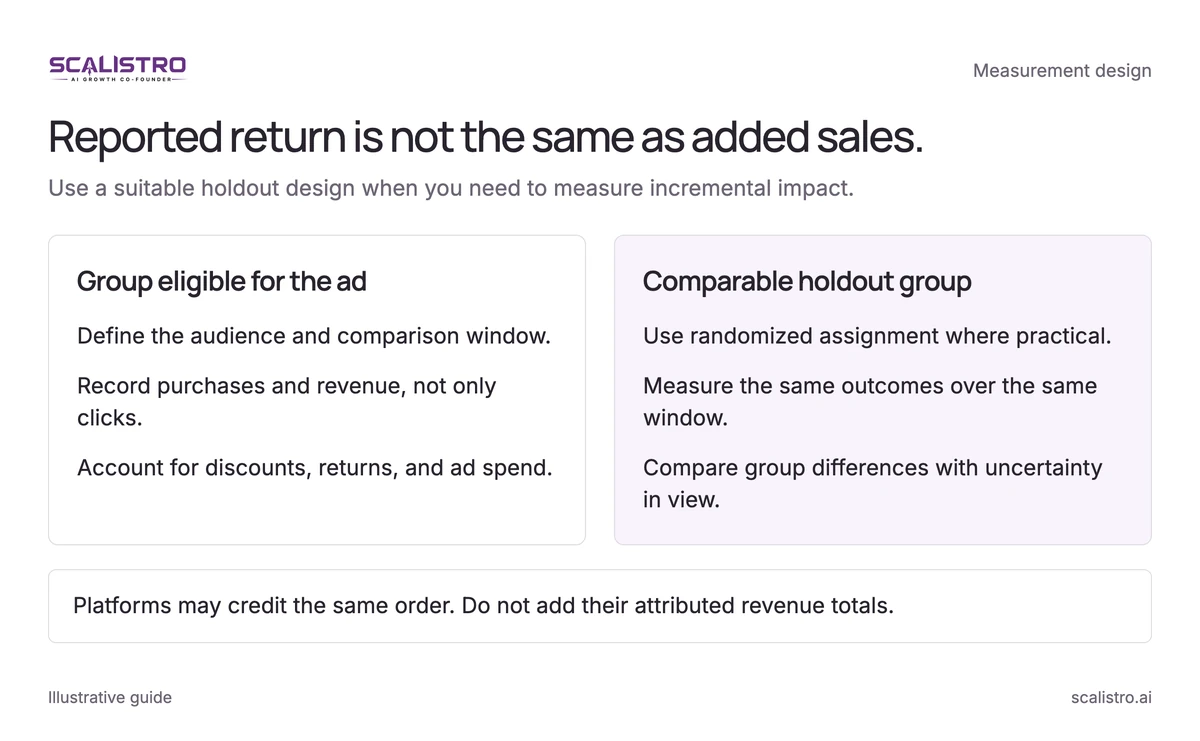
Swipe to explore. Tap to open full size.
Image details: Reported return is not the same as added sales.
Reported return is not the same as added sales. Use a suitable holdout design when you need to measure incremental impact. Group eligible for the ad - Define the audience and comparison window. - Record purchases and revenue, not only clicks. - Account for discounts, returns, and ad spend.; Comparable holdout group - Use randomized assignment where practical. - Measure the same outcomes over the same window. - Compare group differences with uncertainty in view. Platforms may credit the same order. Do not add their attributed revenue totals.
Practical cross-platform retargeting setup:
- Meta retargeting: Website visitors, email subscribers, social engagers (Instagram and Facebook). This is your primary retargeting platform for most D2C brands.
- Google retargeting: Use eligible site-visitor audiences across supported Display, YouTube, and Shopping campaign types, with product feeds where applicable.
- TikTok retargeting: Website visitors and TikTok video viewers. Particularly effective for brands where TikTok is a primary awareness channel.
- Email retargeting: Abandoned cart emails, browse abandonment emails, and win-back sequences. Email retargeting costs little beyond the platform fee. In Litmus's 2025 State of Email survey, 35 percent of companies reported $10 to $36 back for every $1 spent on email, and 30 percent reported $36 to $50 (Litmus, 2025).
Compare repeat-buyer campaigns against customer lifetime value to avoid optimizing for clicks alone.